


Oranje: Naptown’s Craziest Ten-Year-Old

The first few weeks in September tend to be the busiest of Indianapolis’ arts and social calendar. Penrod. French Market. Greek Fest. Irish Fest. Jazz Fest. Art vs. Art. The list goes on. September is possibly the only month that Hoosiers can rely upon consistent, pleasant weather. The humidity of Indiana’s swampy summer is usually behind us. But enough warmth remains for scantily clad nights on the town.
The unfortunate part about jamming some of the city’s most well attended artistic events together is that sacrifices must be made. This year, as I have for the last several, my Saturday night was spent at Oranje. The evening marked the tenth anniversary for the event that bills itself as “Indiana’s Premier Arts & Music Explosion.” Explosion proves an adequate description.

Oranje can be overwhelming. More than 30 musicians and 40 artists fill and surround a warehouse at 23rd and Illinois for a veritable feast of the senses. A whirlwind of sights, sounds and tastes combine for one of Indianapolis’ can’t miss parties. At its best, my memories of the evening wind up a blur of experiences that I rarely separate into individual performances. They all merge together into a single, enjoyable mind fuck.
From an outsider’s perspective, Oranje seems like our city’s ill-fated attempt at trendy, artistic expression. And to some extent all the necessary clichés are in place—half-naked hipsters, experimental music, interactive exhibits. Non-natives may wonder what original thought Hoosiers could offer such a scene. Those who have attended know better.

I always leave Oranje motivated and inspired. This city is home to so many talented, interesting minds. In a state that prides itself on our small government, public funding of the arts is scarce. But the relative low cost of living allows artists to thrive for a fraction of the cost that larger cities, like New York and Los Angeles, demand. What Indianapolis needs to improve upon is providing these artists with a voice. Oranje accomplishes this in spades, but it’s not enough.
Indy’s residents should not wait until the second weekend in September to take in the arts. Terrific, worthwhile events take place all over this city every week of the year. Indianapolis’ greatest strength is arguably its accessibility. We can get almost anywhere in twenty minutes. We can park. With such opportunities all within arm’s reach, there is no excuse for failing to take advantage of all that Indy has to offer.
I thank the Oranje crew for the massive amount of planning and hard work that goes into this annual bash. Their contribution to the Indianapolis art scene over the last decade has opened a lot of local eyes. Now we’ve got to keep those eyes open and get them out of the house before next September. Let’s face it, folks. The Colts are not getting any better. Luckily for us, there’s more than football in Indiana.
Written by Rob Peoni
Photos by Katie Kirkhoff
Album Review: Girls ‘Father, Son, Holy Ghost’

I have a mere 16 gigabytes on my iPhone – It is the bane of my day-to-day existence. Questions. Debates. Self-reflection. I constantly have to cut good albums from the roster to make room for new listening adventures. Deep down in my listening bowels I feel this to be necessary, however, the report tells me I need to SMACK myself in the face. Ticking time and money make it financially impossible for the upgrade that I deeply need. I eat it and fight it.
Exhibit A: Replace Bat for Lashes Two Suns with Miracle Fortress Was I The Wave?
My first inclination is to tell the cats from Miracle Fortress that they were not the wave. The wave is high, but their contribution is minimal. I wish Miracle Fortress gave me something to consider. My only salvation is to listen to their music and attempt to digest its importance. I try to search for wave accreditation and fail. The drone sounds and half-worked dance mixes cause me extreme pain.
Miracle Fortress’ redeeming qualities might peek behind the curtain, but they lack confidence. They remind me of the smart kid in class who was always afraid to raise his hand. Potential might be a matter for debate but delivery is as reliable as a deadbeat dad’s monthly child support payment. Miracle Fortress is as conventional as a PB & J. The only problem is the Jiff ran out months ago. At least I know that if I put Bat For Lashess back into the mix, I will have “Daniel” and I won’t feel like a poser. My lunch break is back and it is delicious.
Exhibit B:
When, Father, Son, Holy Ghost dropped, I had a certain inner excitement. After receiving an early copy of the record, I realized that both previous Girls releases, Album and Broken Dreams Club EP had withstood the test of time. They had remained on my iPhone since their initial purchase. I sincerely enjoy Girls. It may be their San Francisco roots, which I candidly admit I am a SUCKER for, but my enjoyment goes beyond that. From the beginning, they have been their own boss and propelled their own evolution.
Girls makes it happen from track to track. There are few bands right now in the indie hemisphere who have been able to progress their agenda with minimal scrutiny quite like Girls. Album opened the door to the band, but left me to wonder, “Are these guys serious?” Many of the songs from Album seemed as if the band were playing around. This lack of seriousness on certain tracks defines the band.
The best part about Girls is that they challenge our listening experience by making us accept them. Do we really know them? Hardly, but we all trust in their vision. Their subtle projection for satisfaction tries to make us care. It is this dedication that causes me to pay attention.
Father, Son, Holy Ghost rips out with single, “Honey Bunny” which bleeds the Girls true colors all over our living room floors. Sad, simple, effective.
“I’ve been messing with so many girls who could give a damn who I am”
Uncertainty, and a lust for comfort make Girls relatable. They might not be the band you play to your ex-girlfriend to rekindle ties, but they are the band you embrace to regain confidence. That’s Girls out of the box, and that is why they are special.
“Die” is a track that competes for my song of the year. Howling guitars and soothsaying prophecies help breed confidence in any man that has been shut out from sharing the sheets. Plenty more thrillers help smooth over the rough spots. Girls has continued to prove staying power. It might not be with a significant other, but this is why we listen…right?
Written by Brett McGrath.


In The Dust #3: John Coltrane ‘A Love Supreme’
Once a week In The Dust rolls up its sleeves and digs to the back of the rack to find that record, the one you never knew you always wanted, the one that’s lost, but not forgotten. (Listen via Spotify)
This is the Holy Grail.
I wish I could leave it at that, but a record this dense, of this magnitude, of such indescribable brilliance—while with opaque brevity seems the only effective way to approach it, this record deserves more.
John Coltrane recorded A Love Supreme in a single day, on December 9th, 1964, at Van Gelder Studios in Englewood Cliffs, New Jersey. The personnel list is a veritable who’s who of hard bop: Jimmy Garrison on double bass, McCoy Tyner on piano and Elvin Jones on drums. The album is structured as a four-song suite and clocks in at a trim 33:02, but as many physicists contend that an entire universe can exist in a single atom of one’s fingernail, so does a universe in every note of A Love Supreme.
At the albums center is a single concept and a single motif. Coltrane writes in his liner notes to A Love Supreme, “This album is a humble offering to Him. An attempt to say “THANK YOU GOD” through our work, even as we do in our hearts and with our tongues.” It is indeed a spiritual album, a prayer, one over the course of which Coltrane embarks on a quest for understanding and purity. Through this suite, Coltrane wishes to establish a communion with God and express to Him a realization that neither his talent nor his horn are his own, but rather gifts from Him, and for that he is grateful.
Coltrane establishes this communion in a sequence reminiscent of said prayer. Of the structure, Coltrane writes:
The music herein is presented in four parts. The first is entitled “Acknowledgement,” the second, “Resolution,” the third, “Pursuance,” and the fourth and last part is a musical narration of the theme, “A LOVE SUPREME,” which is written in the context; it is entitled, “Psalm.”
Part I, “Acknowledgement” is Coltrane’s “Dear God.” It begins with a gong, a call to attention, over which Coltrane floats a repetitive fanfare that is a loose variation on the piece’s central theme. From beneath Coltrane’s rooster-crow, Elvin Jones washes his way into focus with dusty cymbal crescendos and rolls. It is then, in the deep groove of Garrison’s double bass, we first hear the central motif: “ba-dum ba-dum, ba-dum ba-dum.” Garrison leads this motif as it is repeated four times. Jones then strikes the beat. It is repeated four more times and Tyner joins with a smattering of complementary chords. It is repeated eight more times, as if to set the stage for the main attraction, and Coltrane returns, sliding onto the forefront of the aural canvas with break-neck modulated variations, at which point Garrison retreats and all proceed to follow the master. Coltrane’s horn seems to cry out with the repressed anguish of every past transgression, first in a spitfire wailing, like a pressurized liquid breaking its seal, and later in controlled four-note bleats, as if he has nothing more to confess, no more tears to cry, and is now apologizing to Him, pleading that he’s been a believer all along. These four-note bleats slowly recede into the most visceral, penetrative moment of the album: a vocal refrain from Coltrane himself of the albums theme: “A Love Supreme,” a final acknowledgement, a moment of peace in knowing that if one can muster confession, He can muster forgiveness.
Part II, “Resolution,” begins, as did Part I, with Garrison leading, this time alone. He rapidly plucks sharp pairs of repeating notes with palpable determination, generating a forward momentum, on which Jones, Tyner and Coltrane can simultaneously jump. They attack with a purposeful and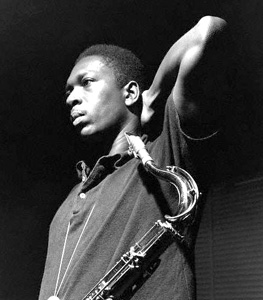 deliberate ferocity, one that they effortlessly maintain throughout “Resolution,” one that echoes the very title of the movement itself. Coltrane has concluded his address to God, not-so-literally acknowledging own misdeeds and misgivings and His grace and power, and graduated to discussing with God what he believes he can do to atone and gain His favor. Coltrane’s resolve comes in the form of two fervent, insistent solos, both foreshadowing and echoing each other respectively, and separated by, as if from His own lips, a strict, capable, and somehow patiently impassioned retort from the keys of McCoy Tyner. Coltrane pleads to be a better man, promising that by giving ownership of his talent and craft away to a higher power, he will become a conduit for Him, and thus more powerful himself. The movement bookends how “Acknowledgement,” began not with a bang, but with a whimper: Jones crashes hard, then rolls softly and washes into the ether as the band slowly and carefully descends and side 1 hisses to a close.
“Pursuance,” Part III of the suite, the beginning of the second side and the centerpiece of the album, is Coltrane’s response to what he proposed in “Resolution.” It begins, appropriately enough, with a drum solo from Elvin Jones. Jones was once asked how he and Coltrane are capable of making the music they do. Jones famously responded, “To play the way we play, you have to be willing to die for the motherfucker.” Jones’s solo is a perfect example of this, and a fitting retort to “Resolution.” He begins in empty space, tapping inquisitively on his ride cymbal and tentatively on his toms until runs begin to materialize, along with his confidence and direction, which take their shape before you as if by magic. He slowly emerges from an ambient whisper to practically scream, “We told you about it, now watch us do it!” From the first notes out of Coltrane’s horn, a walking bounce of sorts, it’s clear that “Pursuance,” is pure action! Coltrane sets this tone and immediately passes it to Tyner for further exposition. Tyner sprints his way up and down the keyboard, tickling wind-chime runs that he breaks with terse, round chords as Jones rides hard and Garrison walks the bass behind him. Coltrane breaks back in over Tyner with fire and brimstone. Inaction is sin! No more propositions! Each member of Coltrane’s band asserts that suggestions and hints have occupied their place in this suite and now it is time for execution. And heads do roll.
Part IV, “Psalm,” is the spire on the church, as the cherry is to the sundae. In his description of the suite, Coltrane refers to “Psalm” as a ‘musical narration’ of his devotional poem of same name as the album, included in the liner notes. The poem reads as follows:
A Love Supreme
I will do all I can to be worthy of Thee O Lord.
It all has to do with it.
Thank you God.
Peace.
There is none other.
God is. It is so beautiful.
Thank you God. God is all.
Help us to resolve our fears and weaknesses.
Thank you God.
In You all things are possible.
We know. God made us so.
Keep your eye on God.
God is. He always was. He always will be.
No matter what…it is God.
He is gracious and merciful.
It is most important that I know Thee.
Words, sounds, speech, men, memory, thoughts,
fears and emotions—time—all related …
all made from one … all made in one.
Blessed be His name.
Thought waves—heat waves—all vibrations—
all paths lead to God. Thank you God.
His way…it is so lovely…it is gracious.
It is merciful—Thank you God.
One thought can produce millions of vibrations
and they all go back to God … everything does.
Thank you God.
Have no fear…believe…Thank you God.
The universe has many wonders. God is all. His way…it is so wonderful.
Thoughts—deeds—vibrations, etc.
They all go back to God and He cleanses all.
He is gracious and merciful…Thank you God.
Glory to God…God is so alive.
God is.
God loves.
May I be acceptable in Thy sight.
We are all one in His grace.
The fact that we do exist is acknowledgement of
Thee O Lord.
Thank you God.
God will wash away all our tears…
He always has…
He always will.
Seek Him everyday. In all ways seek God everyday.
Let us sing all songs to God
To whom all praise is due…praise God.
No road is an easy one, but they all go back to God.
With all we share God.
It is all with God.
It is all with Thee.
Obey the Lord.
Blessed is He.
We are from one thing…the will of God…
Thank you God.
I have seen God—I have seen ungodly—none can
be greater—none can compare to God.
Thank you God.
He will remake us … He always has and He
always will.
It is true—blessed be His name—Thank you God.
God breathes through us so completely…so gently
we hardly feel it…yet, it is our everything.
Thank you God.
ELATION—ELEGANCE—EXALTATION
All from God.
Thank you God. Amen.
Coltrane, in his ‘musical narration’, effectively “plays” these words to close the suite. Over the thick, heavy pulse of Tyner’s chords, the asymmetrical, tympanic rolling of Jones’s drums, the sizzling splash of his cymbals, and the flurried thumping of Garrison’s bass beneath Jones, Coltrane pours his soul from his horn, echoing the messages of each previous movement, and speaks of new life emerging from them. “I will do all I can to be worthy of Thee O Lord. / It all has to do with it. / Thank you God,” he sings, repeating his “Acknowledgement.” “One thought can produce millions of vibrations / and they all go back to God … everything does. / Thank you God. / Have no fear … believe … thank you God,” he sings, colored with the promises of “Resolution.” “No road is an easy one, but they all / go back to God. / With all we share God. / It is all with God. / It is all with Thee. / Obey the Lord. / Blessed is He. / We are from one thing … the will of God … thank you God. / I have seen God – I have seen ungodly – / none can be greater – none can compare to God. / Thank you God,” he sings as we retrace the steps along the road of “Pursuance.” He concludes both his ‘musical narration’ and his poem, “ELATION-ELEGANCE-EXALTATION / All from God. / Thank you God. Amen,” and he summons from his horn a cry of mad and tearful ecstasy, like Baldwin’s John in Go Tell It On The Mountain, writhing on the floor of a Calvinist Church, screaming, disoriented and exhausted, aching from the intense mental trial of being saved. Coltrane’s last breath passes in a flurry of notes and dies softly, as if he is drained of it, and with it the last of him is gone. He will continue to blow his horn, but he will not own it, and it will not be his breath that fills it. It will be His.
Written by Ben Brundage. Check out Ben’s Tumblr Damned Fine Lion.