


Track: Talk Talk “After the Flood”
Most of last night was spent camped in front of my computer as updates of the havoc Hurricane Sandy wreaked upon the East Coast flooded my news feed from every conceivable angle. Failed backup generators at NYU’s hospital. Blown transformers on 14th Street. Walls of water rollicked through the ongoing construction site at ground zero. Powerful images of lower Manhattan sheathed in darkness.
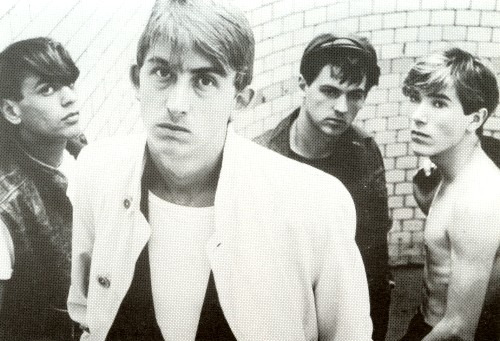
As I’m prone to do on momentous occasions – or occasions of any kind really – I found myself in search of a soundtrack. After a bit of rummaging, I settled on Laughing Stock, the brooding, farewell masterpiece from British post-rock pioneers Talk Talk. Released in 1991, the album resides at a gorgeous intersection of avant garde jazz and art rock, completing the band’s metamorphosis from its synth pop origins a decade earlier. Laughing Stock has a pervasive placidity that seemed to resonate with the opaque images coming from New York.
The nearly 10-minute “After the Flood” sits at the center of this six-track release. The song begins at a slow amble, eventually building around the dampened vocals of lead singer Mark Hollis. A crescendo of distorted feedback from the synthesizer creates a visceral tension in the middle of the song. Just when it begins to feel as if the track is going to collapse from the pressure, the synth recedes and the interplay between Hollis and the keys returns to bring it home.
Laughing Stock received a full vinyl reissue from Ba Da Bing! Records in October of 2011. In the two decades since its initial release, Talk Talk has remained a source of inspiration for a broad cross-section of musicians. Austin, TX’s Shearwater and fellow Brits Wild Beasts are two disciples whose recent work comes to mind. However, Talk Talk has been covered by everyone from Weezer to No Doubt. Their influence is limited by neither time nor genre. Listen to “After the Flood” below.
Written by Rob Peoni
Album Review: Matthew E. White ‘Big Inner’

What would a Periodic Table of Elements for soul and R&B look like? What essential components are necessary to create the genre? These seem to be the questions with which Richmond, Virginia’s Matthew E. White wrestled while laying down the vision for his debut LP Big Inner. In his review, Hank from We Listen For You talks about White’s use of religion as a touchstone for the genre on the album’s 11-minute closer “Brazos.” I couldn’t agree more, but why stop there? The subjects of the LP’s seven tracks read like a thematic history of R&B: love, heartbreak, yearning, tragedy, patience, celebration and salvation are distilled down to their respective essences, standing like pillars upon which the entire genre’s existence is built. It’s as if White is saying, “This is soul in its most prosaic form. The stories and characters are all superfluous.”
At the turn of the century, R&B was undergoing a minimalistic renaissance spurred by artists like The White Stripes and The Black Keys. White employs a different kind of minimalism, both implied and literal, to achieve a similar end on Big Inner. His lyrics are reduced to mantras, almost entirely devoid of narrative of any kind. Musically, the tracks on Big Inner contain complex horn charts, strings and vocal arrangements, but the individual parts are all so understated that the work, taken as a whole, feels sparser than it really is.
Much has been made of the connection between White and Randy Newman. This is not without merit, as White has declared Newman a major influence. However, the genius of Newman’s early work lies in his ability to create grandiose concepts out of political irony. White steers clear of such topical discourse. Instead, the irony he conveys rests on his ability to make a 30-piece band sound so simplistic and focused. White has taken music with the scope and size of Newman’s film work, and boiled it down to resemble Sail Away or Good Old Boys.
Regardless of its inspiration, White has achieved a rare feat with Big Inner, releasing a Big Band soul record while avoiding the pitfalls of the genre’s clichés. He pulled this off by deconstructing minimalism not R&B. In doing so, White has brought the genre’s tenets to the forefront and whittled them down to their cores for all to see. Whether the model he has constructed at his new label Spacebomb Records is financially sustainable is a different post for a different day. For now, let us all give a resounding thanks that whatever happens, we’ll always have Big Inner. Listen to “One of these Days” and “Big Love” below.
Connect with Matthew E. White via Facebook
Written by Rob Peoni
Fresh Track: PAPA “Put Me to Work”

A while back, we featured Los Angeles’ PAPA as a Band to Watch on the merit of their sensational, five-track EP A Good Woman is Hard to Find. The soulful indie rockers have returned with the up-tempo first single from their forthcoming debut LP, due out sometime in 2013. Centered around bassist Daniel Presant and drummer/lead singer Darren Weiss, “Put Me to Work” finds the band delving into power pop territory behind an energetic plea for the opportunity to earn a keep. Weiss writes directly to his own circumstance as a performer in the song’s chorus, repeating “I wanna see the lights / Put me to work tonight.” Though the track lacks any overt political message, I can’t help but make the correlation between its subject and one of the season’s hottest election topics – jobs.
Ironically, the multi-instrumentalist Weiss had previously served as the drummer for the now defunct band Girls. His former bandmate Christopher Owens also released a new single yesterday in “Here We Go.” As is often the case, both acts appear destined to prove that sometimes two bands ain’t so bad after all. Listen and download “Put Me to Work” for free, below.
Connect with PAPA via Facebook | Twitter
Written by Rob Peoni

