


In The Dust #5: Django Reinhardt ‘The Classic Early Recordings’ (1935-1939)
Once a week In The Dust rolls up its sleeves and digs to the back of the rack to find that record, the one you never knew you always wanted, the one that’s lost, but not forgotten.
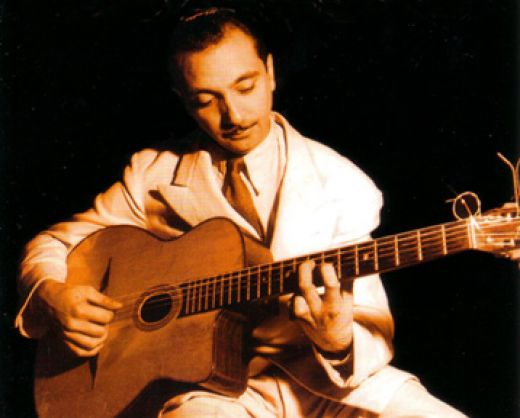
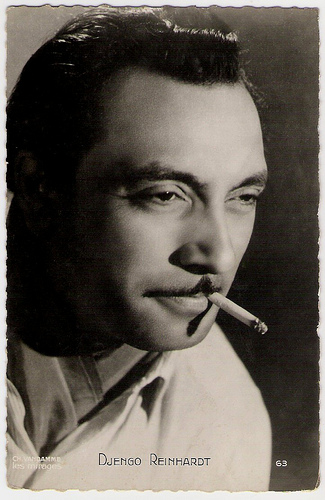
In the Belgian countryside in 1910, a baby boy was born to the Reinhardts, a family of Manouche gypsies. They named him Jean, but soon would refer to him by his nickname, “Django”, Romani for “I awake”. Little is known about his life, as such a community keeps no record, though we know just enough to account how a near-death accident begat one of the most original and most influential jazz guitar players in history.
The Reinhardts were furniture makers. They scavenged for cane or any suitable material they could find to weave it into tables, chairs, anything of necessity for potential customers. The Reinhardts lived mostly in group encampments close to Paris, but far enough away that the community’s vagrancy was not a bother.
As entertainment was hard to come by, the Reinhardt clan and their extended community included a number of talented amateur musicians and music was a keystone of life. Django exhibited an interest from an early age, learning very young how to play the violin and, later, at age 12, the banjo. Thanks to the tutelage of two older gypsy musicians, Django left furniture making behind and began playing banjo professionally one year later, at the age of 13.
By 18, Django was married, living with his wife in their own caravan, and deep into his career as a professional musician. They were desperately poor, as Django was still young and inexperienced, so his wife, Florine, sold flowers she twisted out of celluloid and paper for extra money. After returning home late from a gig, Django knocked over a candle. He went to bed, not knowing his wife’s flowers had caught flame.
Django’s neighbors pulled he and his wife to safety, but not before Django had sustained first and second-degree burns over a substantial portion of his body. His right leg was initially completely paralyzed, and the ring and pinky fingers of his left hand, the one he used to form chords, were severely burned. He was taken to a hospital, where doctors informed him they would have to take his leg, and he would never play guitar again.
Reinhardt refused the surgery. Within a year he was walking with the aid of a cane and, after receiving it as a gift from his brother, Reinhardt put aside his banjo and set about reinventing jazz guitar.
His ring and pinky fingers never overcame their partial paralysis. Reinhardt learned to play solos with just his index and middle fingers, the others he used exclusively for chording. This new technique resulted in a curious and entirely new style now referred to as “hot” jazz guitar, akin to style of New Orleans-based Louis Armstrong and his band, featuring blinding tempos and frenzied improvisations of astonishing speed and dexterity, peppered by crisp, cutting chord work.
Soon after Reinhardt’s rehabilitation and discovery of “hot” jazz, he met a young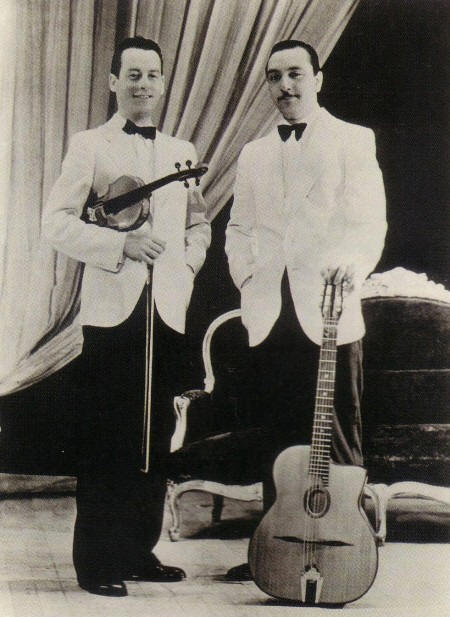 violinist named Stephane Grappelli. The two were both enamored of Louis Armstrong and shared similar musical sensibilities. Because of the radical nature of Reinhardt’s new style, paid work was nonexistent, so from the years of 1929 to 1933, he and Grappelli played only for, and with, each other and several other local musicians. These years, along with Reinhardt’s previous rehabilitation, are largely considered to be one the most important “quiet” periods in jazz, and the musical companionship of Reinhardt and Grappelli, for many, produced the finest music of either of their careers.
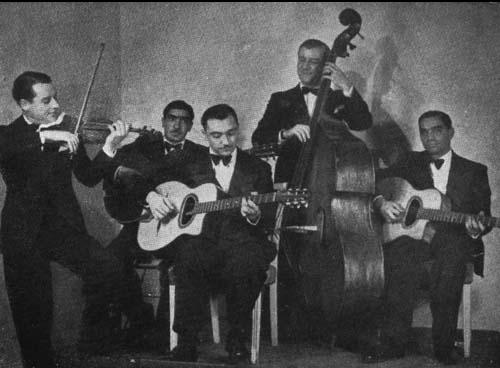
In 1934, Reinhardt’s brother, Joseph, invited Django and Grappelli to join his Quintette du Hot Club du France. Effectively no longer a quintet, the group now featured three guitars, a violinist, and a bassist, all string instruments, which at the time was rare. Occasionally the group would back a singer, but Reinhardt, his groundbreaking guitar playing and masterful interplay with Grappelli would soon become the focal point.
It is at the formation of the Quintette du Hot Club du France The Classic Early Recordings, a five-disc box set, begins, featuring the group’s first ever recordings, twenty-two sides billed as their own and four as the backing band for instrumentalists Frank ‘Big Boy’ Goudie and Alix Combelle. Of the twenty-two QHCF sides, nineteen are jazz standards or popular songs, but “Djangology”, a dizzying, jaunty, knock-kneed three minutes split into first a Reinhardt then a Grappelli solo, one of the groups first original compositions, would soon become a jazz standard itself and solidify Reinhardt, Grappelli and the entire QHCF as artists of the highest caliber.
Volume B skips ahead considerably in the chronology, as it is a collection of the 1938 & 1939 London Decca Recordings, some made with the QHCF, others with Reinhardt and Grappelli or even Django by himself. This session featured a matured, strengthened QHCF, and an equally more sophisticated Reinhardt and Grappelli. Of the songs recorded for Decca in London, about half are original compositions, most notably, “Daphne” another Reinhardt and Grappelli original that would make it’s way into the cannon of jazz standards. “Daphne” is a cheerful, almost-sing-a-long lead by Grappelli’s soaring violin, which bookends first with a refrain and then a solo and refrain a long, scaling Django solo of remarkably pure trills and triplets. The consistency of rhythm, balanced velocity and tonal quality of the band in this recording show truly proficient musicians operating at their finest, and the poise with which Grappelli and Reinhardt show in their ability to sail just over them, not overcome them, and play into and off of each other with such lackadaisical ease and seeming carelessness, alternating matador and bull, is the mark of a fully realized musical relationship.
The collection visits the concurrent Paris Decca Recordings in Volume C, also from 1938 & 1939. The vast majority of QHCF recordings and Reinhardt and Grappelli work happened in Paris, London Decca being the obvious exception, but the same competent, talented band as the London Decca sessions is now back home, in familiar surroundings, and free to feel and play as only nationals can in the country of their birth. Paris Decca features most of the core members of the QHCF, but not billed as such. These recordings are again about half standard or popular song and half original. The interesting feature of this volume is that many of the songs are collected with multiple takes and assembled from dubs, which show the striking amount of improvisation from take to take of every song recorded by Django, Grappelli and the QHCF, no matter the structure of stature of a particular tune. The differences, at times, are astounding. The two takes of “Twelfth Year” (Version 1 & Version 2) another Reinhardt original, contain some of the most incomprehensibly brilliant jazz guitar anyone has ever heard, but both swing in completely different ways, both so strongly rooted in a unique feeling worlds apart from one another, solely due to Reinhardt’s varying expression of the intro rhythm, hinting refrain and color of his improvisations. Grappelli does the same with his solos, which close out the piece. Both artists defer first to the mood, and then to each other, to craft totally flawless and entirely spontaneous performances on each and every go-around, which, to put it simply, is jazz.
We travel back in time some to 1935 & 1936 for Volume D, more Paris recordings, and some of the most exciting of the collection, those made with tenor sax legend Coleman Hawkins. While Django mostly plays sideman in these sessions, his guitar is always very audible, and there are moments where he is allowed to shine. He does not disappoint, showing up many of the bands soloists and, at times, Coleman himself. On “Avalon”, the second song of the first session, Django performs a very brief but scalding solo which he slides into with insane, frantic grace, then immediately slows to a slender syncopated picking pattern, and finally speeds back into a reckless, but never out-of-pocket, flurry of strums. On “Stardust”, the only song of the second session, we see prominently Stephane Grappelli’s remarkable skill at the piano, a delight that is featured several times in the collection. Django also gets another solo, one of similar length, but of a slower lover’s tempo so that he can really unfold. Django chimes in with a small fanfare as Coleman commences the last four bars of his solo. Django then takes over with calm, collected runs that drip contemplatively like wax from a candle, scaling up and scaling down, arpeggiating and resolving, in characteristic style, with a flourish and not a flicker.
 The collection concludes with Volume E, an “odds and ends” of sorts, featuring two sessions, the 1935 Garnet Clark and 1937 HMV recordings, none of which, in themselves, are particularly rare but the condition in which these recordings are presented is. Composed mostly of standards and popular songs, these sessions contain many songs of the hottest songs of the day, such as “Charleston,” “Ain’t Misbehavin’,” and “Body and Soul,” recorded by the classic QHCF personnel, but also three recorded by Garnet Clark and his Hot Club’s Four, which includes Django playing some of his few-and-far-between contract work. They play “Stardust,” as did Django with Coleman, but of the three songs they recorded, “Rosetta,” is the standout. At times sounding mysteriously like a precursor to Monk and bebop, Garnet Clark’s piano is a tumbling, lazy-eyed and delirious trip across the various octaves of the keyboard, separating the excellent solos of his various band members, but unfortunately relegating Django solely to rhythm work.
Of the 124 sides of this collection, many are some of the finest jazz ever recorded, but that is not to say that Django’s brilliance commenced, and ceased, here. He went on to record some of his best work and play in Paris and around the world through the Second World War and on into the early fifties. He settled in Samois-sur-Scene, a small French town in his later years, where he rarely travelled, but still played out consistently. He began playing the electric guitar. His final recordings show Reinhardt’s total comprehension, and appreciation for, the burgeoning bebop movement.
There is a myth that Reinhardt simply disappeared, vanished, never to be heard from again. That is not the case. Reinhardt collapsed of a brain hemorrhage at a train station in Avon and was pronounced dead on arrival at a hospital in nearby Fontainebleau. He was 43 years old. But as craftsmen die, their handiwork lives on. Like the furniture of the finest furniture maker, proud, aged, dignified, impervious, destined to outlive it’s master, so is the legacy of Django Reinhardt, carefully woven from so many unusual strands into a strong, totally unique and altogether incomparable body of work upon which can rest the weight of his influence, and the ears of scores of adoring fans for centuries to come.
This entire five volume set is available via Spotify.
Written by Ben Brundage. Check out Ben’s Tumblr Damned Fine Lion
Album Review: Youth Lagoon ‘The Year of Hibernation’

Potatoes, Blue Football Fields, Potatoes, BCS Hopes, Built to Spill, and more POTATOES! These are the first thoughts that come to mind when thinking about Boise, Idaho. Once, a town known strictly for potato production has quickly GROWN into a city with high hopes. Expanding culture and a new found winning identity has gradually pushed this town to adopt a new mentality. Boise indie-rock legends Built to Spill made dreaming acceptable. Their 1997 album Perfect from Now On followed by their 1999 EP Center of the Universe assisted in laying down the foundation. Shortly after their name was established and ripe the Boise State Football Broncos made dreaming a reality. The improbable upset in the 2007 Tostitos Fiesta Bowl of national powerhouse Oklahoma put Boise on the map. Football aside, it helped project the idea that anything is possible anywhere. Think of all the delicious sides that can be made with the potato. Examine cheesy mashed potatoes, French fries, sweet potatoes with caramelized onion, twice baked, skinned, hashed, smothered, covered, and even peppered. While the base remains the same the opportunities for variation and progression exist. 22-year-old Boise native Trevor Powers slices the spud his own way. It is this innovation that helps continue to bring optimism to this TaterTown that once just thought in starched reality.
Trevor Powers is the young mind behind his project Youth Lagoon. Signed to famous indie label Fat Possum, Youth Lagoon released its first LP The Year of Hibernation in September. Quickly picked up on blogs and played on major indie outlets such as Sirius XMU, Powers began to gain notoriety for his honesty. The Year of Hibernation is a free pass into Powers’ mind. I reflect and wonder how many other talented musicians have these abilities not only in Boise, but towns much smaller across our country? Untapped growth without the proper progression tools exists all around us. This is why Youth Lagoon’s should be recognized. Powers’ drive should inspire us. The vulnerability of his message should resonate with us. The title of his album is either extremely ironic or Powers is in fact resting after spending a year giving us this gift. This album floats just fine in anyone’s sea of reflection. He allows for his mind to enter our minds. He leaves me with the idea to just go.
Songs, “Cannons” and “Seventeen” stand out as the sails behind this ship. These two songs help to extend Powers’ message and make an eight song release sound much more full. The best advice I can give is not to sleep on The Year of Hibernation. Youth Lagoon is one of those artists that I appreciate. This could be all we hear from him, but at least he made something that I had to write about. Inspired intimacy. Beautiful. His message should not only go out to the good indie rock loving folk who read this blog, but also to the great people of the city of Boise. Think outside the potato, and the opportunities are endless.
Written by Brett McGrath
In the Dust #4: Elvis Presley ‘The Sun Recordings’
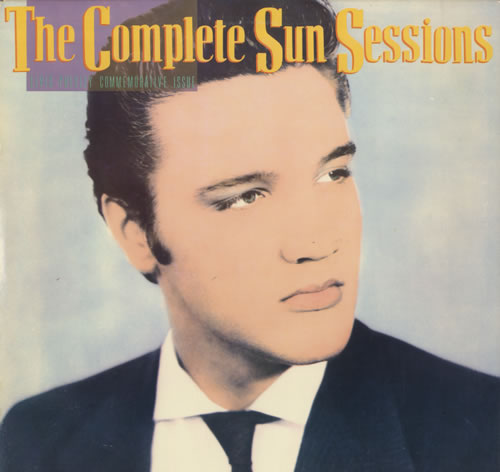
Once a week In The Dust rolls up its sleeves and digs to the back of the rack to find that record, the one you never knew you always wanted, the one that’s lost, but not forgotten. (Listen via Spotify)
Elvis.
Enough said, right? If you’re still reading at this point, let me say that this is not the bloated, bacon-banana-peanut-butter-fried-donut sandwich King that the name draws to mind. This is Elvis Aaron Presley, an aspiring young singer from Memphis, Tennessee, moonlighting as a truck driver just to keep his head above water.
Presley, at the age of 13, moved with his family to Memphis where he immediately immersed himself in the music scene, absorbing country, honky-tonk, western swing and, most notably, R&B and the blues. Throughout high school, Presley was berated and discouraged by music teachers claiming that he had no aptitude for music, but by the time Presley graduated he was determined to pursue a career in music regardless. With blind confidence, he scrapped up $3.98 and went to Sun Records to record two sides. This is the point in the story where, for other artists, one would say “and the rest was history,” but that’s not the case.
On July 18th, 1953, Presley recorded his first two sides, “My Happiness” and “That’s When Your Heartaches Begin”. The receptionist, Marion Keisker, upon Presley’s arrival, asked him what he sang. He said “all kinds.” “I don’t sing like nobody,” he continued. After recording his sides, Keisker recorded his name on the acetate and added, “Good Ballad Singer. Hold.” Presley received one copy of the recording, which he gave to his mother, who, at the time, did not even own a record player.
Early the next year, on January 4th, 1954, Presley recorded two more sides, “I’ll Never Stand In Your Way,” and “It Wouldn’t Be The Same Without You”. These, much like the first two sides, were flops. It appeared that no one was interested in Elvis Aaron Presley the ballad singer.
After several failed auditions as a vocalist for local bands, Presley told his father, “They told me I couldn’t sing,” echoing the words of his old teachers. It is then Presley got a job big-rigging at the Crown Electric Company. He continued to try out for other local groups but was rejected every time, bandleaders citing that Presley should stick to being a truck driver “because you’re never going to make it as a singer.”
Sam Phillips, Sun Records President, saw what he believed to be a hole in the market, but could not find the right man to fill it. Keisker remembers, “Over and over…Sam saying, ‘If I could find a white man who had the Negro sound and the Negro feel, I could make a billion dollars.” Phillips had acquired a copy of “Without You”, and he could not identify the vocalist. Keisker reminded Phillips of the young truck driver, the one from Memphis, the good ballad singer, and Phillips invited Presley back to Sun Records for a tryout of sorts.
On May 26th, 1954, Presley returned to Sun Records. In his audition, he failed to do the recording justice. Phillips asked Presley to run through a few other songs in his repertoire. Phillips was less than enthused, but Presley expressed a spirited interest in finding a back-up band and Phillips obliged. He contacted two Memphis, western swing musicians, Winfield “Scotty” Moore, guitar, and Bill Black, slap bass. It is at this point in the story where, for other artists, one would say “and the rest was history,” but that is again not the case.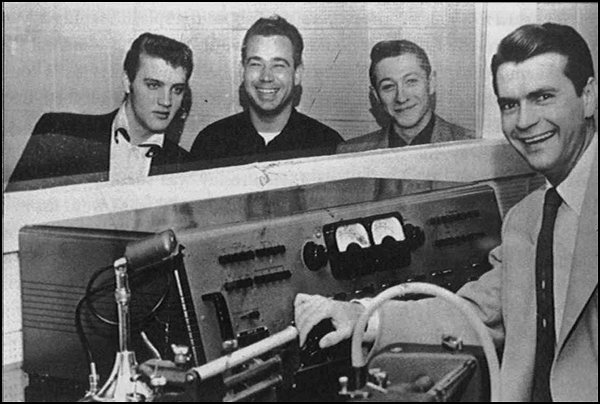
Presley was set for another audition, one with Moore and Black, at Moore’s house. Again, like Phillips, Moore and Black were less than enthused, but Elvis expressed a spirited interest in a recording session with the two, and they obliged. The session was held on July 5th and lasted late into the night. With exception of what was then considered a mediocre country ballad, “I Love You Because,” the session was largely felt to be unsuccessful. That is until Moore and Black were packing to leave. Elvis struck into Arthur “Big Boy” Crudup’s “That’s Alright Mama,” and started “acting the fool”.
Moore remembers:
“All of a sudden, Elvis just started singing this song, jumping around and acting the fool, and then Bill picked up his bass, and he started acting the fool, too, and I started playing with them. Sam, I think, had the door to the control booth open … he stuck his head out and said, ‘What are you doing?’ And we said, ‘We don’t know.’ ‘Well, back up,’ he said, ‘try to find a place to start, and do it again.”
And the rest was history.
Phillips had found the sound he was looking for, and frantically began checking levels and taping. “Damn. Get that on the radio and they’ll run us out of town,” Black remarked. Phillips did just that.
It premiered three days later on a local radio show to such a response that the DJ 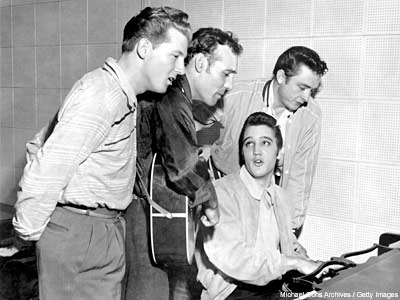 played it repeatedly for the last two hours of the show and later had Elvis himself in for an interview, in which he asked him to identify his high school so listeners could identify his color. Sun Records received over 6,000 advanced requests for the record, with a pop, 4/4, rock and roll version of slow waltz, “Blue Moon of Kentucky” to be pressed as the b-side.
So began the career of Elvis Aaron Presley, some would say with an act of minstrelsy, others would say with pure dumb luck and raw, unrefined genius.
Presley recorded more than twenty songs between 1953 and late 1956 for Sun Records. Of them, 18 “Elvis Presley” sides survive, two are lost, and the rest are billed to The Million Dollar Quartet, of recent Broadway fame. Of the songs credited solely to Presley (with Moore and Black), several the author believes to be among the finest of his career. It is no surprise, when listening to these recordings, that so many have had such issue with Presley’s singing. It is unique, ahead of his time in many senses, and strangely contemporary in others.
“That’s All Right,” Presley’s first hit, a slippery, top-down, walking-bass country blues bears moments of clear attraction to a young Roy Orbison (later to record with Sun Records), Presley’s silky vibrato wafting above of the slap-clang pound of the bass and thin, lick-heavy guitar, which, when taking the two together, appear to inspire the unrestrained grunge-wop, western rock and roll of a “Maybelline” era Chuck Berry to-come. When taken as a whole, the effect is a sound reminiscent of Johnny Cash in his days with the Tennessee Two (also later to record with Sun Records). “That’s all right, mama,” Presley sings, foreshadowing his own breaking stardom, overarching influences and legions of followers and imitators, “I’m leavin’ town, baby / I’m leavin’ town for sure / Well, I didn’t want you to be a-bothered with me a-hangin’ ‘round your door / Well, that’s all right / Well, that’s all right now, mama,” the acetate a fitting gift for his mother, a gesture of reassurance that he will make it, and a prescient stiff-arm to those who come after, inviting them to play in his wake, because he’ll be watching from the top, shaking his head, knowing they can’t do it like the King.
In 1955, a young Buddy Holly saw Presley perform in Lubbock, Texas. This left a sizable impression on Holly, as he then began to incorporate the country, rockabilly for which much of his music with The Crickets is known. Chances are very good that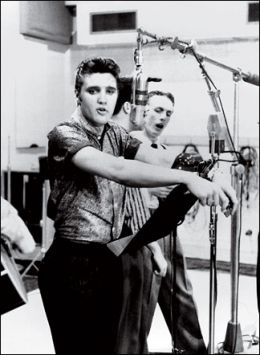 Holly’s attention was most closely drawn by, “I Don’t Care If The Sun Don’t Shine,” a song that sounds as if it could’ve been recorded by Holly himself and simply mislabeled as Presley. “I Don’t Care If The Sun Don’t Shine” exhibits the archetypal, up-and-down slap-bass of the Sun Records sound, coupled with bright, cutting guitar chords, occasional finger-picking and well-bent, Holly-esque solos of classic rock and roll simplicity. Presley rarely visits his lower register, singing of love for his baby in a high, dizzying vibrato akin to Holly’s performance of “Modern Don Juan”, bridging the gap between Presley’s newfound fame as a young, pop sensation and his earlier ballad-driven sensibilities, ostensibly eliminating doubts of his ability to adapt “all kinds” of music for the current market, simply because he “don’t sound like nobody else,” yet.
The song previously felt to be mediocre and difficult to market, “I Love You Because,” shows a particular interesting side of the “good ballad singer”. Elvis adopts a languid, melancholy croon that would later be heard issuing over audiences at the Copa Cabana and all over Vegas, Atlantic City, and other destination hot spots from the microphone of Dean Martin. Presley’s delicate, sliding vocal line is complemented by the striking, metallic and swinging jazz-cum-reverberated rock fingerpicking of Moore. Presley, in a sense, lets it all hang out, expanding to fill the sonic space, and putting his own unusual styling so strongly in the forefront that when he warbles, “No matter what the world may say about me / I know your love will always see me through / I love you for the way you never doubt me / But most of all I love you because you’re you,” it is distinctly as if he is in conversation with himself, echoing the same blind confidence that he first took with him to Sun Records, refuting the opinion of countless music teachers and bandleaders and even Phillips himself, continuing that, “No matter what the style or season / I know you’re heart will always be true.”
Over the course of the Sun Recordings, Presley successfully tackles a multitude of genres from sentimental ballad, to western swing, to country and country blues, to rockabilly, to even bluegrass waltz and blues standards like “Milk Cow Blues”, reworked into the boogie-woogie “Milkcow Blues Boogie”. With each song we hear a different, but equally poised and unyielding Elvis, singing unlike no one else in his day. It is apparent that Elvis is still finding his voice, but he is in no hurry. He is making everything his own, and as he does so cycles through vocal performances that will inspire countless singers for decades. Many have claimed Buddy Holly to be the single most influential figure in rock and roll. Others have said Roy Orbison or Chuck Berry. Perhaps, those with that claim did not go back far enough.
Written by Ben Brundage. Check out Ben’s Tumblr: Damned Fine Lion

