


In The Dust #8: The Ronettes ‘Presenting the Fabulous Ronettes Featuring Veronica’
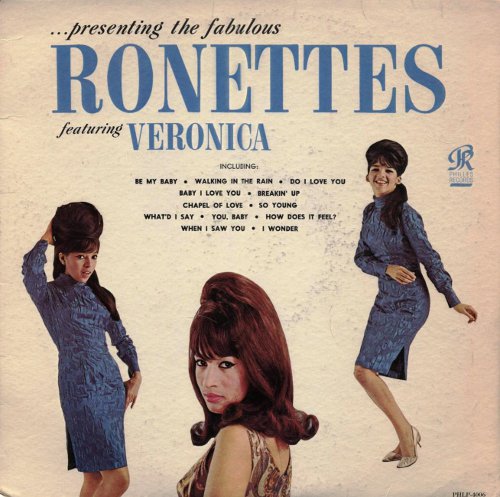
Once a week In The Dust rolls up its sleeves and digs to the back of the rack to find that record, the one you never knew you always wanted, the one that’s lost but not forgotten. (Listen via Spotify)
The Ronettes, despite the clear emphasis on lead singer Veronica Bennett (later Ronnie Spector), were, first and foremost, a family. Contrary to ideas that the group was put together via the traditional girl group cattle-call, Veronica Bennett, Estelle Bennett and their cousin, Nedra Talley, began singing together when they were merely children, performing numbers for friends and family at their grandmother’s house.
“By the time I was eight,” Ronnie Spector remembers, “I was already working up whole numbers for our family’s little weekend shows. Then Estelle would get up onstage and do a song, or she’d join Nedra or my [other] cousin Elaine and me in a number we’d worked out in three-part harmony.”
As the girls grew older, they became enamored of Frankie Lymon and the Teenagers and other popular groups of the day. The Bennett girls, with Talley and two other cousins, Diane and Elaine, took their grandmother’s sing-outs one step further and, with her help, formed a group, choreographing dance moves and orchestrating five-part harmonies to jukebox favorites, “Goodnight Sweetheart” and “Red Red Robin”. Inspired further by Frankie Lymon, they invited another cousin, Ira, a male, to join the group and signed up for Amateur Night at the Apollo Theatre in Harlem.
Billed to perform Frankie Lymon’s “Why Do Fools Fall In Love?” with Ira singing lead, they took the stage at the Apollo Theatre to a notoriously skeptical and antagonistic crowd. The band began to play and the first verse approached. Ira froze. Ronnie acted.
“I strutted out across the stage,” she remembers, “singing as loud as I could. When I finally heard a few hands of scattered applause, I sang even louder. That brought a little more applause, which was all I needed.”
After the tumultuous night at The Apollo, Elaine, Diane and Ira left the group. Veronica, Estelle and Nedra remained together under the moniker Ronnie and The Relatives. The group enrolled in vocal lessons and performed at local dances, parties, and formal occasions. It is as Ronnie and The Relatives that things began to happen for the three young girls from Spanish Harlem.
They played the right shows, shook the right hands and signed to Colpix Records, which lead to a regular set at the Peppermint Lounge in New York City, a feat considering that the girls were still underage. They disguised themselves to be “at least twenty-three” years old every night in order to shirk suspicion and ease their admittance.
During this period of masquerading at the Peppermint Club, the girls adopted the name the Ronettes, and when they decided to end their contract with Colpix Records due to lackluster sales and less than enthusiastic label support, they took the name with them.
Estelle called popular Record Producer Phil Spector, who granted them an audition. He admitted to seeing them perform several times prior and that he had been considerably impressed.
Midway through the group’s first audition for Spector, a rendition of their first Apollo amateur night performance of Lyman’s “Why Do Fools Fall In Love?”, Spector, who had been accompanying them on the piano, jumped from his seat in excitement. “That’s it! That’s it,” he screamed. “That’s the voice I’ve been looking for!” He, of course, was referring only to Ronnie.
He courted her as a solo act but Ronnie’s mother, daughter of their original mentor and tutor of age-defying make-up in their Peppermint Club days, refused, saying that they go together or not at all. Spector agreed and The Ronettes jumped ship at Colpix to join Phillies, Spector’s label, and set about making their first record, Presenting the Fabulous Ronettes Featuring Veronica, a record that, for reasons incomprehensible to the author, is criminally out-of-print and has never been issued on CD, despite holding a place in history as one of the most influential records ever produced and #427 on Rolling Stone’s Top 500 Records of All-Time.
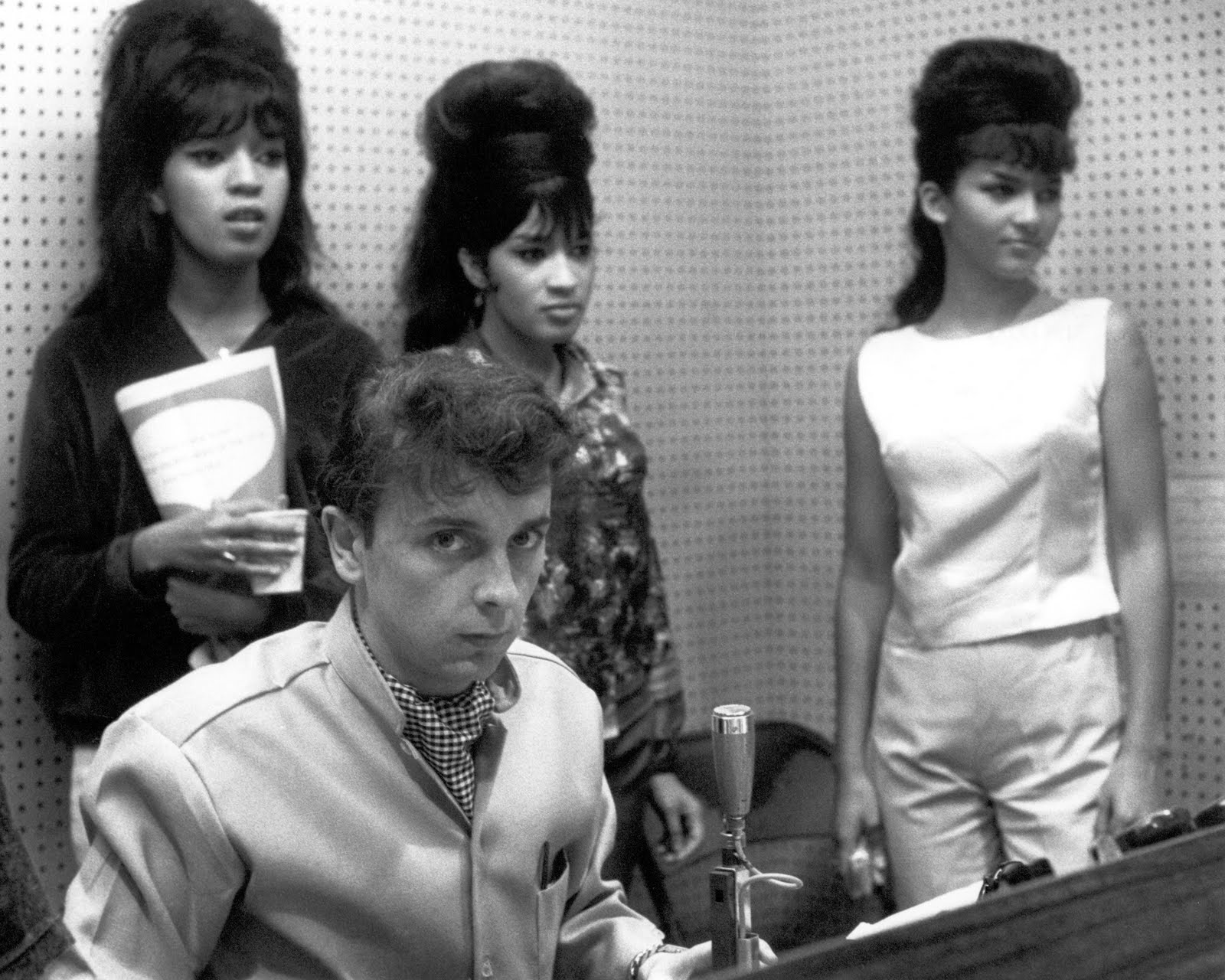
“Be My Baby” was the group’s first single. It went straight to the Top Ten, cresting at #2 on the Billboard Top 100. There was no denying it. The Ronettes had broken it wide open. The song’s effect was permeating. It garnered constant radio play. Brian Wilson recorded “Don’t Worry Baby,” as a tribute to it. It’s one of the most iconic intros in all of music. Bum. Ba-bum. Crack. Bum. Ba-Bum. Crack. And it comes on, a sonic assault so dense, so reverberant it can only be “The Wall of Sound”, a technique invented by Phil Spector specifically with AM radio and mono jukeboxes in mind, featuring four-to-five guitars playing the same part in unison, two basses doing the same, thickly layered percussion, occasionally strings and horns, often in numbers more akin to an orchestra, and all recorded in an echo chamber, plenty of reverb applied. Beneath the spicy Spanish Tinge of castanets and shakers, you hear it: that thick-but-airy, miles-deep sound, pushing upon your ears like a swift dive in the deep end, Ronnie Spector’s angelic, soul-affirming voice casting down to you like a leaden life preserver, floating slowly across the sky for just a moment before breaking the water’s surface, then sinking all the way down, through the mix, to you and facilitating your ascent into the bright, clean air above.
The group’s second single was “Baby, I Love You”. Due to a scheduling conflict, only Ronnie sings on the record, backed by Darlene Love and Cher, who was, believe it or not, a permanent backup singer for The Ronettes. Leon Russell, of Joe Cocker and Leon Russell and The Shelter People fame, a massively brilliant and underappreciated artist in his own right, guests on piano, which is featured prominently on the intro but soon is mostly lost to the Wall of Sound. Like “Be My Baby,” “Baby, I Love You,” is dense, nearly asphyxiating, but considerably more intricate rhythmically. Spector uses many more layers of percussion to cut through the mix like the ‘chuck, chuck’ of a train on its tracks, segmenting the sound, syncopating the strings and emphasizing the bass, providing a colorful, low and buoyant sound to support and lift Ronnie’s voice above its churning engine.
“Walking In The Rain,” is a haunting, Beach Boys-esque slow burn, which Ronnie issued gracefully in a single take. Its Grammy-winning special effects are instantly recognizable. A startling, artificial thunder-clap introduces the record and echoes over the canvas like the flank of a raincoat, carefully escorting the band, Nedra, Estelle, and later Ronnie to the center. Her poised, woeful cry matches perfectly the melancholy arrangement. One pictures her standing at a window, rained in on what would’ve otherwise been a beautiful Saturday out, wishing only to say ‘to hell with it’ and share a walk in the rain 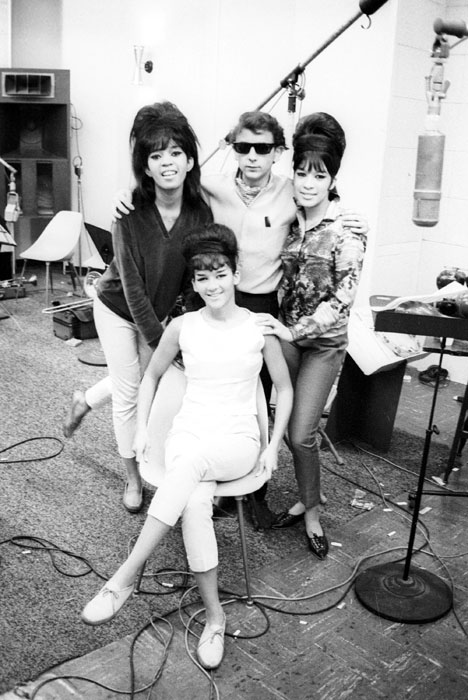 with her man, “wishing on the stars above and being so in love,” but she has no man, she cries. “Johnny, no, no he’ll never do,” and “Bobby, no, it isn’t him, too” because, unlike her, he’ll never love “walking in the rain,” she dreams, imagining the perfectly soaked suitor, compelling every man to get a little wet if that’s what it takes.
The standout of the record is not “Be My Baby,” although it is perhaps comparably famous. “Breakin’ Up” is a jaunty jolt of inspiration that strikes like a medicine ball to the stomach of one’s senses. The interplay of Ronnie’s beautiful, soaring lead lines and Nedra and Estelle’s undulating counterpoint makes for the most stirring, impressive vocal performance on the record. Full of the rubbery, bouncing quality present in the best McCartney, the rhythm of “Breakin’ Up”, reminiscent at times of a blues shuffle, with its simple quarter notes leading to two swung eighth notes and into periodic breaks, is addictive and masterfully crafted. Clocking in only at a trim 2:25, the constant counting and interspersed swing and rupture of the rhythm and gradual fade-out allows the song to appear to stretch, like counting every step in a short walk, making it seem more like a meal than a bite and lending just enough variation for perpetual replay appeal.
Ubiquitous classic, “Chapel of Love,” closes out Presenting the Fabulous Ronettes Featuring Veronica. Rhythmically it is every bit as impressive as “Breakin’ Up”, but for its collective complexity, rather than its basic structure. The arrangement of the auxiliary percussion (castanets, claves and tubular bells) when juxtaposed against the drum kit compounds the simple 4/4 rhythm and transforms it into a propulsive, shuffling forward roll, driving The Ronettes’ excessively square, unisonous and patient harmonic expressions onward and onward, effecting a feeling like that of a montage, as if they truly were heading to the chapel, as a family, fretting and fussing in joy, anxiety and anticipation in the minutes before the clear separation of two lives: a single girl and woman, and a married adult and wife, but coming to terms with the two and celebrating them together.
But unlike the ever-present nature of friends and family, Presenting the Fabulous Ronettes Featuring Veronica is almost a ghost. Nearly impossible to find as a cohesive, properly ordered collection, one could purchase a Ronettes greatest hits compilation, and there are many, but the author, at the behest of the simple purity of the music, implores you to at the very least assemble the tracks in their sequence, as in the method of Phil Spector’s Wall of Sound, and the sequencing of nearly every record, but not so with most greatest hits compilations, there is purpose in order, standing in perpetuity fundamental to the listener’s enjoyment.
The Ronettes broke up soon after Presenting the Fabulous Ronettes Featuring Veronica. They toured briefly with The Beatles, issuing a few singles and managing to record another slew of songs, but as most of us now know the true Phil Spector thanks to his 2009 murder conviction, it is no surprise that he, out of deep love for Ronnie and profound insanity, declined to release said songs, putting The Ronettes on indefinite hiatus for fear that, as a result of their popularity, they might outgrow him and Ronnie leave him. Despite the darkness that surrounds the fallout of this record, Presenting the Fabulous Ronettes Featuring Veronica is rife with the pure ecstasy of a frozen moment, a moment where family first made it, as one, and all was well. It is the kiss of familiar lips on the seal of the all-too-short career of one of the greatest girl groups, and one of the greatest musical families, ever to enliven wax.
Written by Ben Brundage. Check out Ben’s Tumblr Damned Fine Lion
Daytrotter Unveils New Design, Live Listening

One day, if there is any justice in this world, Daytrotter will have an entire room at the Smithsonian. I truly believe that Sean Moeller’s contribution to music is every bit as significant as the museum’s non-profit record label Folkways. With each passing day, and subsequent recording, Daytrotter moves closer to cementing itself as a living, breathing library of modern music.
Daytrotter began with a single mission: Record one band a day, every day, then give it away. It sounds so simple, but when one factors in the sheer magnitude of this mission it becomes maddening. At the time of this writing, 1321 artists have stopped by The Horseshack studio. Every post includes original artwork, Moeller’s writing and at least four tracks. When you include multiple appearances, the number of “sessions” grows exponentially. This volume of work is staggering.
The Horseshack is located in the abysmal, albeit convenient, armpit of Illinois that is Rock Island. Part of the Quad Cities, Rock Island is one of a handful of industrial towns straddling the Mississippi River at the Iowa-Illinois border. For decades, the city’s lifeblood has remained Rock Island Arsenal: the largest government-owned weapons manufacturing facility in the United States. Not exactly a hotbed of creativity.
Nonetheless, Moeller’s decision to make the Quad Cities the home of his burgeoning enterprise proved a critical one. Interstates 74, 80, 88 and 280 all converge here, along with nearly a dozen Illinois state highways. Thus creating a hub for travelers headed to every corner of the continent. As such, Daytrotter found itself a welcome stop for bands looking to break up the grueling voyage across the country. While we may not know about the Quad Cities without Daytrotter, we can be certain that we would not know about Daytrotter without the Quad Cities.
Yesterday, the website unrolled its latest redesign. Along with an updated look and more intuitive functionality, Daytrotter announced an exciting new feature: live listening. For a small price, listeners can now stream sessions as they are being recorded. Just when you thought the site couldn’t possibly get any sweeter, it did. For years I have dreamt longingly of a life as a fly on the wall of The Horseshack. Now, that opportunity is mine.
Another change involves subscriptions. Daytrotter’s free downloads will not be available for much longer. The site is moving toward a $2/month subscription fee. This is a small price to pay for 365 artists and 1300+ songs per year. Not to mention, I would rather pay two dollars than have my listening experience interrupted with annoying ads like many other free music services.
For those that have yet to visit Daytrotter, you may think that I am over-selling yet another music blog. I promise you, without a shred of doubt, that my words can not begin to do justice to the greatness that is this musical juggernaut. My only hope is that the site will outlive everyone that stumbles upon this post. Daytrotter is an invaluable institution. To all those whose daily grind makes our enjoyment possible, we are forever indebted. Thank you.
Written by Rob Peoni


Why I Love Vinyl: A Collector’s Confession
The Dig
I have been a collector my entire life. You name it: baseball cards, Teenage Mutant Ninja Turtles, starting lineups, wrestling figures, ticket stubs, etc. In many instances I have taken this collector’s mentality to ultra-obsessive measures. I am completely aware that this is self-incriminating, but during the seventh year of my life I had my mother scour the aisles for over a year to find me The Nasty Boys tag team dual pack from Hasbro. I would not stop until the Nasty’s were mine. Ten months passed and with the help of a dedicated mother my gems were found at Children’s Palace (now Best Buy). Looking back, this was the collector’s pinnacle in my life. So much hard work, I should haven given them the tag team titles, started reading books and ended this sick obsession right there. Unfortunately, those are not the next steps of a self-diagnosed addict.
Music has always been my first and most important obsession. I give my dad credit for this. When I was a youth we would listen to the oldies radio station and he would always name the song, band, and year of any song that were to blast through the ’88 Oldsmobile factory speakers. My dad’s obsessive attention to historical detail made me think that this was how everyone was supposed to be introduced to music. Knowing that Spiral Starecase’s “More Today Than Yesterday” was the best one-hit wonder of 1969 at age 12 was normal, right?
My obsessive compulsive relationship with music coupled with my collecting, for many years, caused me to refrain from starting to collect vinyl. It was like opening the door of the local brewery on free sample day to a broke, deadbeat, recovering alcoholic. My dad enabled. He offered me his collection with the understanding that they would not be sold. The downward spiral into the deep, dark, grooves of the record began.
My dad’s collection was the fantastic beginning to my digging journey. Chicago, Beach Boys, America, Barbara Streisand, The Guess Who, The Grass Roots, early disco, Motown, I could not ask for a better foundation. I took these 70+ records and decided to build a vinyl skyscraper that I hope is never finished.
I love digging for vinyl because it is always an experience. If you are a dedicated digger, then you have the opportunity to discover something as rare as the Nasty Boys every trip. I love that most record stores give you the chance to dig through boatloads of 99 cent bins. Sure, a bad back and sore knees might result but it is completely worth it when you are on a mission. The justification for buying new releases on vinyl is elementary. It gives you a tangible item, cool sleeves, and a digital download along with your purchase. Why would you buy Dum Dum Girls latest release ‘Only in Dreams’ on iTunes when you can get a kick ass record along with it?
Playing a record is more intimate. All my attention is focused on the artist and their songs when I am spinning. Listening to songs in iTunes has become the norm in this new listening era. While it is convenient, easy, and the shuffle feature is fun, it does not completely suck me into the artist’s work like vinyl. The digital listening experience is flawed because of that very convenience and functionality. We are an impatient society and iTunes makes it to easy to expose this human flaw. The skip, shuffle, and search features enable us to enjoy what we already know we like, however, it does not challenge us to explore new listening opportunities. Listening to a 12″ LP forces us to hear it all. This is why I love vinyl.
This forced engagement has given me an expensive, but satisfying new hobby. I knew my addiction was in full force when I stepped off a U.S. Airways jet in LaGuardia airport. Instead of looking for directions to my hotel I pulled out my iPhone and searched “record stores + Manhattan.” My initial experience in the Big Apple was not visiting Times Square, the Statue of Liberty, or visiting my hotel. No, it was spent walking 30 blocks to a store to talk and buy records. John Coltrane’s A Love Supreme, I needed this record. I needed it not because it was one of the greatest jazz albums of all time, but because I needed to bring back a piece of NYC with me. Vinyl currency is always the most valuable. Thank you Academy Records & CDs. You guys were great and feel free to reach if you ever follow through on your planned excursion to Richmond, Indiana.
A collector will always be a collector. I have met new friends, expanded my musical interests, and enjoyed many lonely nights since I began collecting records. While it can be an expensive obsession it rewards the listener. Why not pay for something that will last forever? If you’re on the fence I would recommend you to hop over to the other side. The hours will pass along with the soreness in your knees, and the grooves will get you. The recovery from your new nasty addiction will not be easy. I’m okay with being your enabler. Jump in.
Written by Brett McGrath