


In the Dust #14: Bo Diddley ‘Bo Diddley’
Once a week In The Dust rolls up its sleeves and digs to the back of the rack to find that record, the one you never knew you always wanted, the one that’s lost but not forgotten. (Listen to Bo Diddley The Chess Box via Spotify)
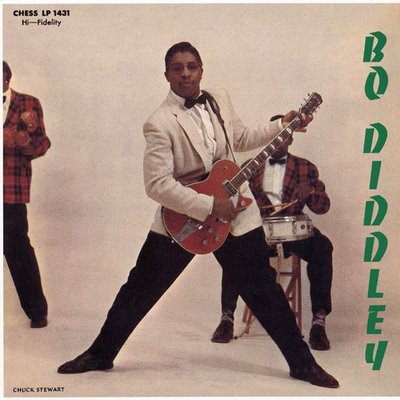
Who do you love?
Bo Diddley, and he’ll be the first to tell you so.
Easily one of the most unabashed self-promoters in the history of rock and roll, at first glance, Bo Diddley’s career seems to be entirely dedicated to solidifying his place, or more accurately his name’s place, in the social consciousness. Certainly no other artist has ever used in his own name in a song’s title, chorus and album more so than Bo Diddley, but Diddley’s work, while perceived by some due to the repetitive name dropping as kitsch and pop novelty, when considered in context, offers much more substance and historical importance than just the universal awareness of a name.
Born Ellas Otha Bates in McComb, Mississippi, in 1928, Diddley was soon adopted by his mother’s cousin, taking her name as Ellas McDaniel. When Diddley was 6 years old, the family moved to the South Side of Chicago, where he became active in the Baptist church and proceeded to learn the trombone and violin. Diddley’s skills at the violin developed quickly and he soon joined a local orchestra, with which he played until he was 18. Diddley, while still interested in the violin and classical composition, found himself increasingly drawn to the energy and vibrant musicianship of those playing at local Pentecostal churches, in particular anyone could play guitar.
One evening he went on the town to see John Lee Hooker, who was playing at a local juke joint. Hooker played “Boogie Chillen”. That was it, Diddley decided.
He soon formed a band, The Hipsters, with pal, and who soon would be longtime band mate and collaborator, Jerome Green. Diddley’s distinctive guitar style, a choked, muted-string method based off of core violin technique, soon set them apart.
After graduating high school, Diddley started working as a mechanic and carpenter, but discovered that even with the two jobs it was difficult to make ends meet. The Hipsters began busking on the street and quickly scored a regular gig at the 708 Club, a popular South Side juke joint.
The Hipsters played a mélange of styles, from Diddley’s own originals, to songs by Louis Jordan, his inspiration, John Lee Hooker, and his future label-mate, Muddy Waters.
After a few years’ buzz and toil at the 708 Club, Diddley signed to Checkers Records, an imprint of Chess Records. Then, he was still Ellas McDaniel, a name Leonard Chess insisted was not suitable.
There are many conflicting claims of how Bo Diddley acquired one of the most famous monikers in rock and roll, and there is no definitive version. Diddley maintained that his peers gave him the nickname, initially as an insult. He also states that it was the name of a popular singer of whom his mother was fond. Others claim it was the name of a popular comedian, and that Chess borrowed the name to lend to Diddley and his first single, “Bo Diddley”.
Others say it is a reference to the diddley bow, a popular instrument among children that features a single string tied tightly to two screws and is played by simultaneously strumming the wire and manipulating its tension with a slide. A common first instrument of the Delta bluesman, it is well known as a progenitor of the slide guitar.
Regardless of how Diddley assumed the moniker, Chess released his first single, the immortal and highly influential, “Bo Diddley”, featuring Otis Spann on piano, under the name in 1955.
He went on to record many more successful singles for Chess in the following three years, all of which, including several B-sides, are collected on Diddley’s 1958 debut album, Bo Diddley. While not as celebrated as Diddley’s first true studio album, Go Bo Diddley, included are some of the most iconic songs of his career.
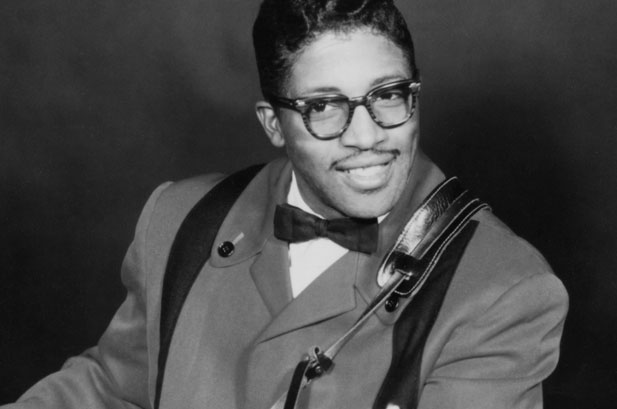
First, and this should come as no surprise, is “Bo Diddley”. In unison, the band begins, and a rolling, tumbling hiss issues a curiously uniform effect. Green’s maracas, as well as Frank Kirkland’s drums, were originally intended to simply reinforce Diddley’s rhythm. Diddley’s guitar, in turn, reinforced their rhythm back, and all melded together, achieving a strange rhythmic harmony, which came to be known as the Bo Diddley Beat, a major innovation. Diddley breaks up his beat with characteristic, seemingly spontaneous chording and traditional pop AABB lyrics, leading into one of the most distinctive guitar solos in rock and roll, one that has been echoed time and time again by guitar players for over 60 years. A simple tremolo technique of Diddley’s own devising slathers a simple alternating chord progression, creating what is a slithering, bending and prophetically psychedelic sound that would come to permeate the genre.
“I’m a Man”, the album’s second track and the B-side to “Bo Diddley”, is for obvious reasons instantly recognizable. You might know it as “Hoochie Coochie Man”, recorded by none other than Muddy Waters. What you might not know is that after hearing Diddley’s version, which was inspired by Waters, Waters continued the conversation by recording “Mannish Boy,” a song written by Willie Dixon, who plays bass on all three versions, and a jabbing reference to Diddley’s being much younger than Waters and, thus, not the “man” that Muddy was when he recorded it. “I’m a Man” features the same iconic stop-time rhythm as Waters original “Hoochie Coochie Man”, but in his classic style it is substantially “Diddley-fied” by the addition of heavy shakers, distinctive guitar tone and reverberated hollering throughout.
One of Diddley’s most famous to-date, but relatively under-appreciated at the time, “Who Do You Love?” is the second-to-last track on the album. As with many Diddley songs, this country-western stomper is swathed in reverb, and his vocals especially, in slapback. His guitar, almost pedal steel-like at times, soars over in chorus, interrupted by the remarkably angular, but sweet and confident soloing for which he is known. As in “Bo Diddley”, “I’m a Man” and the majority of his work, he, and his magnificence, is the subject, testifying to a cocksureness that is at once overt braggadocio and tongue-in-cheek, corner-mouthed charisma:
I walked 47 miles of barbed wire / I used a cobra snake for a necktie / I got a brand new house on the roadside / Made out of rattlesnake hide / I got a brand new chimney made on top / Made out of human skulls / Now come on and take a little walk with me, Arlene / And tell me who do you love?
He continues, boasting, “Only 22 / And I don’t mind dyin’”.
Diddley’s brash and loveable egotism is only a part in his lasting legacy. Aside from wonderful songs and a persona to match, his skills as innovator and inventor garner him as much accolades as his music.
In 1958, Diddley built his own guitar, a more complicated version of what is largely known as a “cigar box guitar”, a favorite among blues musicians and poor guitar pickers of the south because one could make it easily and cheaply one’s self. This guitar featured a very unusual and unorthodox electrical build, one that contributed greatly towards the distinct sounds Diddley was able to create as his career progressed. He also was one of the first to build and operate his own home studio, engineering and recording a lot of his music himself.
Diddley’s homespun individualism sheds a more complicated light on what the author has, up until this point, referred to as self-promotion and egotism. Diddley, in all ways, is a true original, and fittingly dubbed by his loving admirers, “The Originator”. He turned blues into rock and roll and gave Buddy Holly, The Rolling Stones, The Yardbirds and countless other infamous artists a cornerstone upon which to build their own house of worship. When Diddley uses, reuses, and overuses his name, it is more than just the repetition of a moniker; it is pride in the insistent impulse to do it himself, his way, picking a guitar like a violin, making its sound tremble like a reed in the breeze or slyly undulate like a snake to its prey. It is Diddley being Diddley, marking the high water, banging out his juba and, “Diddley” by “Diddley”, changing music forever.
Written by Ben Brundage
Album Review: Blue Moon Revue ‘Phases’

Daily or even weekly readers of this blog have likely picked up on a pet peeve of mine. I take issue with the trend amongst bands labeled as “indie” to strive unrealistically for complete originality with their music. These bands appear to shun any relic of the past. All too often this leads to gimmicky distractions that serve to cheapen the art rather than enrich it.
Fellow music blogger Zach Hart indirectly spoke to this problem in his terrific retrospective “Pitchfork at Fifteen: WLFY on Pitchfork” saying,
“I understand that time and tastes change, but good music and the personal experiences that shape individual taste do not. I live by the thought that good music is good music regardless of genre, album cover, band name, or the look of the band.”
My disdain for this failed attempt at a new sound stems from a longtime appreciation for the blues. A genre whose songs are so shared and incestuous that tracing their origin becomes a near impossibility. The strength of a blues performance lies in the artist’s ability to relate emotionally to the material. The authenticity comes from the musician convincing the audience that these same 12 bars are as meaningful now as ever.
Indianapolis’ Blue Moon Revue is an independent rock band. Underappreciated, underfed and unsigned – they qualify in every sense of the word. Their latest release Phases was recorded under the guidance of Alan Johnson at the Static Shack. The album is a satisfying mix of hungry, energetic songwriting and airtight instrumentation that blends into soulful, funked-out rock.
Phases kicks off with the punchy, distorted blues of “Lil Mama.” We featured a video for the song in a post just before the band’s December show at Radio Radio. On the first spin, you’ll be certain you’ve been listening to this track for years. Lead singer Matt Marshall begs unabashedly for the returned phone call of an unresponsive lover, while Dave Sullivan mimics the singer’s desperation on his Les Paul. Good stuff.
“Waiting On a Wire” serves as another of Phases’ more successful tracks. Here, Sullivan bounces along with a stabbing horn line, while bassist Andy Salge takes the reins on vocals. I would place Salge amongst this city’s strongest bass players. In an earlier era, he would have made the ideal session musician. It’s rare to find a band that rotates front men effectively, but Marshall and Salge trade with ease, each bringing a unique voice without destroying the band’s identity.
“Waiting on a Wire”
I am also thrilled by BMR’s decision to bring keyboardist Gary Mielke into the fold on a full-time basis. Pianists often serve as unsung heroes in the classic rock formula. While I may not argue that point here, Mielke’s play adds a texture and depth to BMR’s songs that I look to see expanded in the future, particularly in their live shows. His addition has, to this point, been subtle but effective.
Blue Moon Revue may not be a band at the cusp of conquering the musical landscape. Maybe they don’t have “the look,” but several simple facts remain. These guys are more talented than many acts with larger regional and national followings. They sound like what they are: Midwest gentlemen that were raised on classic rock, funk and blues. Rather than run away from the music that brought them here, they chose instead to embrace it. If that is a crime, then it is a crime worth committing.
Download a copy of Phases on iTunes. Indy folks, don’t miss BMR’s 2nd Annual Mardi Gras Party, featuring a few covers of the Crescent City’s finest at Locals Only on February 17th. Bloomington residents can check out the new material at Bear’s Place on February 24th. Hard copies of the album are available at a few locations as well. Eat, drink, listen local. Click below for a free stream of Phases:
http://widget.tunecore.com/swf/tc_run_v_v2.swf?widget_id=80887
Connect with Blue Moon Revue via Facebook | Twitter
Written by Rob Peoni


Help The Coasts and Hotfox get to SXSW
Two of this blog’s favorite bands are currently featured in a pair of contests that, if won, will land them a spot in the Austin’s SXSW 2012. Hotfox, a terrific band from Bloomington, IN released You, Me, and the Monster in 2011. The album was one of my favorite Hoosier releases of the year. Vote for Hotfox in JanSport’s Battle of the Bands. Fans can vote once each day. The contest runs through January 19th. A group of panelists will select the winning band from the Top 10 finalists. The winner will receive $5,000 in travel money and JanSport gear and will be featured in the SonicBids SXSW Party.
The Coasts, whose self-titled debut was featured on my Top 10 albums of 2011, are featured in a contest through Maurices Hometown Sound. The winner will receive a trip to Los Angeles, where they will shoot a music video. They will also win prizes from Maurices as well as a slot in their SXSW daytime showcase. Vote for The Coasts. Vote daily. The contest runs through January 23rd. Their album kicks ass and they deserve this opportunity.
Need more convincing?
Album Release: Hotfox You, Me, and the Monster
Video: Hotfox “Mountain Tiger”
Album Review: The Coasts
Thought on Tracks Interview: The Coasts
Written by Rob Peoni