


In The Dust #17: Harry Smith’s ‘Anthology of American Folk Music’
Once a week In The Dust rolls up its sleeves and digs to the back of the rack to find that record, the one you never knew you always wanted, the one that’s lost but not forgotten.
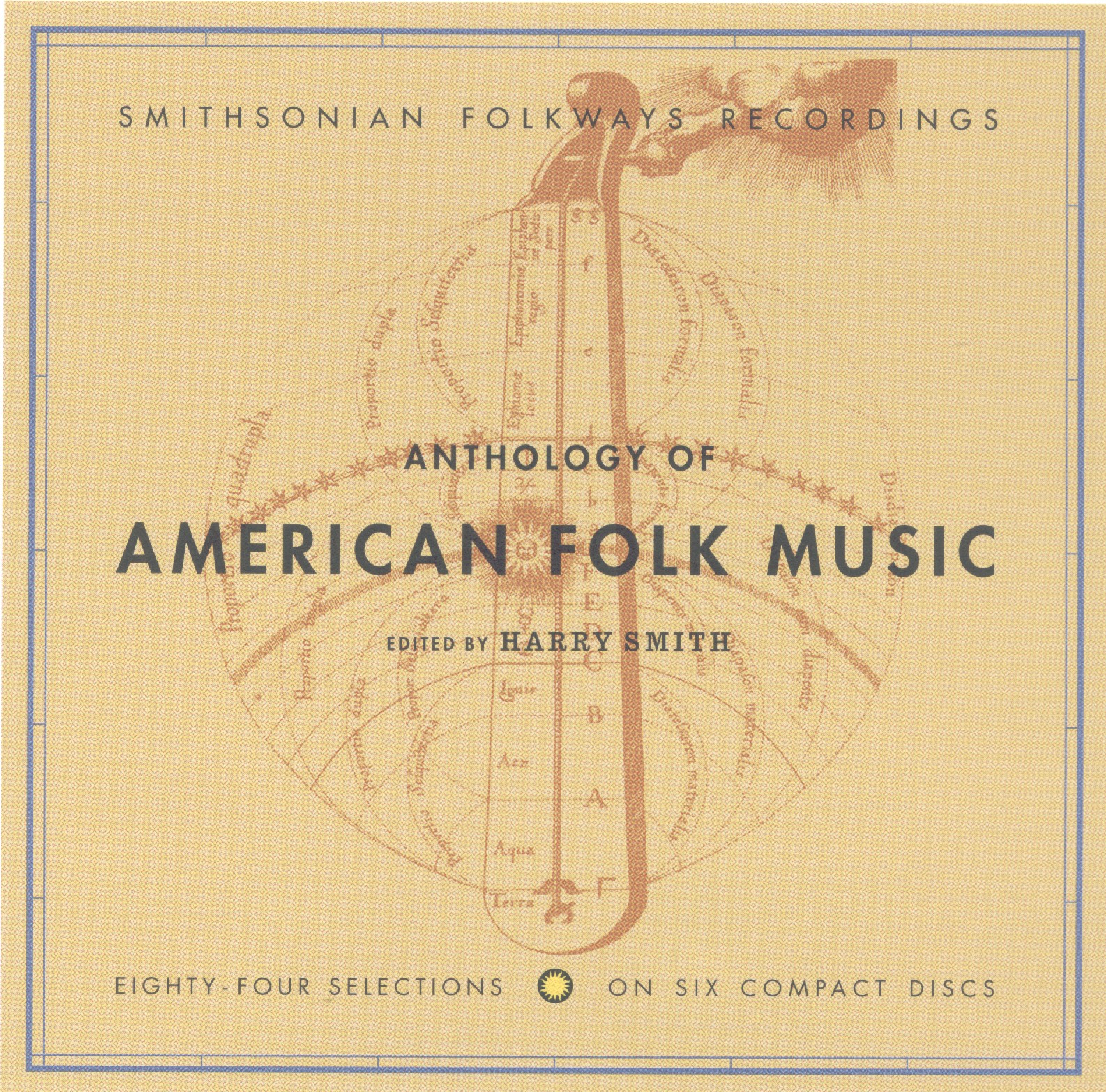
In the early 1950s, there began a revolution. It wasn’t marked with massacre or power struggle. Those outside it knew it existed, but barely, and only through stories of the Bohemian, Greenwich Village, and emerging stars like Bob Dylan, Joan Baez and Phil Ochs. It was a new American revolution, one in which musicians, critics, casual listeners, and even hipsters and some fashionistas began to look back in order to look forward. It was a folk revolution, and Harry Smith, then just 29 years old, was at its center.
Smith was, in many ways, a jack-of-all-trades. A filmmaker, ethnomusicologist, anthropologist, mystic and artist, he embodied 1960’s New York bohemianism. He lived with Ginsberg, rubbed elbows with Igliori and The Fugs, hung out at Hotel Chelsea, screened films at the San Francisco Museum of Art and, perhaps most importantly, amassed an astonishingly deep collection of early American 78 rpm records. Many of these records were collected to form The Smithsonian Anthology of Folk Music, a six-LP box set that stands not only as a valuable document of the development of American music, but also as one of the most influential compilations ever released.
The collection, released in 1952, is comprised of 84 sides recorded sometime during 1927-1932 (Smith notes his reasoning for this timeframe as “1927, when electronic recording made possible accurate music reproduction, and 1932, when the Depression halted folk music sales,”) and divided into three parts, each with two records of stylistically linked material: Ballads, Social Music, and Songs. Ballads collects songs that recount a particular time or event and loosely tells a historical narrative. The first LP of Social Music collects dance songs and party music, typically performed, as one can imagine, at community gatherings. The second LP features pieces centering on religion and spirituality and Songs collects those in between, detailing everyday life, relationships, activity, etc. Genres range from Cajun to country to delta blues, generally running the gamut of popular, regional American music of the time.
Smith oversaw every aspect of the box’s production. He wrote and crafted the liner notes himself, which are nearly as famous on their own, using a style of collage later adopted by post-modernist artists. Always the eccentric, Smith sometimes provided editorialized summations of songs in cryptically poetic, journalistic expressions. For “King Kong Kitchie Kitchie Ki-Me-O” by Chubby Parker, a song in which a frog marries and mouse, later sampled by Mickey Avalon for his song “What Do You Say”, Smith penned the following: “Zoologic Miscegeny Achieved Mouse Frog Nuptuals [sic], Relatives Approve.” Each volume in the collection features the same cover art, a “celestial monochord”, but printed in its own unique color: green, blue and red. These, Smith asserted, were to represent the essential alchemical elements, Air, Water and Fire, and were to be in harmony with the “celestial monochord”, another alchemical reference, taken from an early treatise by the alchemist Robert Fludd. It was later replaced by a photo of a farmer in response to the politically charged atmosphere of the culture at which the collection was aimed for fear that its mystic angle might prove heavily divisive.
But the collection was anything but divisive. Its track listing reads like an all-star revue. It introduced uninitiated listeners to Blind Lemon Jefferson, The Carter Family, Mississippi John Hurt, Furry Lewis, Charlie Patton, Blind Willie Johnson, Gus Cannon and Cannon’s Jug Stompers, Dock Boggs, Sleepy John Estes and a host other artists. Its sounds graced the ears of Bob Dylan, Joan Baez, Dave Van Ronk and all the players in the New York folk scene, even Ginsberg, fellow poets, The Grateful Dead in San Francisco, and all those with an ear to the ground. Ronk recalls, “we all knew every word of every song on it, including the ones we hated.” Instantly, it was heralded as a driving force behind the folk movement and all efforts of musical resurrection, inspiring Newport Folk Festival to include Mississippi John Hurt and Dock Boggs on the roster of their next festival. Overnight, forgotten stars once again ascended and were flown to New England, Europe, all over the world, anxious and engorged with folk fever.
It later seduced John Fahey, Elvis Costello and infinite others, the entrancing “talismanic aura” driving every listener under its spell to obsessive love and reverence. It is #276 on Rolling Stone’s 500 Greatest Albums of All-time. Required listening for any American music lover, Smith and his Anthology are American treasures, of the past but not forgotten, to be held closely and affectionately, with curiosity and desire, and appreciated not as antiques but as indispensible, undying articles of America.
Written by Ben Brundage
In the Dust #16: Etta James, 1938-2012
All I need
Is someone like you
My dearest darling
Please, love me too
Within my heart
I pray your answer’s yes
I’ll make your life
Full of happiness
When you need me
I’ll be there by your side
Oh, I pledge my love to you
With God as our guide
Nothing, nothing, nothing in this world
Can keep us apart
My dearest darling
I offer you my heart
Whenever you need me
I’ll be there by your side
I pledge my love to you
With God as our guide
Nothing, nothing, nothing in this world
Can keep us apart
My dearest darling
I’m offering you my heart
My dearest darling
-“My Dearest Darling” – Listen
Etta James, At Last! (1961)
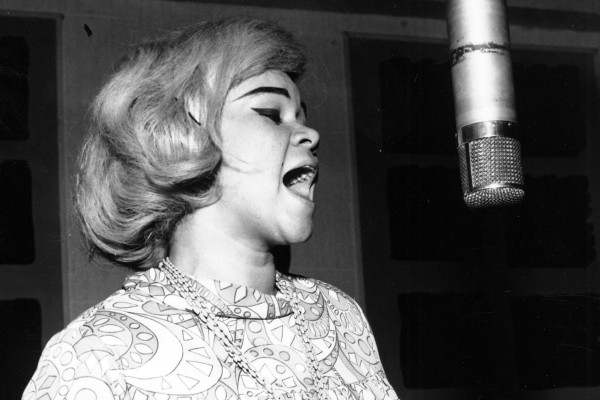
One week ago today, the world witnessed the death of one of the greatest singers of all-time. On Friday, January 20th, 2012, Etta James passed away. She was 73.
To many, she possessed a voice beyond compare. She was a symbol of strength, resolve and triumph over adversity. Her songs became anthems, embodied national consciousness, serenaded a President and garnered her 6 Grammy’s and countless nominations. She was inducted into the Hollywood Walk of Fame, the Rock and Roll Hall of Fame, the Rockabilly Hall of Fame, the Blues Hall of Fame and the Grammy Hall of Fame – twice. One of the first blues singers to “cross over”, her versatility won the adoration of fans from nearly every genre, and her star remains one of the most brilliant in any blues, pop or soul constellation.
She was born Jamesetta Hawkins on January 25th, 1938, in Los Angeles, California. Her mother was 14-year old Dorothy Hawkins. Her father, James speculated, was the elegant, reigning king of pool, billiard player Rudolf “Minnesota Fats” Wanderone.
Due to her mother’s frequent absences and erratic relations with numbers of men, James dubbed her mother “the mystery lady” and spent the majority of her time with caretakers. She took up singing at the age of five, receiving lessons from a musical director at a local church. She quickly became a popular attraction, often to her detriment. One of James’s caretakers, “Sarge”, would hold poker nights and his guests often requested that James sing for them. “Sarge”, at all hours of the night, would wake her up, drag her downstairs and, as she was a childhood bed-wetter, force her to perform, often in a soiled nightgown. This begat in James an intense, instinctual defiance that flared anytime it was demanded she sing, a reaction that, out of necessity, drove her to do things her way, and aided in summoning a vast wealth of emotion and determination totally unheard in all but a few other singers.
In 1950, after the death of her caretakers, James, 14, moved with her biological mother to San Francisco, where she began to fall deeply in love with doo wop. She formed a girl group, The Creolettes, a name inspired by their light skin. There, in many differing accounts, they met Johnny Otis, a legendary multi-instrumentalist, DJ, talent scout, producer and jack-of-all-trades who also died last week, only three days before James, at the age of 90. Otis got the girls a deal with Modern Records, changed their name to The Peaches, Etta’s from Jamesetta to “Etta James”, and set about recording their first hit. “Dance With Me, Henry,” a reworking of Hank Ballard’s “Work With Me, Annie,” co-authored by James charted at #1 on Hot Rhythm and Blues Tracks, and The Peaches were booked as the opening act on Little Richard’s upcoming nation-wide tour. But there remained stumbling blocks ahead.
During The Peaches’ tour with Little Richard, “Dance With Me, Henry,” was rerecorded by Georgia Gibbs, a pop singer, and retitled, “The Wallflower.” It went straight to #1 on the Billboard charts. James was irate. He next single for Modern Records, “Good Rockin’ Daddy,” also did very well, but only on the R&B charts, and the majority of her other singles for Modern were flops. James, fed up, yearning for stardom and confident she could get it, jumped ship at the conclusion of her contracted and signed, solo, with Chess Records. With the help of Leonard Chess, Willie Dixon and the songwriters at Chess Records, and Harvey Fuqua, fling and founder of the doo-wop kings, The Moonlighters, Etta James would record some of the most compelling, unforgettable and aurally immaculate crossover tunes in the American songbook.
Many of James’s songs are now ubiquitous, known to some as well as “Twinkle, Twinkle Little Star”, but they are nonetheless substantial pieces of an astounding career. Each speaks for itself, from the monstrously popular, “At Last”, to deeper tracks like “In My Diary”, and the author’s personal favorite, “Trust In Me”, layers of meaning issuing fruitfully from James’s effortless vocal delivery, at times wistful, ebullient and then so suddenly sullen, poignant and devastating.
Her Chess Box is required listening, as are her early recordings with The Peaches and later work like the completely gutting, perhaps semi-autobiographically inspired, Mystery Lady: Songs of Billie Holiday, as well as 2003’s Let’s Roll, and 2004’s Blues To The Bone, all of which won a Grammy.
In her 73 short years before succumbing to complications of Alzheimer’s and leukemia, James had cycled from doo wop to R&B to blues to pop and back again, mastering every style and interpreting standards from nearly every school with matchless grace and poise. Like Bo Diddley and the blues, she effortlessly established a lasting pathway between rhythm and blues and rock and roll, allowing for the veins of jazz and soul to grow through her and latch like ivy, constructing as she crossed, beneath a fog of undeserved ignorance and under-appreciation, a natural bridge of intertwining traditions, American earth as its base, strong, unyielding and deeply rich, much like the architect herself.
Rest in peace, Etta James. Your lonely days are over.
Written by Ben Brundage
Album Review: Porcelain Raft ‘Strange Weekend’

My introduction came when Ernst Greene (Washed Out) told Pitchfork in an interview that his favorite new artist was Porcelain Raft. The unfamiliarity with this name drove me to his Bandcamp site and I streamed and then spent an easy $5.00 on his EP “Fountain’s Head”. I was immediately struck by the timing of the measures. The simple rhythm was paired with an influential voice. The more I listened, the more I appreciated what Porcelain Raft had to offer. My gratitude reached an all time high when Porcelain Raft came to Indianapolis and opened for Yuck. Mauro Remiddi was solely orchestrated an enormous sound. His entire performance offered a DIY approach smothered with polish and control. Remiddi carries this mix into his debut LP Strange Weekend, released this week on Bloomington’s Secretly Canadian.
The first thing I noticed when I saw Porcelain Raft live is that Remiddi is a punctual perfectionist. He understands that, in order for this project to work, time management and execution must be constantly at the top of mind. While the live show is good, the studio is Porcelain Raft’s dock, his comfortable home. It is my best guess that Remiddi took of his shoes, got warmed up and relaxed as he recorded Strange Weekend. A patient structure is noted throughout this recording as a heavy dose of daze brings each song together.
The album begins with an infectious rhythm that strikes each note at just the right time. Opener, “Drifting In and Out” is a great first impression for new listeners. An electric guitar blows through each speaker, recreating a chillwave vibe. As I listen to this track I understand why Washed Out was washed in. They share the DIY approach by creating a certain mood-melting music that can send one dreaming for days.
A repeated thump of a drum machine, the mellow progression of an acoustic guitar, and emotional vocals combine to ease your post work pains. Track, “Shapeless & Gone” follows with a certain relaxation that is pulled for the last note of “Drifting In and Out”. This song is certainly the catalyst that takes this album to the end. Many sounds cover the track, but Remiddi’s vocals push through the surface to guide not only the track, but also the listener.
“Shapeless & Gone”
“Unless You Speak from Your Heart” serves as the signature moment of the release for me. Remiddi calmly declares, “I don’t want to listen, unless you speak from your heart.” While simple, this phrase reflects a straight-to-the-point, subtle confidence that defines Porcelain Raft. This song is where thought mixes with vision and breeds a project. Listeners will have a difficult time letting go of this moment as 2012 quickly passes us by. Hundreds of albums will be released and thousand songs to follow, but “Unless You Speak from Your Heart” has the longevity to sail through the year on Porcelain Raft.
“Unless You Speak from your Heart”
The black sheep in this new flock of songs are acoustic tracks “Picture” and “The Way In”. The stripped-down melodies on the six-string allow Remiddi’s voice to shine. While these songs might appear unconventional for the album, they prove to be the most straightforward tracks of the bunch. It is his explanation for difference and dedication to simplicity.
I have listened to Strange Weekend backwards and forwards several times now. As I finish this post, I get the feeling that this album will be with me for a long time. Porcelain Raft might have started as a creative idea, but now has evolved into a true vision. I am not sure where he is going, but I hope he continues to embrace his simplicity and patience. I could chill here for a while.
Connect to Porcelain Raft via Facebook | Twitter | Bandcamp
Written by Brett McGrath
 Thought on Tracks