


Album Review: Purity Ring ‘Shrines’
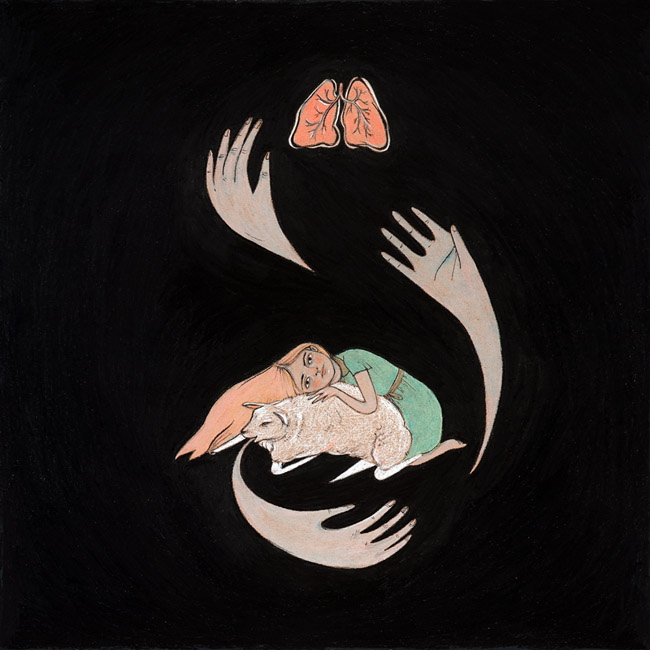
Yin and Yang. Which is the dark half? I find the emotions that most of us suppress to be the most interesting. Everyone can put on a shitty smile and act happy all the time, but that’s not real. Worst of it all, social media is a non-stop barrage of inspirational quotes, “life is great”, and fake positivity. You want to convince me your life is fantastic? Don’t tell me about it. Otherwise you’re just one of the rest of us, filling a giant hole with anything you can. The truth is, I am not a happy person all the time. I’m not depressed and shitty all the time either. I’m a mix, as it probably ought to be. Life needs to be a good balance, not some one-way Prozac induced trip. Well maybe it is for some people, but we all need to deal with our other half at some point.
Shrines, the debut album from Montreal’s Purity Ring, is a dive into the other side of human nature told via electronic synths from Corin Roddick and pristine vocals from Megan James. The duo’s uniqueness lies in their style, or better yet, their atmosphere. Whereas Tanlines brought about the early favorite electronic album of 2012 with their upbeat synths and positive vibes, Purity Ring combine morose, morbid lyrics and thunderous synth beats together to weave a world of a fairy tale gone wrong. And I mean that in the most congratulatory way possible because Megan and Corin have crafted one of my favorite electronic albums of all time. This isn’t just a band introducing themselves to the world. This is running straight through that door.
Shrines begins with “Crawlersout”, a fitting introduction to the experience of Shrines in that it’s about darkness, or nightmarish evil, taking over. When your first song on your debut album ends “they’ll sew their own hands into their beds to keep them crawlersout”, I’m officially interested. And after that introduction, “Fineshrine” takes it to a new level. In fact, I’m willing to go out and call this the jam of the summer. A hot beat full of emotion and feeling, it necessitates volume.
“Ungirthed” follows and begins with a drippy beat and more dark poetry. Images of “teeth clicking” and “drying bones” fill an otherwise somewhat happy mood. But perhaps the most interesting track on the record is the longest one, entitled “Grandloves”. An R&B jam with a slow moving, heavy synth that stretches out the beat, it’s a duet that brings a certain dark sexiness to the album. It’s a large song that can be so big that it feels almost overwhelming, until it retreats for a split second with Megan pulling the listener back in with her vocals before spreading out again. It’s like watching the universe be created in under five minutes.
The second half of the album features previously released favorites “Obedear”, “Lofticries” and “Belispeak” which I’ve previously covered as they were released. In total, I will freely admit that this album likely won’t be loved by everyone. Focusing on the ugliness of the human spirit amid electronic beats isn’t in the general public’s wheelhouse. But for those willing, you’ll get back more than you bargained for.
Connect with Purity Ring via Facebook | Twitter
Written by Greg Dahman
Album Review: Sonny and the Sunsets ‘Longtime Companion’
It’s early evening and you’re bellied up to the bar at your favorite watering hole, The Longtime Companion. You like this place for its general state of disrepair that, in a certain light, could be mistaken for nostalgia. A layer of dust, about the thickness of a dime, appears to cover every inch of the dimly lit bar, giving the place a kind of yellowish glow.
The jukebox spins old 45s of 1950s country ballads. Every track features a warbling lap steel. This type of music suits the patrons of The Longtime Companion. The crowd is older and entirely male; everyone looks to be some variation of the narrator from The Big Lebowski. Men with leathery hands and dust-worn smiles that carve furrows in their weathered cheeks. Urban cowboys trading singles, with a silent seriousness, over racks of nine-ball.
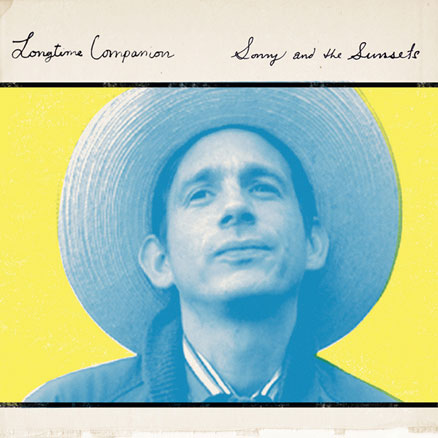
In the background, you hear the soft, bouncing slap of an acoustic guitar followed by an eerie, springing pluck of the lap steel. The first few notes of Hank Williams’ “Ramblin’ Man” waft across the bar like the smoke of too many cigarettes. Just then, the entrance to the saloon creeps open, casting a flood of golden light across the room. Through the doorway, only the outline of a man wearing a straw hat is visible. After the door shuts, a slender man, looking to be in his early 40s, comes into focus. He strolls past the pool tables and sets his hat on the bar, occupying the stool next to yours. As introduction, you offer the man a knowing nod and return your focus to bourbon and Hank Williams.
“Don’t know if I’ve seen you around these parts before,” you say, extending a handshake to your new drinking companion.
“Name’s Sonny,” he says.
“You live near here?”
“Not too far,” Sonny says, signaling the bartender for another whiskey. “I live just outside of town in a small spot on the beach.”
“So what’s your story?” you ask.
Sonny offers a half-smile and squinted eyes that appear fixed on some otherwise invisible horizon. It’s more of a wince than a grin. “You don’t want to hear my story,” he says. “It’s a bummer.”
“I like train wrecks,” you say. “Try me.”
***
On his new record Longtime Companion, we find Sonny Smith grappling with change, both professional and personal. After a disappointing pair of releases on Fat Possum, Smith has found a new home at Polyvinyl Records. He is also fresh off the break-up of his marriage. To tackle these issues, Smith has moved his project, Sonny and the Sunsets, from the Link Wray side of the Bay Area surf rock scene towards a country-infused sound fit for the honky tonk. This is a logical decision, as country music has long served as a platform for the downtrodden and brokenhearted.
Why do we love break-up records? The late rock critic Paul Nelson offered up an explanation in his 1975 review of Neil Young’s post-divorce record Zuma, saying, “Listening to these cancerous, often brilliant albums, one feels like a police reporter or a priest hearing a heartbreaking last confession.” There is certainly merit to this point but I would argue that our interest is more selfish. We don’t seek the confession; we seek understanding. The opportunity to interpret another’s pain so completely allows us to better understand our own feelings when we are forced to endure similar circumstances.
At the crux of this album, lies the title and closing track “Longtime Companion.” It’s here where Smith most effectively blurs the line between the personal and professional. When he sings in the chorus, “I’m going to try to make you love me / I’m going to try to make you care / I’m going to try to make you stay” listeners are left to wonder whether he’s referencing his lost love or his fickle fan base.
The album’s strongest track remains its debut single “Pretend You Love Me,” an acoustic slow roll highlighted by gorgeous flourishes of flute. Smith pleads for the restoration of his marriage, realizing that even feigned love is better than no love at all. “Pretend You Love Me” is as fine a driving song as any in recent memory.
There are times when I wish Smith would wrangle with his feelings less directly. The bitterness and helplessness of tracks like “I See the Void” and “My Mind Messed Up” can be draining. The beauty of an album like Zuma lies in Young’s ability to make a song about Spanish conquistadors double as a discussion on the theft of innocence as he does on “Cortez the Killer.” With the exception of the symbolism found on the Johnny Cash-like foot-stomper “Year of the Cock,” Smith deals with his hard times head on, without filter. Does Longtime Companion rank among the great break-up albums of all time? Maybe not. Is it a captivating account of a man at an emotional crossroads? Most assuredly.
Connect with Sonny and the Sunsets via Facebook | Twitter
Written by Rob Peoni
Album Review: DIIV ‘Oshin’
A close friend recently told me that I was the most impatient person that they had ever met. As I searched for a rebuttal, I slowly came to grips with the new infamous title. I wanted to flip this perception immediately; however, I understood this was going to be a work in progress. After attempting to master the deep breath, battling to find an adult bedtime, and lowering my caffeine intake to a reasonable level, I begin to find regular calmness. Like most instances I turn to music and try to find ways to connect the dots. While I continue to look for areas of enhancement, I immediately dial in on a certain absentminded, musical genre that has completely influenced my train of thought this year. Releases by Beach House, Grimes, and Chairlift have helped relieve my intolerance by providing a powerful ease through the textures and moods that they focus on. Existential in nature, dream-pop has emerged as my elixir to during experiences when calmness does not come quickly. The latest delicate disposition is DIIV’s debut release Oshin. After several spins I have found an additional record to lean on to help me keep track of my tranquility.
Zachary Cole Smith may not be household name amongst independent music circles, but I begin to classify his work among the top tier of mood changing guitarists in my rotation. When I put on Beach Fossils’ EP, What a Pleasure last year I quickly realized that Smith was a mood master. Songs like “Calyer” help to showcase Smith’s ability to highlight otherworldly textures through his guitar playing. His style has etched a path in my brain that demands attention while offering an exit to ease. His direction in Beach Fossils provides me with my first dose, while his introspective melodic playing on Oshin helps to proactively numb impatient nerves.
Smith recorded this project in his bedroom with no Internet. The intimacy with these unplugged intentions builds immediate appreciation as I sink into this release. His cracking melodies provide comfort almost effortlessly. Words appear to be subtle whispers throughout this record. The blurry lyrical perspective hides behind the melody, but also endorses many compliments to this dim 13-track release. The embedded, transposition that bassist, Devin Ruben Perez brings to the project is immediately noted in opening instrumental, “(Druun)”. Former Smith Westerns drummer, Colby Hewitt, provides perfect structure around Smith’s childhood friend, Andrew Bailey’s guitar magic. The record serves as a silhouette where each band member’s style helps to blur the line.
DIIV might come across to the listener as comfortable, but I find tracks like “Human” a bit unsettling. This song is true to the foundation of Oshin, but yearns for more with their most aggressive approach. The addition of songs “Sometime” and “Doused” promote Smith’s vision to captivate and build lightly. The insinuating approach that Smith subtly conveys throughout Oshin contentedly challenges the listeners’ experience. Send off, “Home” serves as the perfect lullaby and a last layer to rest my thoughts on. This record’s ambiguity is amplified with each play, while inviting the listener into a comfortable distraction.
The rise in my own personal connection with dream-pop could not have come at a better time. Each new release offers additional mesmerizing textures that display patience. Albums like Oshin are perfect for anyone looking for a change in musical perception and self-reflection. A familiar feeling of uneasiness sets in as I impatiently think about a follow-up only a week after its release…a work in progress.
Connect with DIIV via Facebook | Twitter
Written by Brett McGrath
 Thought on Tracks