


Thought on Tracks Interview: Introducing The Shamefaced Sparrows
“Murder in the Dollhouse”
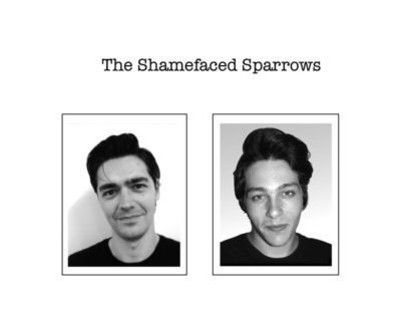
Steve Jarvis and Liam Riley. Steve sings and writes the melodies/lyrics, Liam plays and writes the music. As for the live line-up, in the brief time of The Shamefaced Sparrows’ existence, a small flock of musicians have fled before they could settle the nest…
…we had a bass player, Tyrone, who insisted on calling Liam “Reg Thorpe.” We still don’t know why. We played him our track “The Madison” and he tried to convince us selling it to another band to fund his drug habit was a capital idea. He later stole Liam’s plectrums and we haven’t heard of him since. So Tyrone, if your reading..
We also had a drummer who left the band before we had even rehearsed. Twice. She was so insecure about her drumming, she refused to even play in front of us. If you’re looking for a drummer, a paralysing lack of confidence in their own ability is, we can assure you, bottom of the list of criteria.
She would also make ludicrous statements such as ‘Meg White was the real driving force behind The White Stripes’ and ‘Lou Reed would be nothing without Moe Tucker’. Now, we admire – love even – both Meg White and Moe Tucker. However, we can’t help but feel Jack White and Lou Reed would have somehow traversed the staggeringly deep abyss of absent rudimentary drumming, and continued to fashion a semi-decent music career anyway.
Then there was Madame Lagrange, our former rhythm guitarist. But that’s a story with too many chapters for now.
We’re not even sure exactly how to work the recorder efficiently. All we can say with even a morsel of assurance is that the red button means record.
We used to share a shoe-box sized rehearsal room in Bethnal Green with another band. They borrowed a guitar from Liam – a vintage ’63 Gretch – and they broke it, snapped the neck clean off. Of course, they promised to pay up. And, of course, the payment never came. A friend of a friend knew the culprits and informed us of where they were now rehearsing. We found the place, doors-ajar, and commandeered the recorder and a guitar whilst our girlfriends played the (scantily-clad) diversion. The perfect swindle or barefaced thievery?
So – we’ve never had any instructions for it. And it’s never forgiven us.
And then, more than a decade later, we did.
Exact dates are hard to pinpoint. Mostly, we spent our time wandering fields, climbing trees and sleeping under hedgerows, discussing the music we would make if only we’d stop wandering fields, climbing trees and sleeping under hedgerows. The greater part of our time is still spent on those activities. In fact, all of our songs concern some grassland escapade or other. But when the weather will not permit us to venture outdoors, we make music. The three Soundcloud tracks are the first three songs we ever wrote.
In the last few months, we have had interest from A & R, labels, managers, blogs and the like…but the strongest interest in us would surely be that of Magda The Kings Cross Ballerina. Magda seems to think sending us one incoherent lipstick-written letter a week is a reasonable route of seduction. She also discovered that we are rather keen on wild flowers – so she sent us a home-made bouquet of Daffodils, Foxgloves and Daisies with random petals painted black with nail varnish. A unique gesture if nothing else – after all, how often does romance and downright horror entwine?
For her sake, can we state in print, that we have officially turned down her offer to nail a dead sparrow to Liam’s front door.
Our yearning was not easily surrendered though. Such was our desire, we made a promise that when one of us turned 16, the other would dress like Miss Wallace – white blouse, short black bob, general air of unattainable cool – whilst doing a sensual dance to ‘Son of a Preacher Man’. We would lower the lights until ”Mia” passably resembled Mia. However, this meant dimming the lights so low that we ended up sat on a couch in a darkness thicker than pitch, eating party sausages and listening to Dusty Springfield
These shenanigans did result in some tangible benefit though. Tarantino’s flick-knife surf soundtrack became ingrained in us. But for a while we assumed Link Wray was like most surf rock artists in that their oeuvre was limited to a handful of outstanding tracks.
But then, in pursuing another of our-semi obsessions, namely the new wave films of Jean-Luc Goddard, we discovered Link’s track “Jack The Ripper.” We had inexplicably thus far missed that song until discovering it on the soundtrack of the American remake of Goddard’s A Bout De Souffle. This led to immediate acquisitions of The Original Rumble, Mr Guitar and the Missing Link volumes.
Then there is Femaleband. They sound like 4am.
Keel Her – she sounds like the sort of person that springs out of bed at 6am, jolly as a bean. But not in an annoying way, rather in a way that brings you steaming gourmet coffee, bakery-fresh croissants and a morning blow-job.
Blood Music sound like they sit in a plush Hackney loft apartment endlessly debating avant-garde European composers and the diacritic writings of Joris Karl Huysmans. And then, when even they are repulsed by the content of their own po-faced conversations, they casually knock of brilliance like Unending Blues
Our favourite new bands though are American and must be mentioned. Habibi‘s four demos are the Shangri-Las if they weren’t a seminal 60’s girl group, but instead a buried treasure on a Girls in the Garage compilation. Even the great Ellie Greenwich would have surely swooned.
And Hunters’ Hands On Fire EP is about to be played until we both cry blood.
Anything to add?
* You won’t have heard of it – you’ll never need to.
Interview by Rob Peoni
Thought on Tracks Interview: The Bright Light Social Hour
Austin, Texas based band The Bright Light Social Hour, who recently played at MidPoint Music Festival 2011, will be returning to Cincinnati for a show at the MOTR Pub next Thursday, January 12th. The band had a momentous rise in 2011 highlighted by touring in support of their self-titled LP, which was recognized with six Austin Music Awards at SXSW 2011. The band is composed of Curtis Roush (guitar/vocals), Jack O’Brien (bass/vocals/moustache connoisseur), A.J. Vincent (keyboards/vocals), and Joseph Mirasole (drums) and recently took the time to answer some questions from our team here at Thought on Tracks. So please enjoy getting a glimpse into a band that is sure to follow up their success in 2011 with an even bigger 2012. The show at the MOTR Pub next Thursday night is FREE, so get off that couch and start your own personal 2012 concert year off right!
First off, congratulations on your self-titled LP and the recognition it received at SXSW 2011 winning Band of the Year, Album of the Year, and Song of the Year for “Detroit”. When I listen to it I hear everything from Southern Rock to funk to psychedelic rock. How would you describe your sound to someone who has never heard you?
I guess we’d say southern psychedelic rock? It’s got some soul and deep-funk and hard dance too.
What acts did you (and the band) listen to growing up that have influenced your current sound? For instance, I hear some of The Doors with the organ in “Bare Hands Bare Feet”. Am I right on that or just a coincidence?
Zeppelin, Daft Punk, Sly & The Family Stone, Slayer, Pink Floyd. Yup, that’s a 60’s Farfisa combo organ similar to the ones Ray Manzarek often played.
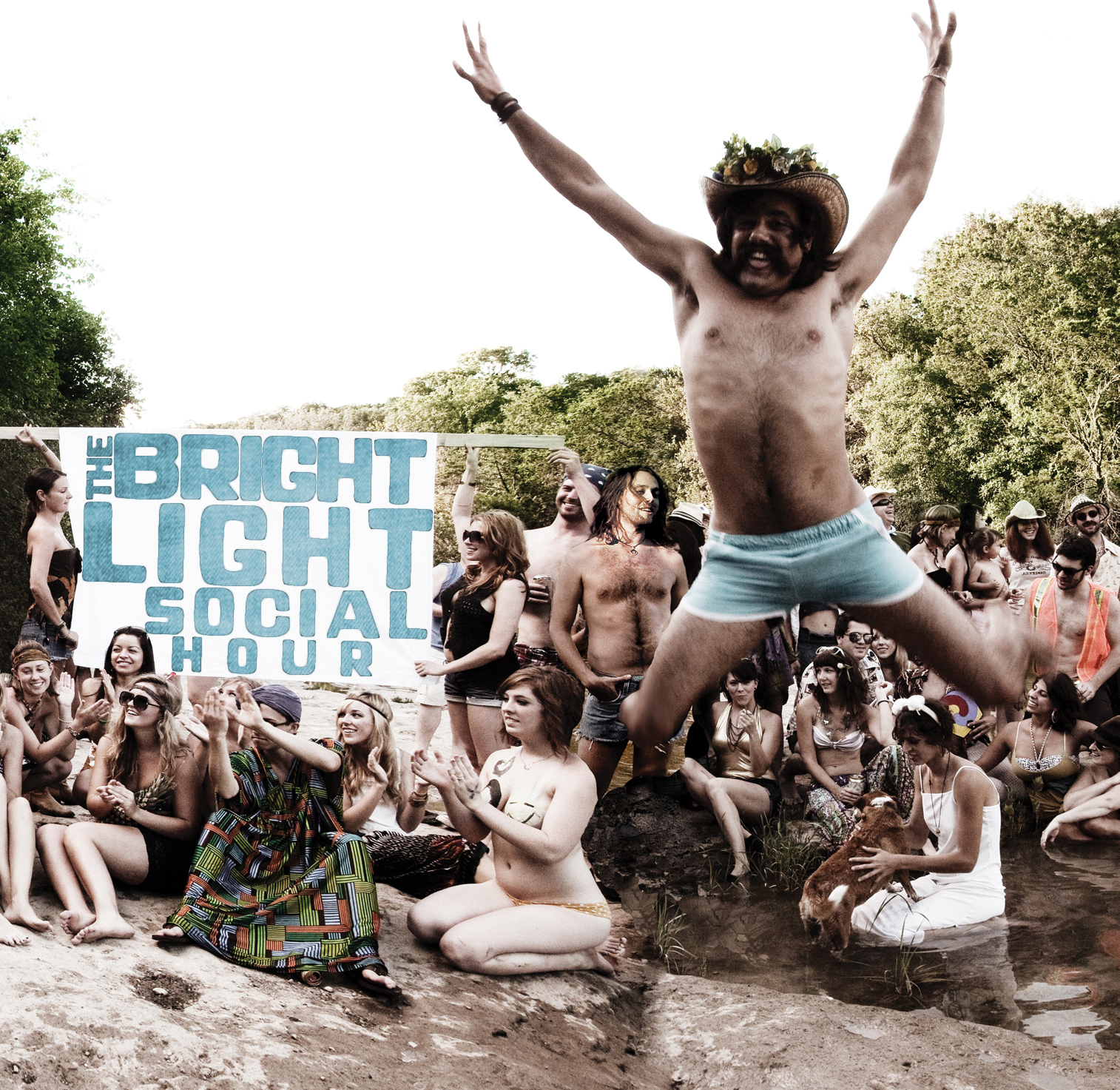
When I first got the album, the first thing that really stuck out to me was the cover art. Can you give us the back-story here? Because it’s absolutely ridiculous and fantastic in every way.
Curt and the art director independently had the idea of creating a sort of rock ‘n’ roll utopia scene, so we invited a bunch of friends out to the Greenbelt in Austin, told them to wear whatever and bring dogs and music and beer and whatever they felt like. The photographer and director would have us move around, but mainly everyone was just gettin down by the water and we later put together all the best shots for the album.
Can you go into the process the band takes when making music, specifically, the self-titled LP? Do you play together when you write music and build off each other or separately? How are the lyrics written?
A lot of the songs were born out of baby ideas for drum parts, riffs or vocal lines that we would then jam on extensively. When we’d find a feel that excited us, development would turn for that direction, and the process would gradually move from one of improvisation to one of refinement. Almost everything is written with the four of us in the room, every detail requiring approval from the entire group. One of us will bring in lyric concepts and ideas with the others giving input until we have something that fits the song.
What’s it like to be a band on the road and the inter-band dynamic along the way?
Man, that’s a huge question. It’s been a blast so far, but I think this latest tour video we threw together can answer a lot better than I can:
What is the Texas music scene like and your band’s place in it? Had you asked me 5 years ago I would have said cowboys, rodeos, and country music, but with other rock acts such as White Denim getting more attention and notable festivals like Fun Fun Fun Fest and SXSW, it seems that the music scene is thriving as much as, and if not more, than Brooklyn.
There’ve been incredible acts of all types coming out of Texas for a long time. The Austin scene is crowded but prolific, healthy, and very supportive of its musicians. It’s hard to say what our place is because the scene is constantly growing and changing, but we’re really lucky to be rooted in such a supportive and enthusiastic music community that is happy to help us grow.
When will you begin work on your next album and how would you like to see your sound evolve going forward?
We’ve been working hard on new material for the next record, but it’s still a ways off. We try to have no preconceived ideas of what the music should sound like. We do our best to guide the songs in the way that feels right, but ultimately they are their own creatures. So far what we’ve got is a bit darker and and thicker, we’re very into it.
And the last, and certainly most important question. Which wins in a cage fight and why: Jack’s moustache or Local Natives front man Taylor Rice’s one?
Hmm. I bet they could talk it out.
Connect with The Bright Light Social Hour via Twitter | Facebook | Website
Interview by Greg Dahman
 Thought on Tracks
Interview: Henri-Pierre Noel
Since Columbus hit the shores of Haiti en route to the Americas, the island has spent the better part of the last five centuries being repeatedly conquered and occupied by a revolving door of European colonizers. Along with an influx of disease, these rulers brought their various cultural influences and a steady stream of slaves to pillage the country’s vast natural resources. These imports served to create a volatile political climate and one helluva cultural melting pot.
Last week, UK label Wah Wah 45s reissued Piano, the 1979 self-released LP from Hatian pianist Henri-Pierre Noel. Piano serves less as an exploration of Haiti’s individual cultural parts and more of a synthesis of all that had come before. Piano is the boiled down reduction with splashes of disco, funk and other contemporary African-American musical influences.
Noel’s playing style is relentless. He glides over the keyboard at a break-neck speed. If there is a thread that binds Piano’s eight tracks, it is their undeniable danceability. Though I’m unfamiliar with popular live music of late 1970s Haiti, if I had to hazard a guess I would assume that if you weren’t moving the crowd, you weren’t getting gigs. We can safely assume that Noel had listeners’ hips swaying.
Noel has since moved to Canada where he continues to perform. Until last week, Piano has been left to reside in obscurity on the shelves of the few lucky souls to have nabbed the LP at an early 80s performance or Hatian record store. Fortunately for us all, the album has found new life thanks to Wah Wah 45s and the remastering work of Kevin Moonstarr. In honor of the album’s reissue, we asked Noel to sit down and answer a few questions.
Interview
Salut et félicitations!
I just want to start by congratulating you on the reissue of Piano. It must be a tremendous feeling to have this work find new life with a new generation. How did the process of releasing the reissue begin?
To make a long history short, it all start with DJ Kobal. When he discovered Piano, he liked it. He met, by chance, a member of my family living in Brussels who gave him my phone number. So DJ Kobal made the contact between me and Dom Servini [of Wah-Wah 45s]. That’s the way everything started.
How much involvement did you have in the re-mastering process with Kevin Moonstarr?
I was deeply involved. Kevin asked for my feedback at every step of the mix. In fact, I did not have much to say, because he was obviously going to the right direction. The guy is competent and has a nice personality.
Obviously there is the addition of the vocal track on “Merci Bon Dieu”, but what else has changed since the original pressing?
Not much. We tried not to change too drastically from the original arrangement. Besides adding some maracas in “Cogaxa” and the voice of “Merci Bon Dieu”, the instrumentation remained the same. Of course, it’s a different mix, Kevin did a amazing job.
Piano was originally self-released, correct? How common were independent pressings in Haiti in the 1970s?
I don’t think independent pressings were common at that time in Haiti. It was rather rare. The product would have been impossible to distribute. There was no other way to sale a record than the music stores, even locally. Nowadays, one can make self-distribution, by selling this record through different events.
Do you remember your goals for Piano at the time of the original recording? What did you set out to achieve, in terms of a sound, with this release?
My goal was to immortalize some traditional folkloric songs of Haiti. To me, they deserved to be known. I’m very happy that those songs have a new life. I would like the future generations to recognize them. If that happens, my mission will be accomplished.
What makes Piano distinctively Haitian? Or do you think this album could have been created anywhere?
I don’t think so. Most of the songs are traditional folkloric of Haiti. The conga by his sound, is heavily Haitian. The piano now: I don’t think a pianist who has not been exposed to the Haitian folklore music and culture could have interpret these songs that way.
In the decades since its release, Piano has developed a kind of cult following or folklore status. Could you try to explain why this album remains important and relevant to so many musicians?
That was the first time, in my knowledge, that a Haitian musician has made a link between the Haitian folklore and the Afro-American rhythms (Blues, rhythm & blues and funky). It looks like this marriage was successful!!! 🙂
How has your style evolved in the decades since Piano was originally released?
As a musician, I’m more versatile! More versatile in my interpretations and in my compositions. As a pianist, I give more independence and more room to my left hand, that gives a better rhythmic support to the whole song.
I would imagine that your playing style requires a tremendous amount of energy. It’s kind of propulsive and relentless. I know you continue to perform. How do you stay in shape?
Big question! I think the love of music does it all. The music take me to a world where the word “fatigue” does not exist.
How often have you returned to Haiti since moving to Montreal? Have you been back since the earthquake in 2010? Please describe your current relationship with your native country.
Not very often. I used to go often, but not anymore. Even though I don’t go there as often as I would like, Haiti remains for me the ”alma mater”.
Is there anything you would like to add?
I would like to thank the people who have made this reissue of Piano a beautiful experience. I had a feeling to be surrounded by a wonderful team of friends willing to make of that experience, a great event. Those persons are named: Dom Servini from WahWah45s, Andy Williams, Kevin Moonstar, and the last but not least Jerome Decis (DJ Kobal).
Written by Rob Peoni