


The Winning Pitch: Preview of ArtPrize Pitch Night 2015
Editor’s Note: This story was originally published on defunct, Central Indiana arts website Sky Blue Window on May 12, 2015. Some formatting, content and style changes may differ from the original version.
One of the Midwest’s largest arts events is partnering with Indianapolis Museum of Art to create a substantial opportunity for Hoosier artists.
ArtPrize is an annual event held over 19 days in Grand Rapids, Michigan. Throughout the event, installations fill the city from museums and galleries to restaurants, banks and city parks. During the exhibition, the public votes to select the grand prize winner. Artists also compete for a juried grand prize worth $200,000 and four $12,500 juried category prizes. The panel of judges consists of world-renowned art experts.
 On June 10, the IMA will host Pitch Night, an ambitious new event that will fund an ambitious project by an Indiana artist for a prominent ArtPrize venue. Five artists will be selected to give a five-minute presentation using five slides each. A selection panel of experts along with the audience will be able to ask questions following the presentations. The winner will receive $5,000 to create an exhibit within a 3,500-square-foot office space in downtown Grand Rapids.
The first Pitch Night was developed at the Walker Art Center in Minneapolis with Scott Stulen, who now serves at the IMA as curator of audience experience and performance. Stulen offered the IMA and Indy as a potential expansion site for the event. ArtPrize officials agreed, and now the Circle City is included, along with Minneapolis and Durham, North Carolina.
“IMA’s mission is to support the creative, innovative and exciting works of art and the local and regional artists,” Stulen says. “Pitch Night does both in a very inventive way.”
Last year Indianapolis mixed-media artist Anila Agha ushered in a historic victory at ArtPrize, winning the $200,000 public vote and $100,000 of the juried prize. For more on Agha’s work in the competition, take a look at this Sky Blue Window piece: Memory & Meaning Cubed.

Courtesy of Anila Agha
“Anila’s win last year was huge, not only for Indiana, but for ArtPrize,” Stulen says. “Anila achieved something that few thought possible — winning both the critics’ and the public vote,” he says. “It means that the public is being exposed to more contemporary art, learning more and that artists are understanding the unique venue of ArtPrize. More specifically, Anila’s win has highlighted the art scene in Indianapolis outside Indiana and will hopefully help to attract more attention for other talented artists in the state.”
Agha will serve on the panel at Pitch Night. Other panelists include: Stulen, Sarah Urist Green, host of The Art Assignment, Mindy Taylor Ross, owner of Art Strategies, and Roseanne Winings, assistant curator of audience engagement and performance at the IMA.
Artists interested in applying must do so by the May 26 deadline. Pitch Night Indianapolis is limited to those currently living within Indiana. Artists must submit a proposal, an artist CV and up to five images all by email to pitchnight@artprize.org. Additional details on the application process are available via ArtPrize. Pitch Night will take place in the Toby Theater on June 10. The event is free.
Written by Rob Peoni
Interview: Pokey LaFarge chats
Editor’s Note: This story was originally published on defunct, Central Indiana arts website Sky Blue Window on May 15, 2015. Some formatting, content and style changes differ from the original version.
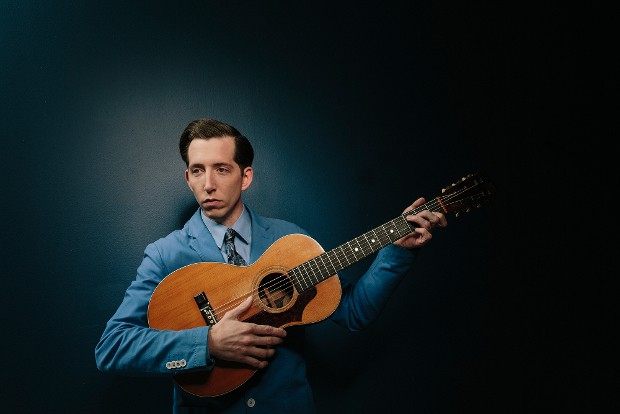
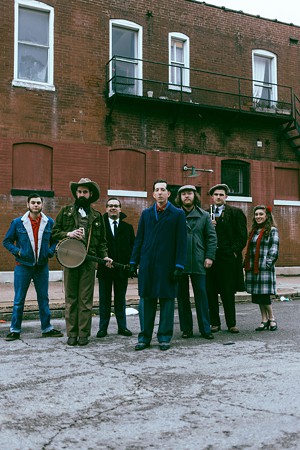
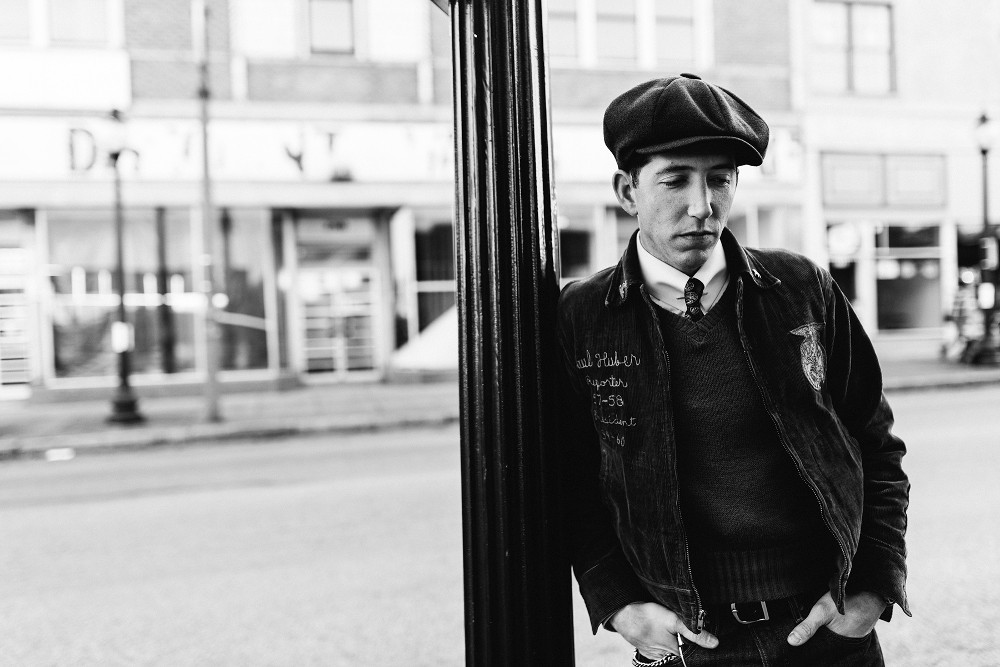
St. Louis songwriter and Illinois native Pokey LaFarge will take the stage at The Vogue Saturday to promote his latest album Something in the Water. With seven albums under his belt, the gifted musician, born as Andrew Heissler, has established a loyal following through his ability to amble admirably across the landscape of early American music: ragtime, jazz, pre-war blues, traditional country and more.
As LaFarge crosses genres and timeframes with ease, his old-timey sound and lyrics remain rooted in the Midwest. “My Hoosier girl so fine / shake the watermelon off the vine / She’ll blow you a fist / blow you a kiss / and you’ll thank her every time,” LaFarge sings on the title track of his new record.
We caught up with him on the phone this week ahead of his show to talk about his influences, which include Indy blues greats Leroy Carr and Scrapper Blackwell, his new album and his plans for the future. Watch the video for Something in the Water and then grab tickets to tomorrow night’s show via The Vogue.
\\
SBW: Your music contains such a patchwork of influences from all of America. You have traveled extensively. Yet you’re a Midwestern guy. Can you talk about any sense of place in your songs that’s more specific than America itself?
Pokey LaFarge: Well, I don’t know if you heard the last track [Knocking the Dust off the Rust Belt] on the album. That’s pretty regionally specific. Goodbye Barcelona I would say it’s not American there. So yeah, I don’t know, I think there’s world experience that’s made its way into my tunes.
Also, it’s like the context that both plays with each other, the compare and contrasting all the places that we go to. It’s sort of a mish-mash in your mind. You like to think that you know what some things are about and so you, maybe even for the sake of a song, will take an idea that you have about a place, a feeling, a people and an experience and write a tune about it.
Courtesy of Pokey LaFarge
SBW: You worked with Jimmy Sutton on your new album. How’d you come to work with Jimmy and how’d he put his stamp on this LP?
PL: Jimmy is a well-known figure in music, especially on the underground rockabilly and early rock n’ roll, blues music scene. Obviously, he’s had his most recent acclaim with playing bass with JD McPherson. From a producer role, he produced JD’s last album Signs and Signifiers, which has done really well for him. Working with Jimmy, knowing his catalog over the years and him as a person, I knew that he would be a perfect fit. We got together and started talking, eventually pre-production stuff, I just knew that we were hitting it off and we were gonna do well together. He’s got a good style. He’s got his own style. He brings it, and I think you can hear that through the record for sure. He’s also easy to work with, and helps you go through the process, which, of course, is important.
SBW: Your latest album was released on Rounder. Why the switch from Third Man Records this time?
PL: Rounder was interested in me being a part of a new identity with them. Obviously, them signing JD [McPherson] was a part of that as well. Trying to take blues music into the future. I felt respect for that, and obviously there were some business dealings in there that were favorable as well. It just seemed like a good fit.
Courtesy of Pokey LaFarge
SBW: I caught your recent interview with Terry Gross on Fresh Air. You played a song by an Indianapolis musician, Leroy Carr, for her. I was wondering how you came to know his music and why it spoke to you?
PL: Yeah, Leroy Carr and Scrapper Blackwell — his guitar player. Well, you know, just the same way I found a lot of music. You look at a record, or a CD, or a tape, or even a YouTube video, and you look at the next thing. You look at the discography. You look at the label or what the YouTube thing suggests, right? And I write things down into notebooks as I always do, and you dig it up. So, that’s simply how that happened. The specific labels I would listen to, and I would dig through in-depth as a youngster was Yazoo Records and Document Records specifically. They re-mastered and reissued hundreds and hundreds of titles from the pre-war era.
SBW: You’re an artist who wears his influences on his sleeve. When did you began to feel confident enough to feel you could offer something unique to such established, traditional forms?
PL: When did I feel confident in it? I don’t know, I think I’m still gaining confidence. I think that confidence is something that wanes. It’s something that increases. You try not to let it brim over. You try to keep it in check. I certainly have more of it now than I had before. I didn’t really think of it from a confidence standpoint. I just thought of it from you do what feels good. You listen to music that makes you feel good. You make music that makes you feel good. You sing what makes you feel good. You write what makes you feel good. As you get older you challenge yourself, and there’s a lot more things in your brain that it’s kind of harder to get to some of the things that just simply feel good. There’s a higher bar set now for what is good and what is not, in my mind. So, I’m writing even more now, but I’m releasing and performing less. There’s a lot of stuff that ends up under the table out of experimentation.
SBW: Your live shows are notorious for a lot of dancing. How has your audience’s appetite for kicking up their heels shaped your songwriting?
PL: I guess, unless when you play in Cleveland. If the youngsters come out, it will be a rowdy time. We’re very honored that we have a somewhat accessible music that transcends the age groups. So, we’ll get a decent amount of older people that I wouldn’t say are so much into making noise and dancing – quite the contrary really. We want to make sure that people can come to the show and express themselves. So, we would want to stress that no one can tell anyone else in the crowd to be quiet and stop dancing.
SBW: You’re heading to Europe for a couple of weeks following your U.S. shows. Have you toured in Europe extensively in the past?
PL: We have. We actually do better in Europe than we do in the states.
Courtesy of Pokey LaFarge
SBW: Can you tell us about the difference between audiences overseas versus back home in the states.
PL: I don’t know, I think that they, perhaps, appreciate the classic sound. I think that they appreciate the refinements in the form, more so than Americans do who are more often than not trying to chase a fad. I think it has to do with the wealth of music we have over here. Not saying that Europe doesn’t, but I don’t know that Europeans think about forms in the same way that we do. They don’t attach the same sort of buzzwords to it. Their stimulus, it’s not hindered really. Again, they just do what feels good.
SBW: What’s next for Pokey LaFarge?
PL: Well, thank you for asking. I know that it will be a pretty busy touring year, all the way through the spring of next year. In August, I look forward to the opportunity to get into the studio and see what a few months of steady writing will bring to me in the studio and maybe do some demos.
SBW: Anything to add?
PL: I will just say that we’re definitely coming to Indiana in support for equal rights. For people to practice whatever religion that they want to, and sleep with whoever they want to and marry whoever they want to, and to not let people’s use a fictional guy in the sky to defend their own ignorance or their intolerance. We’re just happy to come to Indianapolis as always. We love Indiana, and we’re happy to play for the good folks there. It’s gonna be a great time, and I thank you for taking the time.
Written by Rob Peoni
Jonathan McAfee’s last hurrah
Editor’s Note: This story was originally published on defunct, Central Indiana arts website Sky Blue Window on July 7, 2015. Some formatting and style changes were made since the original publication.
Jonathan McAfee made a big splash last summer with his What People Like About Me Is Indianapolis exhibit at Kurt Vonnegut Memorial Library. The show featured 15 portraits of Indy’s most famous author. Half of the paintings sold during the exhibit’s opening reception, and the rest sold within a couple of months afterward.
“I had painted him a few times, and people would buy him. He’s got a great look to him. He looks like a cartoon,” McAfee says. “Indianapolis, in general, is just really all for Vonnegut. They just really like Kurt.”
The success of his Vonnegut exhibit — his first sold-out show — gave McAfee the confidence to quit his job in PR at Bohlsen Group. So in January he began to pursue painting full-time. He believes the work he’s producing now is the best of his career, as he focuses full attention on furthering his style and technique.
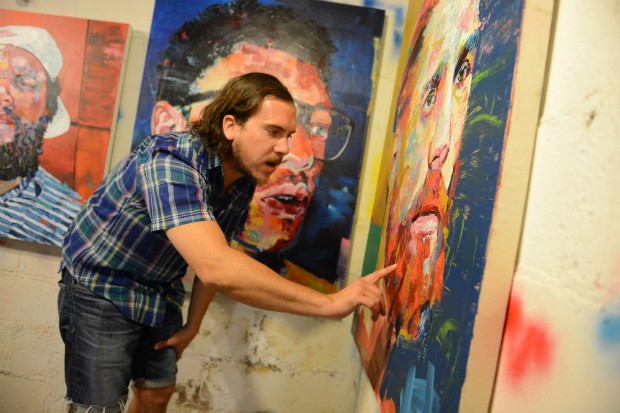
Photo by Matt Beuoy
“I’m taking way more time on my pieces,” he says. “I still paint pretty quickly, but I won’t say a painting is done now until I am 100 percent happy with it. Before, I would not wait until the last minute, but I’d book a lot of deadlines and have to get things done. I wouldn’t give it the same attention that I’m giving things now.”
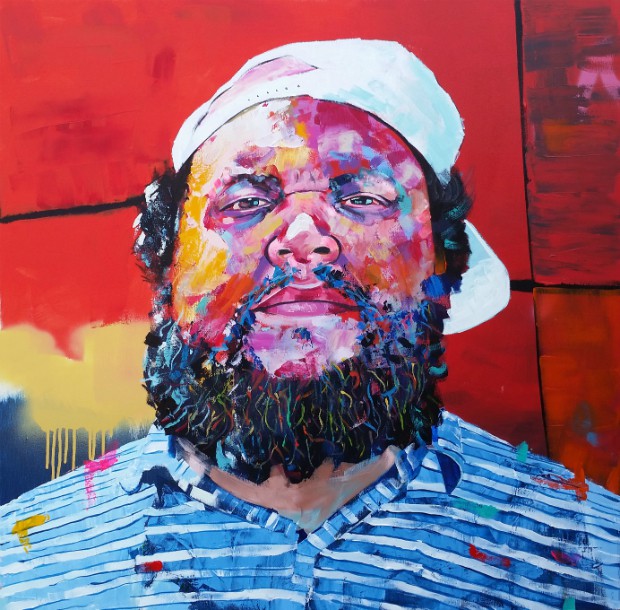
On Friday, McAfee will debut 16 new paintings in a show at 3 Mass Gallery for Emerging Artists. The show will feature four portraits of local hip-hop musicians Oreo Jones, Sirius Blvck, John Stamps and Grey Granite. The idea came to McAfee as a cross-promotion of Chreece – a hip-hop festival in Fountain Square that Jones is organizing as a benefit for Indiana music archive and nonprofit Musical Family Tree.
“I had painted a bunch of different celebrities and icons over the years,” McAfee says. “I had grown pretty tired of doing that. I didn’t feel like I was getting to the spot where I was growing as an artist. I still enjoy painting people, and I had been interested in what these guys have been doing locally. I just feel like they have a really neat aesthetic going on. I like their style; I like their music.”
McAfee often listens to hip-hop music while painting in his home studio near Garfield Park. He prefers to paint along with music that has a strong backing beat. He says the music occasionally bleeds into the color choices in his work. “When I hear music, I see colors,” he says. “I don’t know if that’s influenced by the album art itself, but, typically, whatever I’m listening to I focus on those colors because of the album or maybe a music video associated with it.”
Beyond the appeal of McAfee’s new subject matter, Friday’s show is significant, because it will be his last solo exhibition as an Indianapolis resident. McAfee will move to Denver with his wife at the end of the summer. “I feel like I need a change,” he says. “I’ve grown complacent over the last several months to where I need to go somewhere and start fresh, make new contacts. It’s scary, because I don’t know anybody out there really.”
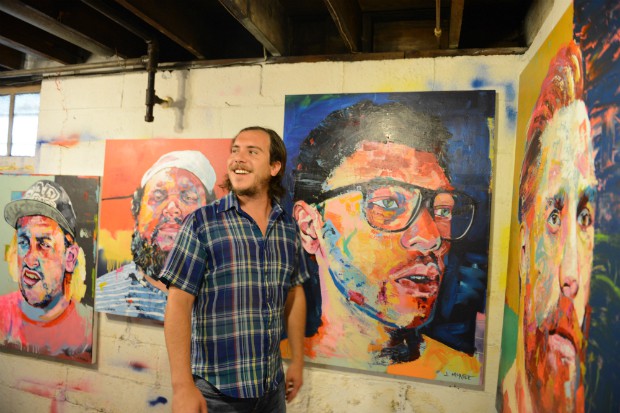
Photo by Matt Beuoy
McAfee and his wife chose Denver after falling in love with the city during a visit in March. His wife has a background in parks and recreation management, and the couple was looking for a city with more outdoor amenities. While visiting Denver, they stopped in a gallery at the suggestion of friends. McAfee introduced himself to the gallery’s curator, and told her he was a painter from Indianapolis who was considering a move. Much to his surprise, the girl enthusiastically confessed to being an Indy ex-pat. McAfee showed her a few postcards featuring some of his work, and that’s when things got really weird.
“I showed her the postcards and she looked at it for a second and she goes over to her computer and says, ‘Is this you?'” McAfee recalls. “I look at it, and it’s an image I painted — a portrait of the painter Basquiat. It was hanging at the restaurant Pure in Fountain Square. Her dad, who must still live here, snapped a photo of it, sent it to her and said ‘I think you might be interested in this guy.’ It was really kind of serendipitous, because this was the only gallery that I went into, and she kind of had heard of me in a sense.”
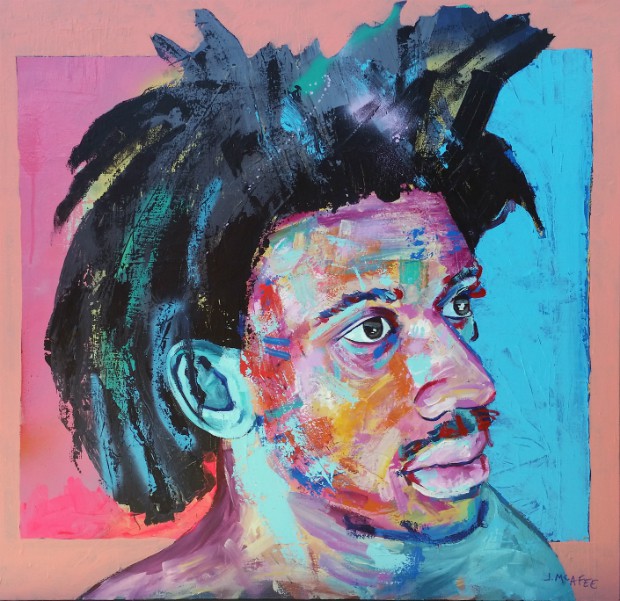
Though McAfee is scared and intimidated at the prospect of starting from scratch in a new city, he’s hoping the move forces him to kick his painting into high gear and work even harder. In the meantime, he is excited about sharing his latest work and celebrating some of Indy’s most talented, up-and-coming rappers. “Maybe I am painting some icons that are in the works right now,” he says. “Contemporary icons. I think they’re going on to do some pretty rad sh_t. Who knows, maybe I’m the first one to paint their portrait?”
Stop by 3 Mass Gallery on Friday (July 10th) at 6 p.m. for McAfee’s exhibit entitled Peace-key Whees-key. The event is free and open to all ages. Or find out more info via Facebook. For more info on Chreece, follow along with updates from the Aug. 29 festival via Facebook and Twitter.
Written by Rob Peoni
 Thought on Tracks