


The Avant-Garde invades Irvington
Editor’s Note: This story was originally published on defunct, Central Indiana arts website Sky Blue Window on November 12, 2014. Some changes to content, style and formatting may differ from the original version.
Nick Ohler is on a lifelong search for the origins of musical innovation. As a former record store owner, on-again, off-again concert promoter, and general music junkie, Ohler’s quest has led him further into the fringe, where he believes pure, unadulterated creativity takes place.
“After you hear so much music, you start to learn that everything is actually a fragment of something else,” Ohler says. “Usually the ensembles or bands that generate that core essence, not always but usually, they’re the ones that don’t make any money at it … So the goal of our group is to take what I think is an innovative core and promote it.”
The group to which Ohler refers above is his concert promotion company Mythopeic Industries. He launched the organization with the intent of becoming a nonprofit a few years ago, before his role as a father and family man took a higher priority. Even though the nonprofit never came to fruition, Ohler’s reputation as a promoter of experimental, avant-garde music occasionally draws him back into booking events.
“I still do one or two things a year,” he says. “Somebody will get ahold of me, and it will be something that I have to do.”
Friday, Ohler’s latest musical experiment will arrive in the form of the Irvington Creative Music+Film Festival. The event will take place at the historic Irving Theater and the performance space at Irvington Vinyl, in the basement of Bookmamas book store. More than a half-dozen musical performances will take place on two stages between screenings of a new documentary on avant-garde, jazz musician Rahsaan Roland Kirk, called The Case of the Three-Sided Dream.
“Irvington is very cool culturally,” says Irvington Vinyl owner Rick Wilkerson. “There’s a lot of good vibes and a lot of people doing interesting things, but there hasn’t really been a music presence.” Wilkerson says that’s what distinguishes this historic neighborhood from Fountain Square.
“[It’s the] same with art. We had the Irvington Guild of Artists disbanded around three years ago,” he says. “I think we’re going to see a big rebound with both of those things as time goes on.”
Ohler, who booked a lot of shows in Fountain Square alongside his friend Matt Chandler prior to that neighborhood solidifying its status as a local music destination, agrees. He thinks “Irvington has changed a lot” since he moved there in 2003. Ohler says he used to spend a lot of time in Fountain Square, but these days Irvington is the place to hang with its additional options for eats and drinks from Black Acre and Jockamo’s Pizza to Legends. “With events going on at The Irving and all that … We’ve got a record store and a bookstore,” he says. “It really kind of reminds me of Fountain Square when Tufty first opened Radio Radio and we were doing shows there.”
In terms of musical curation for the fest, Wilkerson was more than happy to rely on Ohler to do the heavy lifting. Wilkerson recently finished the release of his retrospective Indy compilation, spotlighting local punk and new wave acts from the 1980s. The release was NUVO‘s cover story last week, penned by frequent Sky Blue Window contributor, Seth Johnson.
“I’m just providing the venue, and am happy to do that,” Wilkerson says. “Nick is pretty advanced when it comes to avant-garde music. Although I know a lot about music, I don’t know a lot about that. So, all of those bands will be new to me.”
He says he’s looking forward to the Rahsaan Roland Kirk movie, of course, but as for all the rest, he’s going at them with judgment or set expectations. “It is going to be like, ‘OK. My mind is open; Let’s see,'” he says.
Eastside native and current Irvington resident, David Adamson leapt at the opportunity to perform at the single-day festival. “I pretty much just said yes right away, because it seemed like such a cool event,” Adamson says. “I’m stoked that it’s going on right around the corner from where I’m living.”
As the former front man of Jookabox, Adamson has been making noise across Indianapolis and beyond for years. His current musical pursuits are divided between DMA, which released its album Pheel Phree on Joyful Noise Recordings last year, a Chicago footwork-influenced project called TUFFBLADES, and his most recent instrumental endeavor Sedcairn Archives, which will release its debut LP on local label Warm Ratio at the end of the month. For the set at The Irving, Adamson plans to blend selections from all of his current projects.
Adamson will perform alongside locals Sea Krowns and Lost Cult. Lost Cult is the project of Eric Brown, who runs local label Audio Recon. Sea Krowns features Alix Cain and Tom Burris. Burris is a longtime friend of Ohler’s, dating back to his days running A1 Records in Anderson. Their repertoire runs the gamut from avant-garde to accessible. Listen to a pair of tracks below for an example of the contrast.
“A perfect event for me is a local, regional and a national, because the local act gets to hang out with a regional, and that will usually get them a show in Chicago or Cincinnati or wherever,” Ohler says. “So, a perfect scenario for me is that three-tiered approach, because it really helps everything in general.”
For non-Hoosiers, Ohler tapped two Minnesota musicians who employ homemade instruments to create otherworldly sounds in Paul Metzger and Tim Kaiser, the heavier, guitar-driven sounds of Ohio’s Hyrrokkin and hip-hop/jazz fusion ISWHAT?!. Metzger is known for his unorthodox play on his 23-string banjo. Kaiser built his reputation upon the ambient sounds culled from his vast array of Frankenstein-esque instruments, field recordings and the proverbial kitchen sink. As an introduction, scope a pair of videos on the singular musicians below.
Ohler believes The Irving’s reputation as a welcoming space to experimental musicians through events such as Midwest Electro-Music Experience and its all-ages atmosphere should prove a recipe for success. “There’s something going on at The Irving. I just like the vibe of it,” he says.” For the most part, the folks in Irvington have been fairly supportive. If this is successful, I would be totally down with making it an annual event.”
Whether you’re intrigued or confounded by the lineup Ohler has curated, the improvisational nature of the performers promises an experience that should prove impossible to duplicate. At just $10 (Tickets), the inaugural Irvington Creative Music+Film Festival is an auditory pair of dice worth rolling.
Written by Rob Peoni
Museums Places of Child’s Play?
Editor’s Note: This story was originally published on defunct, Central Indiana arts website Sky Blue Window on November 19, 2014. Some content, style and formatting changes may differ from the original version.
A recent study in the Journal of Early Childhood Literacy created a stir in the museum community. The reaction was spurred by coverage in the press, where attention-grabbing editorial tactics and divisive quotes from prominent artists misrepresented the author’s conclusion as a call to allow children to run free in museums. This reaction comes despite the fact that the museum served solely as the setting of the research, rather than the planned target of its results.
Regardless of the intended audience or reaction, Abigail Hackett’s study Zigging and zooming all over the place: Young Children’s meaning making and movement in the museum has people talking. This is due in part to a shift in museum marketing in recent years, which finds the industry redefining its target audience. “There’s been a huge push for family audiences across the board,” says Elee Wood, Director of IUPUI’s Museum Studies program, “both in terms of catering to the needs of younger children … and trying to think about how to be more responsive to audiences in general.”

Courtesy of Indianapolis Museum of Art
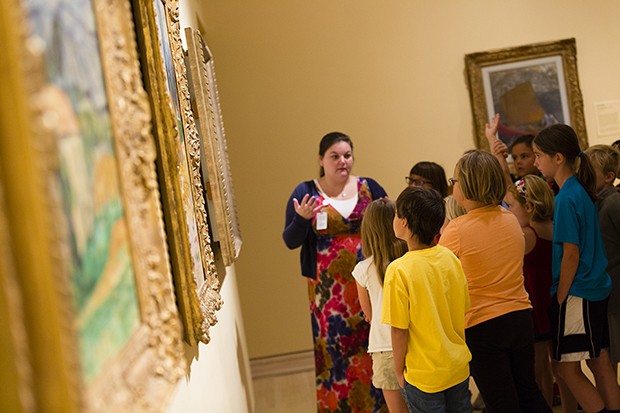
The Indianapolis Museum of Art (IMA) is one such local museum that has embraced the trend of family-oriented offerings. Through Wee Wednesdays, a weekly program targeting the 2- to 4-year-olds group, the IMA combines structured activities with family exploration. The IMA also offers Art Packs, which provides children with artistic quests of varying complexity. Starting in January, the museum will offer a family day on the first Saturday of every month, which will be thematic, both in terms of the seasons and exhibitions.
“The more successful thing is when you create programs for adults that also work for kids,” says Scott Stulen, IMA’s Curator of Audience Experiences and Performances. “What you want is that the parents feel equally engaged as the kids do … but you think about different ways to engage them.”
Kyle Herrington, Director of Exhibitions at the Indianapolis Art Center agrees with Stulen’s philosophy. His approach to programming for younger audiences is less about lowering the bar and more about leveling the playing field. “Everyone who walks through our doors is an artist or an arts patron,” says Herrington. “It doesn’t matter whether you’re 3 years old or 83 years old. So, when I’m giving tours, I’m talking to them like they’re interested in the work, and I find they respond really well to that. I think that if you assume they’re not going to understand art that’s really detrimental.”

Courtesy of Indianapolis Museum of Art
Stulen also warns against the assumption that kids are unable to comprehend highbrow artwork. He talks about an experience at a previous position at another museum, where he asked 6-year-olds to lead tours of one of the more complicated, contemporary art conceptual shows. “Their tours were incredibly accurate, because they don’t have any baggage,” he says. “They’re actually right, because they’re saying what they see in front of them. At times, we assume a lot of things as adults that are not necessarily true about kids.”
In the same way Herrington and Stulen are altering the discourse between art institutions and their patrons, Hackett is attempting to reinterpret the way in which child development experts analyze early forms of communication. “Focusing equally on all modes employed by young children in their communicative practices presents a challenge to the role of spoken and written language, both as the primary means of communication and as the end goal towards which other forms of communication are building,” Hackett writes. “Instead, the emphasis is on understanding the perspectives and viewpoints of the young children who are constructing these complex and creative multimodal practices.”
“Just as play activities have been recognized as a complex and meaningful combination of multiple modes, drawing on creativity, identity, and peer and family relationships to construct communicative signs,” she continues, “walking and running must not be dismissed as the ‘noise’ that happens in between focused engagement and learning in a museum.”
For her part, The Children’s Museum‘s Director of Early Childhood Education, Cathy Southerland agrees, “We [as adults] know that children have different learning styles. There are children that learn through music. There are children that learn through body movement — the kinesthetic sense. There are children that learn through auditory means. There are children that learn visually. There are children that learn through connections with nature.”
The Children’s Museum places an emphasis on family learning, with the belief that a child’s experience will be enriched by the active involvement of a parent or guardian. “Once in the exhibit, we love to see the adult or parent asking those open-ended questions,” says Southerland. “When you see something, how does it make you feel? What do you wonder? What do you want to know? Asking all those questions that elicit language, because we know this is so important for young children.”
Courtesy of Indianapolis Museum of Art
Herrington echoes that sentiment, saying: “When people are taking young kids to cultural institutions, galleries, and places like that, it’s really the role and the job of the guardian to be a cultural steward for that kid to guide them through why these places are important and how we behave in a gallery.”
Wood points out that art museums are faced with the reality of protecting and preserving the, often expensive, works in their galleries. “The problem is that art museums, in particular, having people wildly cavorting through the galleries is not good for the art if something happens,” she says. “Now, that’s only if something happens, but everyone is worried that something will happen.”
For Stulen, it’s a risk he’s willing to accept. “As far as it goes, with worrying about the artwork, adults are 10 times worse than kids,” he says. “They’re so much worse about touching stuff and being a problem than kids are.”
Written by Rob Peoni
 Thought on Tracks