


Review: Nacho Picasso ‘Black Narcissus’
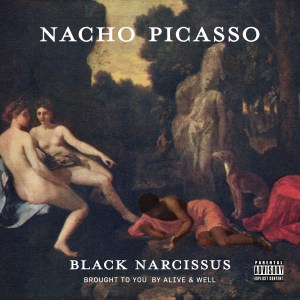
Nacho Picasso hasn’t received nearly the amount of attention that he deserves in 2012. You could say it’s understandable, as it has been the best year for rap music since the early 2000’s and there’s been a lot of worthy artists stealing his shine, but I get the feeling that history will be a lot kinder to Nacho’s recent run than the hip hop hype machine has been to this point. Nacho and his production team Blue Sky Black Death have created their own unique sound in the last couple of years with a trilogy of full length albums that reached a creative high point in Exalted, a fact that that was even more astonishing considering they had just put out Lord of the Fly only a few months earlier.
Nacho’s drive to make each bar better than the next is the key to his success. His subject matter rarely strays from sex, drugs, and obscure pop culture references, but his consistently great writing (especially when it comes to hooks) gives his music a level of depth that’s unmatched by anyone you might consider a peer. His new nine-song mixtape (or “prixtape” as he calls it) Black Narcissus serves a couple different purposes, one to act as a stop gap between Exalted and his next collaborative effort with BSBD, and two to show that he’s capable of holding down a project without BSBD behind the boards.
The production is split between longtime Nacho collaborator Raised by Wolves and newcomer Eric G. While both producers seem to be more or less emulating the spaced out, layered style that has been BSBD’s signature since linking with Nacho Picasso, they do more than hold their own and prove that while Nacho may be a beneficiary of BSBD production, he’s not a product of it. Eric G produced my two favorite songs from the project in “Cover Me In Gold” and “Master Shredder”. “Cover Me In Gold” is an ode to excess and a great way to get familiar with Nacho if you’re unfamiliar to this point. The chorus says it all- “My ego’s enormous, ignore my ignorance/ Cover me in gold till I feel I’m important/ Steal all my fortune, I feel like an orphan…/I’m drugged out in Florence, ignore my performance…/A mean drug assortment with Natalie Portman, cover me in gold till I feel I’m important”. I’m not exactly sure how that chorus reads to someone who hasn’t heard it a hundred times, but I can assure you if you listen to Black Narcissus a few times you’ll be repeating it (and many more memorable Nacho-isms) to anyone willing to listen. Embrace your inner asshole and pick up Black Narcissus from Bandcamp.
Connect with Nacho Picasso via Facebook | Twitter
Written by John Bugbee
Album Review: Sleeping Bag ‘Women of Your Life’
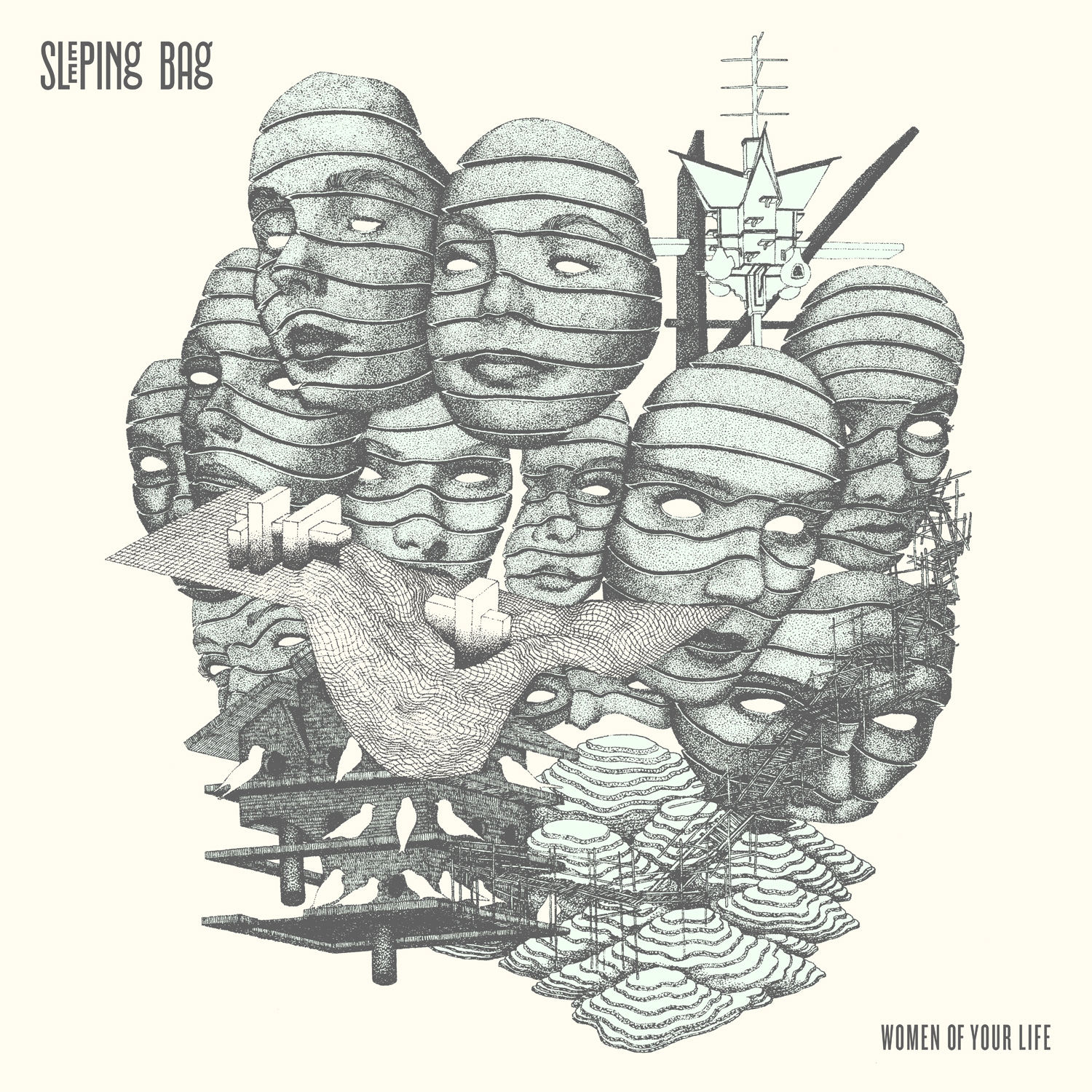
For someone with a natural ability to write straightforward rock songs, Dave Segedy is lacking in confidence. Or, more accurately, he’s lacking in certainty. If you were to waltz into Segedy’s Bloomington home this morning to inform him that he his, in fact, not the lead singer of a band called Sleeping Bag, nor is the band releasing their sophomore LP on Joyful Noise Recordings, the news would likely be met with less an indignant denial and more a calm, “I knew it.”
As a songwriter, Segedy is keenly aware that the facts from which we assimilate our notion of reality are generally up for debate, if not altogether false. The Women of Your Life serve as the lone source of truth or reality in Segedy’s world. The intense white in the corner of their eyes. The heartache of being “rolled over” by the now immortal Allison Cole. If we say farewell to the opposite sex as Segedy commands in the album’s title track, we’re essentially abandoning the only tangible objects available and life becomes a suspicious house of mirrors.
Musically, Sleeping Bag picks up where they left off on last year’s self-titled debut. The band continues to pay homage to the founding fathers of slacker rock. Evan Pearson’s assessment of the band’s sound as “Pavement on Xanax” remains as accurate a description as any. However, Sleeping Bag proves less sedated on Women of Your Life. It’s more dynamic than the debut and offers up a broader breadth of emotion.
Sleeping Bag offers up restrained power pop sensibilities on “Nightmare.” On follow-up “Saturday Night” listeners are reminded that this band began as a drum project when the guitar and bass provide less of a melody than a danceable confluence of polyrhythms. Sleeping Bag has proven they can churn out more than their signature: the beautiful bummer, although this album certainly has its fair share (see: “Still Life”).
Fortunately for listeners, Sleeping Bag is a real band. Women of Your Life is a real record. At least, I think so. I’ll know for sure when my pre-order arrives. Order your copy today from Joyful Noise. Listen to “Saturday Night” below.
Connect with Sleeping Bag via Facebook | Twitter
Written by Rob Peoni
 Thought on Tracks
Interview: Henri-Pierre Noel
Since Columbus hit the shores of Haiti en route to the Americas, the island has spent the better part of the last five centuries being repeatedly conquered and occupied by a revolving door of European colonizers. Along with an influx of disease, these rulers brought their various cultural influences and a steady stream of slaves to pillage the country’s vast natural resources. These imports served to create a volatile political climate and one helluva cultural melting pot.
Last week, UK label Wah Wah 45s reissued Piano, the 1979 self-released LP from Hatian pianist Henri-Pierre Noel. Piano serves less as an exploration of Haiti’s individual cultural parts and more of a synthesis of all that had come before. Piano is the boiled down reduction with splashes of disco, funk and other contemporary African-American musical influences.
Noel’s playing style is relentless. He glides over the keyboard at a break-neck speed. If there is a thread that binds Piano’s eight tracks, it is their undeniable danceability. Though I’m unfamiliar with popular live music of late 1970s Haiti, if I had to hazard a guess I would assume that if you weren’t moving the crowd, you weren’t getting gigs. We can safely assume that Noel had listeners’ hips swaying.
Noel has since moved to Canada where he continues to perform. Until last week, Piano has been left to reside in obscurity on the shelves of the few lucky souls to have nabbed the LP at an early 80s performance or Hatian record store. Fortunately for us all, the album has found new life thanks to Wah Wah 45s and the remastering work of Kevin Moonstarr. In honor of the album’s reissue, we asked Noel to sit down and answer a few questions.
Interview
Salut et félicitations!
I just want to start by congratulating you on the reissue of Piano. It must be a tremendous feeling to have this work find new life with a new generation. How did the process of releasing the reissue begin?
To make a long history short, it all start with DJ Kobal. When he discovered Piano, he liked it. He met, by chance, a member of my family living in Brussels who gave him my phone number. So DJ Kobal made the contact between me and Dom Servini [of Wah-Wah 45s]. That’s the way everything started.
How much involvement did you have in the re-mastering process with Kevin Moonstarr?
I was deeply involved. Kevin asked for my feedback at every step of the mix. In fact, I did not have much to say, because he was obviously going to the right direction. The guy is competent and has a nice personality.
Obviously there is the addition of the vocal track on “Merci Bon Dieu”, but what else has changed since the original pressing?
Not much. We tried not to change too drastically from the original arrangement. Besides adding some maracas in “Cogaxa” and the voice of “Merci Bon Dieu”, the instrumentation remained the same. Of course, it’s a different mix, Kevin did a amazing job.
Piano was originally self-released, correct? How common were independent pressings in Haiti in the 1970s?
I don’t think independent pressings were common at that time in Haiti. It was rather rare. The product would have been impossible to distribute. There was no other way to sale a record than the music stores, even locally. Nowadays, one can make self-distribution, by selling this record through different events.
Do you remember your goals for Piano at the time of the original recording? What did you set out to achieve, in terms of a sound, with this release?
My goal was to immortalize some traditional folkloric songs of Haiti. To me, they deserved to be known. I’m very happy that those songs have a new life. I would like the future generations to recognize them. If that happens, my mission will be accomplished.
What makes Piano distinctively Haitian? Or do you think this album could have been created anywhere?
I don’t think so. Most of the songs are traditional folkloric of Haiti. The conga by his sound, is heavily Haitian. The piano now: I don’t think a pianist who has not been exposed to the Haitian folklore music and culture could have interpret these songs that way.
In the decades since its release, Piano has developed a kind of cult following or folklore status. Could you try to explain why this album remains important and relevant to so many musicians?
That was the first time, in my knowledge, that a Haitian musician has made a link between the Haitian folklore and the Afro-American rhythms (Blues, rhythm & blues and funky). It looks like this marriage was successful!!! 🙂
How has your style evolved in the decades since Piano was originally released?
As a musician, I’m more versatile! More versatile in my interpretations and in my compositions. As a pianist, I give more independence and more room to my left hand, that gives a better rhythmic support to the whole song.
I would imagine that your playing style requires a tremendous amount of energy. It’s kind of propulsive and relentless. I know you continue to perform. How do you stay in shape?
Big question! I think the love of music does it all. The music take me to a world where the word “fatigue” does not exist.
How often have you returned to Haiti since moving to Montreal? Have you been back since the earthquake in 2010? Please describe your current relationship with your native country.
Not very often. I used to go often, but not anymore. Even though I don’t go there as often as I would like, Haiti remains for me the ”alma mater”.
Is there anything you would like to add?
I would like to thank the people who have made this reissue of Piano a beautiful experience. I had a feeling to be surrounded by a wonderful team of friends willing to make of that experience, a great event. Those persons are named: Dom Servini from WahWah45s, Andy Williams, Kevin Moonstar, and the last but not least Jerome Decis (DJ Kobal).
Written by Rob Peoni