


In The Dust #20: Television ‘Marquee Moon’
Once a week In The Dust rolls up its sleeves and digs to the back of the rack to find that record, the one you never knew you always wanted, the one that’s lost but not forgotten. (Listen via Spotify)
Now Little Johnny Jewel / Oh, he’s so cool / He has no decision / He’s just trying to tell a vision / Some thought that this was sad / And others thought it mad / They just scratching the surface / JJ can do the floor kiss
These are the first words the world ever heard from the band Television, singer, guitarist and songwriter Tom Verlaine issuing them in a confident, semi-sarcastic narcotic howl over the seemingly lost, drifting flourish-and-drone of lead guitarist Richard Lloyd, the low-rock rumble of Fred Smith’s bass, and prescient, pseudo-disco-proto-punk-funk drummer Billy Ficca.
Unabashed students of music as art, and artists themselves, for Television the looking glass, as shown is the above excerpt from “Little Johnny Jewel (Parts 1 & 2)“, always pointed inward.
“Little Johnny Jewel (Parts 1 & 2)” was released in 1975 on Ork Records, two years before Television’s debut album, Marquee Moon, would see release. Prior to the “Jewel” 7-inch, Television had spent much time cutting their teeth at the fabled CBGB’s, sweet-talking owner/proprietor Hilly Kristal into a regular spot, and even building the venue’s first stage for him. CBGB’s was, of course, the epicenter of the early 1970’s New York underground, jettisoning acts like The Ramones, The Patti Smith Group, The Talking Heads, The Cramps, Blondie, and Richard Hell & The Voidoids (an original member of Television and long-time friend of Verlaine), among many, many others.
A place for art, music, fashion, and ideas, CBGB OMFUG was more than just a music venue featuring “Country, Bluesgrass and Blues and Other Music For Uplifting Gourmandizers”, it was a spring board, launching rock’s most significant and revered artists of the last 40 years. Contrary to the group’s popularity at-large when comparing them to almost-ubiquitous acts like The Ramones or The Talking Heads or Blondie, Television was at CBGB’s center. A mélange of all things undeniably great about the scene’s music, incorporating a 50’s rhythm and wop similar at times to The Ramones, re-appropriated disco-funk and artful aesthetics à la The Talking Heads, poetic enigma akin to that of The Patti Smith Group, and beyond, soaking up everything from the psychedelia of deep 60’s cult and audiophile/in-crowd favorites like The 13th Floor Elevators, Love, The Count Five, and The Velvet Underground, and even Buffalo Springfield and psych-era Rolling Stones.
This reverent gaze over history coupled with the constant friction of the well-defined and stubbornly defended musical ideologies of Verlaine and guitarist Richard Lloyd spawned one of the most structurally sound, carefully devised and artfully realized sounds to emerge from the New York underground in the early 1970s. A complex, intertwining, guitar-harmony heavy assault with an asymmetrical, ambitious attitude and dangerously danceable edge, a sound that was first heard fully-realized on their iconic, critically acclaimed and still criminally underappreciated debut album, 1977’s Marquee Moon.
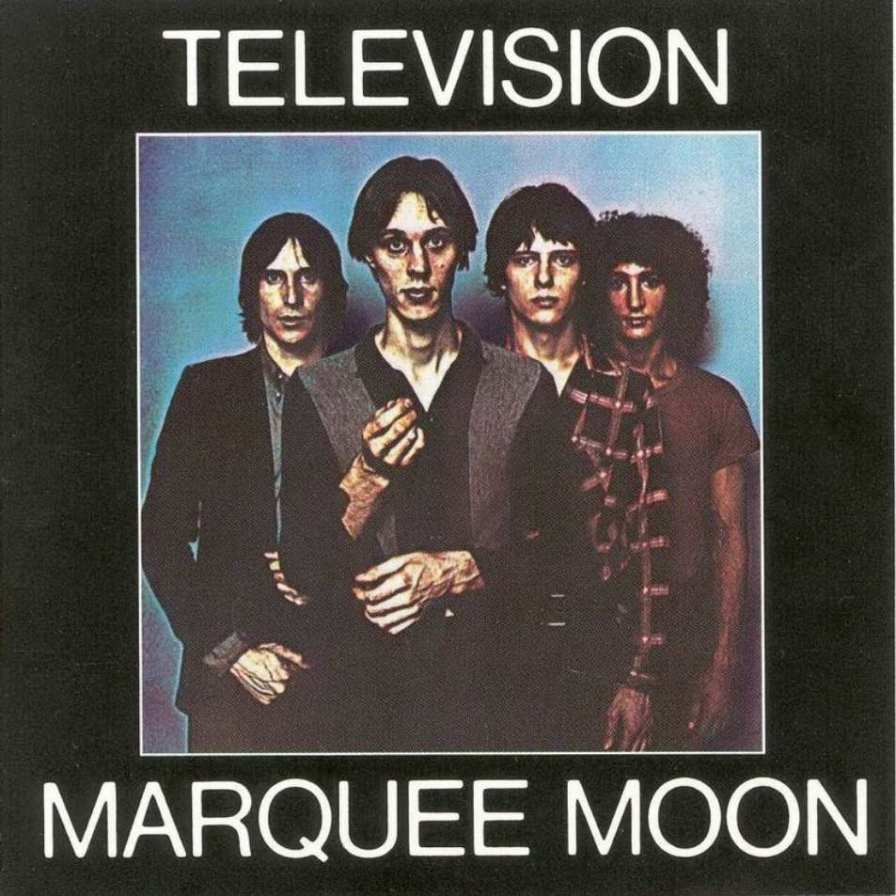
Initially planned to be recorded with Rudy Van Gelder (A Love Supreme by John Coltrane, and countless Blue Note classics) at his New Jersey studio, the album ultimately made it to tape at A & R in New York City. A fitting location for a band that exemplified what made the New York underground scene one to remember: an unknown-star-studded explosion of outrageous creativity (for example, Marquee Moon’s cover features a photo of the band taken by Robert Mapplethorpe).
The album is a balanced eight tracks, four on Side A, four on B, but clocks it at a solid 45:49 and takes off like a rocket.
“See No Evil”, the album’s unbelievably strong debut track, makes the unique, methodical guitar interplay that drives Television immediately apparent. Verlaine’s rhythm begins and is soon joined by Lloyd’s lead, the two strikingly different in complexity, one simple and repetitive, one frenetic and scaling, but both parts equally infectious and appealing in their juxtaposition, fusing a gruff, scuffed up, New York minimalist cool with bright, provocative, shreddy, glam-like waves of melody, like Rothko colliding Frank Stella and Jackson Pollack in a glitter factory next to the Bauhaus.
“And others thought it was mad….”
The album’s centerpiece, the aptly titled, “Marquee Moon”, begins much the same, but the vibe is completely different: introspective, reserved, yet chaffing against its restraints, bubbling, boiling and begging to be unleashed. Modish charm permeates the tensional structure, constantly building, constricting, and expanding, releasing, like the pump of pendulous arms up and down, faster and faster, on the undulating dance floor of a 1960s London loft, or in the song’s spacier moments the dazed, hazy and heavy sway of a mesmerized pit lost in psychedelia at LA’s Whiskey a Go Go. And then it breaks. It breaks wide open. Lloyd’s guitar bays short and sparkling spittle, like sunshine sparsely streaming from the mouth of clouds, and the whole dance begins again anew.
“They just scratching the surface….”
“Prove It” is a perfect example of a sleeper track. The album’s most subtly impressive effort and deceptively simple song to boot, almost cliché in the Orbison-esque lead guitar of the verse and near-doo-wop drumming, “Prove It” shrouds its originality for effect, hiding behind tropes that are predictable and over-used but scratch at all of the itchy soft-spots on every music lover, appealing to history by revisiting it angularly, and just long enough to become an old shoe until it violently discards all notions of nostalgia with fiery, ultra-modern blasts of what Television, and its two guitarists, Verlaine and Lloyd, do best: rifling off history-changing guitar riffs with astonishing aplomb, while Verlaine, once an aspiring poet, plays bard, challenging what, lyrically, could possibly improve upon such a solid base. He proposes this:
The docks / The clocks / A whisper woke him up / The smell of water / Would resume.
The cave / The waves / Of light the unreal night / That flat curving of a room
Prove it… / Just the facts… / The confidential / This case, this case, this case that I… / I’ve been workin’ on so long… / So long…
First you creep / Then you leap / Up about a hundred feet / Yet you’re in so deep you could write a book. / Chirp chirp / The birds / They’re giving you the words / The world is just a feeling you / undertook. / Remember?
Prove it… / Just the facts… / The confidential / This case, this case, this case that I… / I’ve been workin’ on so long… / So long…
Now the rose / It slows / You in such colorless clothes / Fantastic! You lose your sense of human. / Project. / Protect. / It’s warm and it’s calm and it’s perfect / It’s too “too too” / To put a finger on / This case is closed.
But outside of downtown New York, Television’s star never shone as bright as their peers.
“Some thought this was sad….”
And while Marquee Moon was, and is, still hailed by critics and included on nearly every “Best Of” list there is, it has never been close to commercially successful or as widely known and loved as, say, Talking Heads: 77 or Patti Smith’s Horses, perhaps because Television “had no decision” and were merely “trying to tell a vision”, but, for any reason, what surface they scratched would remain marred for time and the telling hoards of devoted listeners to take notice, albeit all-too-belatedly.
Like many artists, Television was before their time, frozen in the looking glass of a scene, so cool, self-aware, dedicated to its integrity and purity, patiently martyring for the good of their art, its rightful place in the elite and, for many, inimitable, untouchable, and irreplaceable amongst our favorite records.
Written by Ben Brundage
Album Review: Lost Left ‘Levollinen’

Gorgeous is a word I try not to toss off lightly, but I think it’s an appropriate term for Lost Left’s debut LP Levollinen. The release is one that achieves an astonishing richness for a trio. Their sound is vaporous, as if born within the London fog from which the band calls home.
The tracks flow into one another, without any real distinction from one to the next. Rather than provide the listener with specific stopping points, we’re supposed relax in the lulls and snap to attention when the band asserts itself. That’s not to say the songs don’t translate individually, they do. But the album works best when digested as a complete thought.
The vocals are as much a fourth instrument as a source of any concrete narrative. Lead singer Ben Pritchard tends to work more as an abstract painter than a storyteller, offering the listener motifs in exchange for plot.
The bass line hums, hopping beneath driving drums and splashing cymbals, combining to serve as the engine of the opening track “Thank You For The Lung,” a bold statement piece to kick off the album. This is serious music for serious listeners.
They’ll smother you and they’ll cover you up / They’ll take you apart and they’ll earn their gold / From your body parts / As if, as if, as if… / You needed them
The second track, “Caves,” would have been an apt title for the entire release. The mood here, as elsewhere on the album, is cavernous, with reverb heavy vocals bouncing off the walls in all directions. This song sounds as if it was written in a cistern. The track is similar to the more expansive side of Fleet Foxes, without the nod to the Beach Boys or 1960s folk. The song erupts into a rocker, with rollicking snares and distorted power chords sending the listener off into a resounding outro.
I would argue that the album peaks with the fourth track, “Ferdinand Cheval.” A beautifully simple guitar riff serves as the introduction to this slow dance. The song takes its name from a 19th century French postman. Cheval spent the bulk of his life creating the Palais idéal. He began building in 1879 when he tripped over a stone and found himself inspired by its shape. The next day, Cheval returned to the same spot and began gathering. Pritchard sings:
It’ll take me years / It’ll take me years / There will be no other home / No other home / And on the way back, I couldn’t wait / Couldn’t wait to see / The gathering stones / That I made / They’re ideal / They’re ideal / You can bury me / Right here
For the next 33 years, Cheval would pick up stones during his rounds as a postman, returning each night to work beneath the light of an oil lamp on the construction of his palace. Though Cheval had requested to be buried within, he knew that French law made such a dream an impossibility. So he spent an additional eight years building a mausoleum in the Hauterives cemetery. He died in 1924, about a year after he had finished the mausoleum. Cheval rests there to this day,
This is the type of weighty material that Lost Left attempts to tackle on Levollinen. Many would argue that such pursuits are pretentious, and that sentiment certainly has its merits. However, there is something admirable about an attempt to translate the Palais idéal into a six-minute song, and the results are certainly rewarding for those willing to give the material a chance.
As is painfully obvious, I adore this release. From a musical standpoint, Lost Left has not reinvented the wheel. The arrangements, though voluminous, are rarely complex. The strength of this album is discovered when the listener peers beyond the surface and wrestles with the bold themes beneath. Listen to Levollinen in its entirety below. Downloads are available via Bandcamp, and CDs may be ordered upon request.
Connect with Lost Left via Facebook
Written by Rob Peoni
Album Review: Lotus Plaza ‘Spooky Action At A Distance’
I feel sad for kids these days. They have absolutely no concept of so many great things that us mid twenty-somethings grew up with. Take the English language for example. “I C U” is not and will never be a sentence. You can write how it’s pronounced all you want, but to me, it just means you are more than likely ignorant and didn’t do to well on your spelling examinations. Or the family sitcom. I grew up with life lessons from Tim Taylor & Wilson, Danny Tanner & Uncle Jesse, Carl Winslow and Zach Morris. What is there today on modern television that will carry on for generations? Reality TV featuring fat people shedding pounds and 800 singing competitions? Please. And to all my readers older than me, I know, my childhood years were miserable compared to yours. Every generation likes to puff their chest out and talk about the “good old days” and I’m certainly no different. But I do have one huge problem with the younger generation, and for that matter, a large majority of my own. And that is the general death of the ability to listen to an entire album.
The iTunes effect. The best, as well as maybe the worst, thing that ever happened to listening to music. Now don’t get me wrong, I am a staunch iTunes supporter and love the access it gives to music. But albums have been, and continue to be, released for a reason. And that is because there is something about the experience of spending 30 minutes to an hour engrossed and listening to songs by one artist in the order they want you to. I have 70.20 GB of music currently on my laptop, but 99.5% of it are full albums, EPs, or complete 7” releases. I don’t buy or download singles strictly because I believe music is not only best served in album form, but that any musician worth listening to gives you not just one song but an entire collection…a masterpiece of craft if you will. And I feel that the album is, unfortunately, getting away from general society. iTunes libraries full of only random singles and one hit wonders is the norm rather than the outlier today and that’s just a shame. Where is the patience people?
This giant rant stems from my most recent album experience: Spooky Action At a Distance by Lotus Plaza. The solo project of current Deerhunter guitarist Lockett Pundt, it provides everything you want when listening to music. It’s entertaining, thought provoking, relaxing…to put it in better terms, it piques the emotive core inside of you. When I began playing the album yesterday evening, it was with a cup of coffee and my work laptop open. It was roughly towards the end of the fuzzy and subtle second track of the album entitled “Strangers” that I realized this type of listening wasn’t going to work. This album required my complete and undivided attention. So the computer was shut, the TV, already on mute, was turned off, and I just sat, listened, and contemplated my life with the music.
The anticipatory third song “Out of Touch” builds from a high fever to a cacophony of sound before leading into the ever thoughtful and nostalgic “Dusty Rhodes”. It’s the middle of this track where you can begin to hear his friendship with fellow Deerhunter member Bradford Cox begin to reveal itself as an influence in Pundt’s own sound. The droned out vocals and dark landscape almost sound like Bradford’s solo project Atlas Sound’s work while the following “White Galactic One” brings the end of “Revival” from Deerhunter’s most recent effort Halcyon Digest to life with it’s own full song.
“Monoliths” begins the second half of the album by bluntly stating the introspective themes already established and ending with Pundt singing, “One of these days, I’ll come around” over and over again. But perhaps the most beautiful and masterful track on the album is “Jet Out of the Tundra”. Sounding as if you are sitting down in a chair watching photos of your life pass you by, there’s a sense of serenity that forces it’s way out and into the room you are sitting in.
The trio of “Eveningness”, “Remember Our Days”, and “Black Buzz” close out this sophomore effort by continuing the overall mood and overarching themes previously mentioned. At the end, I found myself with overpowering feeling of tranquility with my life. This isn’t an album of sorrow in regards to memories, but rather, a realistic and calming journey into each of our pasts. So while singles are great, don’t forget that the best sounds in life come with A and B sides friends.
Connect with Lotus Plaza via Facebook
Written by Greg Dahman
 Thought on Tracks