


In the Dust #16: Etta James, 1938-2012
All I need
Is someone like you
My dearest darling
Please, love me too
Within my heart
I pray your answer’s yes
I’ll make your life
Full of happiness
When you need me
I’ll be there by your side
Oh, I pledge my love to you
With God as our guide
Nothing, nothing, nothing in this world
Can keep us apart
My dearest darling
I offer you my heart
Whenever you need me
I’ll be there by your side
I pledge my love to you
With God as our guide
Nothing, nothing, nothing in this world
Can keep us apart
My dearest darling
I’m offering you my heart
My dearest darling
-“My Dearest Darling” – Listen
Etta James, At Last! (1961)
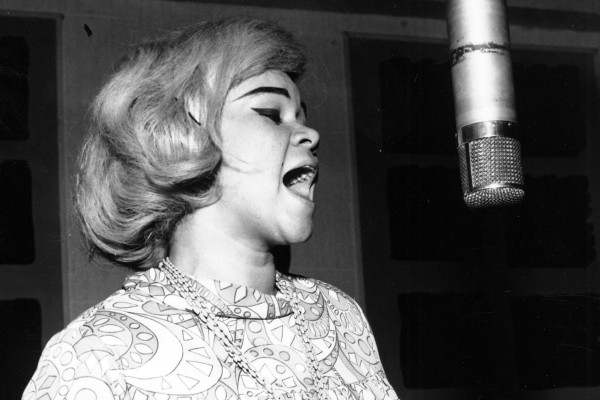
One week ago today, the world witnessed the death of one of the greatest singers of all-time. On Friday, January 20th, 2012, Etta James passed away. She was 73.
To many, she possessed a voice beyond compare. She was a symbol of strength, resolve and triumph over adversity. Her songs became anthems, embodied national consciousness, serenaded a President and garnered her 6 Grammy’s and countless nominations. She was inducted into the Hollywood Walk of Fame, the Rock and Roll Hall of Fame, the Rockabilly Hall of Fame, the Blues Hall of Fame and the Grammy Hall of Fame – twice. One of the first blues singers to “cross over”, her versatility won the adoration of fans from nearly every genre, and her star remains one of the most brilliant in any blues, pop or soul constellation.
She was born Jamesetta Hawkins on January 25th, 1938, in Los Angeles, California. Her mother was 14-year old Dorothy Hawkins. Her father, James speculated, was the elegant, reigning king of pool, billiard player Rudolf “Minnesota Fats” Wanderone.
Due to her mother’s frequent absences and erratic relations with numbers of men, James dubbed her mother “the mystery lady” and spent the majority of her time with caretakers. She took up singing at the age of five, receiving lessons from a musical director at a local church. She quickly became a popular attraction, often to her detriment. One of James’s caretakers, “Sarge”, would hold poker nights and his guests often requested that James sing for them. “Sarge”, at all hours of the night, would wake her up, drag her downstairs and, as she was a childhood bed-wetter, force her to perform, often in a soiled nightgown. This begat in James an intense, instinctual defiance that flared anytime it was demanded she sing, a reaction that, out of necessity, drove her to do things her way, and aided in summoning a vast wealth of emotion and determination totally unheard in all but a few other singers.
In 1950, after the death of her caretakers, James, 14, moved with her biological mother to San Francisco, where she began to fall deeply in love with doo wop. She formed a girl group, The Creolettes, a name inspired by their light skin. There, in many differing accounts, they met Johnny Otis, a legendary multi-instrumentalist, DJ, talent scout, producer and jack-of-all-trades who also died last week, only three days before James, at the age of 90. Otis got the girls a deal with Modern Records, changed their name to The Peaches, Etta’s from Jamesetta to “Etta James”, and set about recording their first hit. “Dance With Me, Henry,” a reworking of Hank Ballard’s “Work With Me, Annie,” co-authored by James charted at #1 on Hot Rhythm and Blues Tracks, and The Peaches were booked as the opening act on Little Richard’s upcoming nation-wide tour. But there remained stumbling blocks ahead.
During The Peaches’ tour with Little Richard, “Dance With Me, Henry,” was rerecorded by Georgia Gibbs, a pop singer, and retitled, “The Wallflower.” It went straight to #1 on the Billboard charts. James was irate. He next single for Modern Records, “Good Rockin’ Daddy,” also did very well, but only on the R&B charts, and the majority of her other singles for Modern were flops. James, fed up, yearning for stardom and confident she could get it, jumped ship at the conclusion of her contracted and signed, solo, with Chess Records. With the help of Leonard Chess, Willie Dixon and the songwriters at Chess Records, and Harvey Fuqua, fling and founder of the doo-wop kings, The Moonlighters, Etta James would record some of the most compelling, unforgettable and aurally immaculate crossover tunes in the American songbook.
Many of James’s songs are now ubiquitous, known to some as well as “Twinkle, Twinkle Little Star”, but they are nonetheless substantial pieces of an astounding career. Each speaks for itself, from the monstrously popular, “At Last”, to deeper tracks like “In My Diary”, and the author’s personal favorite, “Trust In Me”, layers of meaning issuing fruitfully from James’s effortless vocal delivery, at times wistful, ebullient and then so suddenly sullen, poignant and devastating.
Her Chess Box is required listening, as are her early recordings with The Peaches and later work like the completely gutting, perhaps semi-autobiographically inspired, Mystery Lady: Songs of Billie Holiday, as well as 2003’s Let’s Roll, and 2004’s Blues To The Bone, all of which won a Grammy.
In her 73 short years before succumbing to complications of Alzheimer’s and leukemia, James had cycled from doo wop to R&B to blues to pop and back again, mastering every style and interpreting standards from nearly every school with matchless grace and poise. Like Bo Diddley and the blues, she effortlessly established a lasting pathway between rhythm and blues and rock and roll, allowing for the veins of jazz and soul to grow through her and latch like ivy, constructing as she crossed, beneath a fog of undeserved ignorance and under-appreciation, a natural bridge of intertwining traditions, American earth as its base, strong, unyielding and deeply rich, much like the architect herself.
Rest in peace, Etta James. Your lonely days are over.
Written by Ben Brundage
In The Dust #15: Tommy Johnson ‘Complete Recorded Works in Chronological Order: 1928-1929’
Once a week In The Dust rolls up its sleeves and digs to the back of the rack to find that record, the one you never knew you always wanted, the one that’s lost but not forgotten. (Listen via Spotify)

When it comes to the mythopoetic bluesman, Tommy Johnson was the archetype. A rambling, hard-drinking, hard-loving guitar picker with one of the most distinctive and celebrated voices in blues history, Johnson stands in company with Son House and Charlie Patton as one of the genre’s most important early artists, head-hunting and juke-jointing in Dockery and across the delta a full eight years before Robert Johnson ever picked on record.
He was born 1896, near the small town of Terry, Mississippi, on the George Miller plantation. Fourteen years later, Johnson’s family moved to Crystal Springs, Mississippi, where Johnson’s older brother, LeDell, began to teach him how to play guitar. Johnson was soon playing parties with his brothers, Major and LeDell, to supplement the family income, but he stayed only two years, running away at age 16 to become a professional musician. Johnson’s freewheeling, impulsive nature and, in particular, the vices it helped him acquire would come to haunt him for the rest of his life.
After leaving Crystal Springs, Johnson began his career as an itinerant musician, picking up with the likes of Charlie Patton, Willie Brown, Ishman Bracey and a host of other blues legends, but never for long. Johnson only played when money was tight, or he simply felt like it, and exhibited little or no desire for self-promotion or furthering his career. He was busy. Johnson occupied the majority of his time with dogged womanizing or his favorite past-time, and what seemed like his life’s true passion, drinking. When the whiskey river ran dry, Johnson had two ways of getting his fix: he would drink denatured alcohol from a Sterno can, the type used today for heating chafing dishes, or common shoe polish. Both would be heated and strained through bread or a sock, and both would provide Johnson his necessary kick.
As Johnson was still young, his alcoholism was yet a hindrance. He was playing out and playing often, and, despite his own aversion to dogged promotion, was busy cultivating a legendary persona. He was the finest blues vocalist of his day. His voice, a trademark of his music, was remarkably nimble and could modulate from a soft whisper to a great, Patton-esque growl and upwards to a ghostly falsetto, more delicately attenuated than would seem possible when compared to any of his thunderous, preceding barks. Also like Patton, he could play the guitar between his legs, behind his head, and in a number of other crowd pleasing positions, screaming and hollering and howling without a break, throwing his axe into the air and catching it mid-number, but perhaps the most powerful aspect of Johnson’s newly cultivated public face, and certainly the most lasting, was his encounter with the devil.
You’ve heard it a thousand times. The crossroads myth. Well, it began with Johnson, and not Robert. Tommy. He told it himself many times to reinforce his abilities to new, unfamiliar audiences. Many, out of interest, picked up and began telling the story themselves. So began the myth of Johnson’s journey from Dockery to the crossroads, waiting there for the man until his arrival at Midnight, the man nimbly and quickly tuning Johnson’s guitar, rifling off a tune, passing it back to Johnson and, along with it, a comprehensive mastery of blues guitar.
After eight years of playing in and out of combos but primarily alone, honing a distinguished and awe-inspiring reputation as a Satanically-acquainted guitar picker with a library of classical blues delineations, several original compositions, and a throat that summoned at-once gravel and honey, Victor Records, later RCA Victor and then BMG, approached Johnson to make his first recordings.
He travelled to Memphis with his sometime-accompanist, Papa Charlie McCoy. There, in two sessions, he cut his first seven sides: “Cool Drink Of Water Blues”, “Big Road Blues”, “Bye-Bye Blues”, “Maggie Campbell Blues”, “Canned Heat Blues”, “Lonesome Home Blues” and “Big Fat Mama Blues”.
“Cool Drink Of Water Blues”, while not Johnson’s most famous song, is perhaps his most recognizable and influential, serving as a metaphor, in a sense, for Johnson’s complicated relationship with addiction.
Over an ebbing and flowing, hypnotically propulsive finger-picked progression, we hear Johnson’s otherworldly howl issue for the first time. “I asked for water,” he bawls, “then she gave me gasoline.” His voice trembles with the vibrato of a violin playing in the upper register. It is immediately arresting, haunting and spectral. Maybe more than any other Faustian musician, there is the suggestion of devilment in Johnson’s tone. Whether it be the devilment of his demons- an addiction to alcohol -or true soulless lament it is impossible to define, but it is easy to indentify the profound level of sadness with which Johnson sings of his woman woes, her mistreatment of him, and his dependence on the availability of high-strength alcohol of any nature: “Lord, Good Lordy, Lord / Cried Lord, I wonder / Will I ever get back home?” He continues on, using the metaphor of a poor man begging to “ride the blinds” of a train car in the hopes of making it home, but the Conductor denies his request and says, “this train is none of mine”. Johnson’s woes, it seems, are his own to remedy and, thus, destined to remain dry despite his tearful, falsetto plea.
“Canned Heat Blues” is arguably Johnson’s most famous. The centerpiece of Johnson’s first recording session, “Canned Heat Blues” is an upbeat, strum-heavy number ready for peaking the floor of the local juke joint. Like many a Johnson song, it details Johnson’s lament of his affinity for alcohol, particularly canned heat, and, presumably, the awful hangover one acquires after a raucous night on it. He begs for some relief, for someone to physically remove all of his pain and the substance itself, saying women don’t want a man on the heat and that, if not for it, he “never would die”, but the joy with which he sings his regrets, suggests that his wish is only half-hearted, and to dispatch of his canned heat he would very soon regret:
I woked up a-this mo’nin / With canned heat on my mind / Woke just this mo’nin’ / Canned heat was on my mind / Woke up this mo’nin / With the canned heat, Lord / On my mind
Cried, Lord / Lord, I wonder / Canned heat, Lord, killing me / Think alcorub is / Tearing apart my soul / Because brown-skin woman / Don’t do the easy roll
I woke up, a-this mo’nin’
Cryin’, canned heat ’round my bed / Run in here, somebody / Take these canned heat blues / Run here, somebody / An take these canned heat blues.
Cryin’, mama, mama, mama / Cryin’, canned heat killin’ me / Plead to my soul, Lord / They gon’ kill me dead.
It is clear what is meant when reading about Johnson’s love for the craft of blues music when compared to his love of alcohol. They are, in many ways, intertwined, both a subject of great inspiration and dedication, both playing and feeding off each other, but one true love reigns supreme: alcohol, Johnson’s tumultuous relationship with it and his desperate need to acquire it by any means necessary.
A year and a half later, after the Victor sides began to circulate the delta, Johnson was tapped again to record, this time by Paramount Records. Through the channel of an urging Charlie Patton, drinking buddy, on-again, off-again playing partner, constant competitor and collaborative, mutually dependent imitator of Johnson’s, Paramount convinced Johnson to come to Grafton, Wisconsin, where Patton and fellow delta inner-circler, the semi-professional Son House, recently recorded, and cut sides. They would be his last.
In Grafton, Johnson recorded nine sides in total, “Button Up Shoes”, “I Want Someone To Love Me”, “I Wonder To Myself”, “Slidin’ Delta”, “Black Mare Blues”, “Morning Prayer Blues”, “Boogaloosa Woman”, “Alcohol and Jake Blues” and “Ridin’ Horse”, bringing his total oeuvre to just sixteen songs. The songs from Johnson’s Grafton sessions would not prove to be nearly as successful, nor as lasting and influential, as those from his two Memphis sessions with Victor, but they are nonetheless excellent, masterfully composed, beautifully executed and hauntingly penetrative.
In the words of Emily Dickenson, Johnson did not stop for death. Why Johnson’s recording career was cut short at just sixteen songs is a story that fits in remarkably tight with not only the lore of his personal life, but the troubles of his immortal songs as well.
The Mississippi Sheiks, a popular and extremely versatile “jug” band of the time, recorded a song known as “Stop And Listen”. The song was very successful, but a team at Victor records, where Johnson had recently recorded, believed that the Sheiks had stolen their melody for the song from Johnson’s very popular, and to this day one of his best, “Big Road Blues”. The Victor folks brought about a copyright suit, to which Johnson was party, but he was apparently so drunk that, upon signing the final settlement, a decision in his favor, he believed, not knowing exactly what the document was, that he had signed away his right to record in perpetuity. For this reason, this supremely drunken mistake, Johnson never recorded another song. He continued to play parties, juke joints, and all manner of venues until his death, during a performance at a local house party, of a heart attack in 1956. Bonnie Raitt paid for his tombstone.
His music continues to influence countless artists, from the band Canned Heat, to the equally immortal Howlin’ Wolf, a former resident of Dockery, and Otis Spann (a familiar name around In The Dust). The Coen Brothers included his purported likeness in their 2000 film, O Brother, Where Art Thou?.
It is hard to say what is the stronger of Johnson’s legacies, his music or his personal life. His dealings with the devil are, of course, the stuff of legend, but as is his torrid love affair with alcohol. The substance was a greater influence on Johnson’s life and music than any other. It inspired his greatest songs, kept him from a full, lush career as the iconic blues musician he was destined to be, and ultimately caused his death. He lived hard and surprisingly long, with his canned heat at his side, the life of the consummate bluesman: dark, shrouded in myth and mystery, a drunk carouser of the highest verve, a heartbreaking, soul-stirring guitar-picker whose small but significant oeuvre, and unforgettable, chilling voice, are beyond compare.
Written by Ben Brundage
In the Dust #14: Bo Diddley ‘Bo Diddley’
Once a week In The Dust rolls up its sleeves and digs to the back of the rack to find that record, the one you never knew you always wanted, the one that’s lost but not forgotten. (Listen to Bo Diddley The Chess Box via Spotify)
Who do you love?
Bo Diddley, and he’ll be the first to tell you so.
Easily one of the most unabashed self-promoters in the history of rock and roll, at first glance, Bo Diddley’s career seems to be entirely dedicated to solidifying his place, or more accurately his name’s place, in the social consciousness. Certainly no other artist has ever used in his own name in a song’s title, chorus and album more so than Bo Diddley, but Diddley’s work, while perceived by some due to the repetitive name dropping as kitsch and pop novelty, when considered in context, offers much more substance and historical importance than just the universal awareness of a name.
Born Ellas Otha Bates in McComb, Mississippi, in 1928, Diddley was soon adopted by his mother’s cousin, taking her name as Ellas McDaniel. When Diddley was 6 years old, the family moved to the South Side of Chicago, where he became active in the Baptist church and proceeded to learn the trombone and violin. Diddley’s skills at the violin developed quickly and he soon joined a local orchestra, with which he played until he was 18. Diddley, while still interested in the violin and classical composition, found himself increasingly drawn to the energy and vibrant musicianship of those playing at local Pentecostal churches, in particular anyone could play guitar.
One evening he went on the town to see John Lee Hooker, who was playing at a local juke joint. Hooker played “Boogie Chillen”. That was it, Diddley decided.
He soon formed a band, The Hipsters, with pal, and who soon would be longtime band mate and collaborator, Jerome Green. Diddley’s distinctive guitar style, a choked, muted-string method based off of core violin technique, soon set them apart.
After graduating high school, Diddley started working as a mechanic and carpenter, but discovered that even with the two jobs it was difficult to make ends meet. The Hipsters began busking on the street and quickly scored a regular gig at the 708 Club, a popular South Side juke joint.
The Hipsters played a mélange of styles, from Diddley’s own originals, to songs by Louis Jordan, his inspiration, John Lee Hooker, and his future label-mate, Muddy Waters.
After a few years’ buzz and toil at the 708 Club, Diddley signed to Checkers Records, an imprint of Chess Records. Then, he was still Ellas McDaniel, a name Leonard Chess insisted was not suitable.
There are many conflicting claims of how Bo Diddley acquired one of the most famous monikers in rock and roll, and there is no definitive version. Diddley maintained that his peers gave him the nickname, initially as an insult. He also states that it was the name of a popular singer of whom his mother was fond. Others claim it was the name of a popular comedian, and that Chess borrowed the name to lend to Diddley and his first single, “Bo Diddley”.
Others say it is a reference to the diddley bow, a popular instrument among children that features a single string tied tightly to two screws and is played by simultaneously strumming the wire and manipulating its tension with a slide. A common first instrument of the Delta bluesman, it is well known as a progenitor of the slide guitar.
Regardless of how Diddley assumed the moniker, Chess released his first single, the immortal and highly influential, “Bo Diddley”, featuring Otis Spann on piano, under the name in 1955.
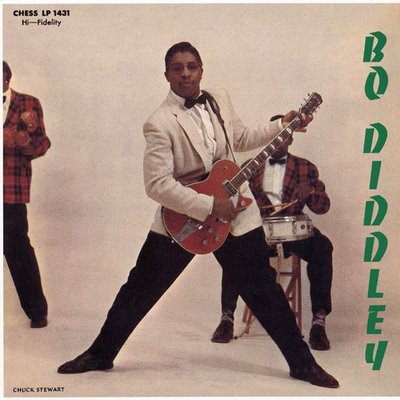
He went on to record many more successful singles for Chess in the following three years, all of which, including several B-sides, are collected on Diddley’s 1958 debut album, Bo Diddley. While not as celebrated as Diddley’s first true studio album, Go Bo Diddley, included are some of the most iconic songs of his career.
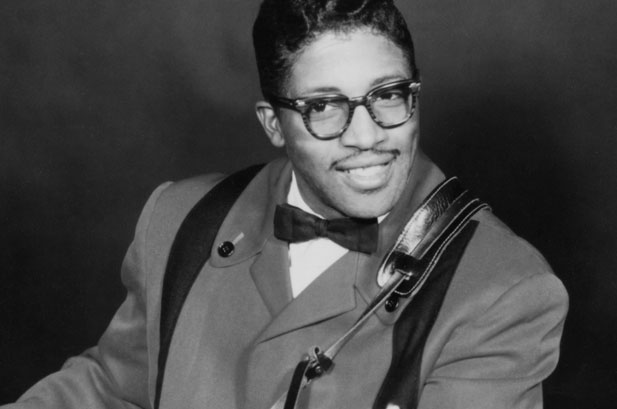
First, and this should come as no surprise, is “Bo Diddley”. In unison, the band begins, and a rolling, tumbling hiss issues a curiously uniform effect. Green’s maracas, as well as Frank Kirkland’s drums, were originally intended to simply reinforce Diddley’s rhythm. Diddley’s guitar, in turn, reinforced their rhythm back, and all melded together, achieving a strange rhythmic harmony, which came to be known as the Bo Diddley Beat, a major innovation. Diddley breaks up his beat with characteristic, seemingly spontaneous chording and traditional pop AABB lyrics, leading into one of the most distinctive guitar solos in rock and roll, one that has been echoed time and time again by guitar players for over 60 years. A simple tremolo technique of Diddley’s own devising slathers a simple alternating chord progression, creating what is a slithering, bending and prophetically psychedelic sound that would come to permeate the genre.
“I’m a Man”, the album’s second track and the B-side to “Bo Diddley”, is for obvious reasons instantly recognizable. You might know it as “Hoochie Coochie Man”, recorded by none other than Muddy Waters. What you might not know is that after hearing Diddley’s version, which was inspired by Waters, Waters continued the conversation by recording “Mannish Boy,” a song written by Willie Dixon, who plays bass on all three versions, and a jabbing reference to Diddley’s being much younger than Waters and, thus, not the “man” that Muddy was when he recorded it. “I’m a Man” features the same iconic stop-time rhythm as Waters original “Hoochie Coochie Man”, but in his classic style it is substantially “Diddley-fied” by the addition of heavy shakers, distinctive guitar tone and reverberated hollering throughout.
One of Diddley’s most famous to-date, but relatively under-appreciated at the time, “Who Do You Love?” is the second-to-last track on the album. As with many Diddley songs, this country-western stomper is swathed in reverb, and his vocals especially, in slapback. His guitar, almost pedal steel-like at times, soars over in chorus, interrupted by the remarkably angular, but sweet and confident soloing for which he is known. As in “Bo Diddley”, “I’m a Man” and the majority of his work, he, and his magnificence, is the subject, testifying to a cocksureness that is at once overt braggadocio and tongue-in-cheek, corner-mouthed charisma:
I walked 47 miles of barbed wire / I used a cobra snake for a necktie / I got a brand new house on the roadside / Made out of rattlesnake hide / I got a brand new chimney made on top / Made out of human skulls / Now come on and take a little walk with me, Arlene / And tell me who do you love?
He continues, boasting, “Only 22 / And I don’t mind dyin’”.
Diddley’s brash and loveable egotism is only a part in his lasting legacy. Aside from wonderful songs and a persona to match, his skills as innovator and inventor garner him as much accolades as his music.
In 1958, Diddley built his own guitar, a more complicated version of what is largely known as a “cigar box guitar”, a favorite among blues musicians and poor guitar pickers of the south because one could make it easily and cheaply one’s self. This guitar featured a very unusual and unorthodox electrical build, one that contributed greatly towards the distinct sounds Diddley was able to create as his career progressed. He also was one of the first to build and operate his own home studio, engineering and recording a lot of his music himself.
Diddley’s homespun individualism sheds a more complicated light on what the author has, up until this point, referred to as self-promotion and egotism. Diddley, in all ways, is a true original, and fittingly dubbed by his loving admirers, “The Originator”. He turned blues into rock and roll and gave Buddy Holly, The Rolling Stones, The Yardbirds and countless other infamous artists a cornerstone upon which to build their own house of worship. When Diddley uses, reuses, and overuses his name, it is more than just the repetition of a moniker; it is pride in the insistent impulse to do it himself, his way, picking a guitar like a violin, making its sound tremble like a reed in the breeze or slyly undulate like a snake to its prey. It is Diddley being Diddley, marking the high water, banging out his juba and, “Diddley” by “Diddley”, changing music forever.
Written by Ben Brundage
 Thought on Tracks