


In the Dust #4: Elvis Presley ‘The Sun Recordings’
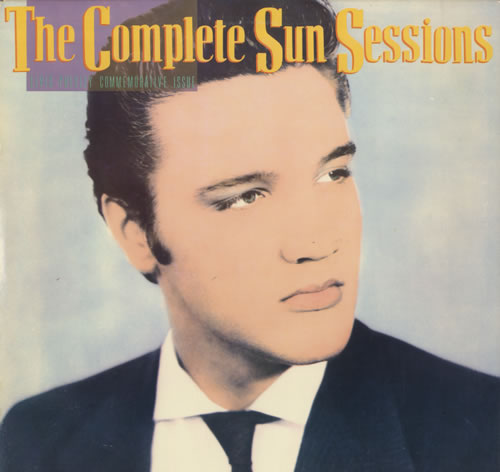
Once a week In The Dust rolls up its sleeves and digs to the back of the rack to find that record, the one you never knew you always wanted, the one that’s lost, but not forgotten. (Listen via Spotify)
Elvis.
Enough said, right? If you’re still reading at this point, let me say that this is not the bloated, bacon-banana-peanut-butter-fried-donut sandwich King that the name draws to mind. This is Elvis Aaron Presley, an aspiring young singer from Memphis, Tennessee, moonlighting as a truck driver just to keep his head above water.
Presley, at the age of 13, moved with his family to Memphis where he immediately immersed himself in the music scene, absorbing country, honky-tonk, western swing and, most notably, R&B and the blues. Throughout high school, Presley was berated and discouraged by music teachers claiming that he had no aptitude for music, but by the time Presley graduated he was determined to pursue a career in music regardless. With blind confidence, he scrapped up $3.98 and went to Sun Records to record two sides. This is the point in the story where, for other artists, one would say “and the rest was history,” but that’s not the case.
On July 18th, 1953, Presley recorded his first two sides, “My Happiness” and “That’s When Your Heartaches Begin”. The receptionist, Marion Keisker, upon Presley’s arrival, asked him what he sang. He said “all kinds.” “I don’t sing like nobody,” he continued. After recording his sides, Keisker recorded his name on the acetate and added, “Good Ballad Singer. Hold.” Presley received one copy of the recording, which he gave to his mother, who, at the time, did not even own a record player.
Early the next year, on January 4th, 1954, Presley recorded two more sides, “I’ll Never Stand In Your Way,” and “It Wouldn’t Be The Same Without You”. These, much like the first two sides, were flops. It appeared that no one was interested in Elvis Aaron Presley the ballad singer.
After several failed auditions as a vocalist for local bands, Presley told his father, “They told me I couldn’t sing,” echoing the words of his old teachers. It is then Presley got a job big-rigging at the Crown Electric Company. He continued to try out for other local groups but was rejected every time, bandleaders citing that Presley should stick to being a truck driver “because you’re never going to make it as a singer.”
Sam Phillips, Sun Records President, saw what he believed to be a hole in the market, but could not find the right man to fill it. Keisker remembers, “Over and over…Sam saying, ‘If I could find a white man who had the Negro sound and the Negro feel, I could make a billion dollars.” Phillips had acquired a copy of “Without You”, and he could not identify the vocalist. Keisker reminded Phillips of the young truck driver, the one from Memphis, the good ballad singer, and Phillips invited Presley back to Sun Records for a tryout of sorts.
On May 26th, 1954, Presley returned to Sun Records. In his audition, he failed to do the recording justice. Phillips asked Presley to run through a few other songs in his repertoire. Phillips was less than enthused, but Presley expressed a spirited interest in finding a back-up band and Phillips obliged. He contacted two Memphis, western swing musicians, Winfield “Scotty” Moore, guitar, and Bill Black, slap bass. It is at this point in the story where, for other artists, one would say “and the rest was history,” but that is again not the case.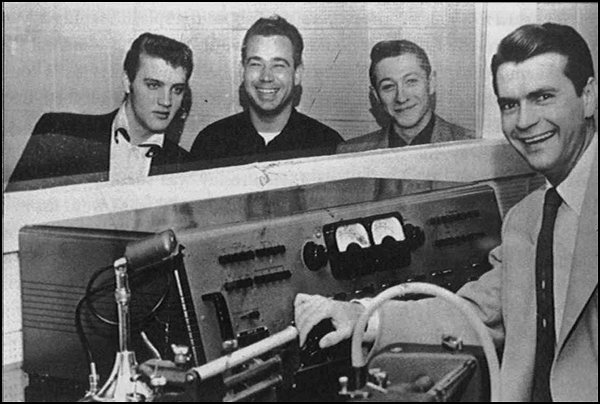
Presley was set for another audition, one with Moore and Black, at Moore’s house. Again, like Phillips, Moore and Black were less than enthused, but Elvis expressed a spirited interest in a recording session with the two, and they obliged. The session was held on July 5th and lasted late into the night. With exception of what was then considered a mediocre country ballad, “I Love You Because,” the session was largely felt to be unsuccessful. That is until Moore and Black were packing to leave. Elvis struck into Arthur “Big Boy” Crudup’s “That’s Alright Mama,” and started “acting the fool”.
Moore remembers:
“All of a sudden, Elvis just started singing this song, jumping around and acting the fool, and then Bill picked up his bass, and he started acting the fool, too, and I started playing with them. Sam, I think, had the door to the control booth open … he stuck his head out and said, ‘What are you doing?’ And we said, ‘We don’t know.’ ‘Well, back up,’ he said, ‘try to find a place to start, and do it again.”
And the rest was history.
Phillips had found the sound he was looking for, and frantically began checking levels and taping. “Damn. Get that on the radio and they’ll run us out of town,” Black remarked. Phillips did just that.
It premiered three days later on a local radio show to such a response that the DJ 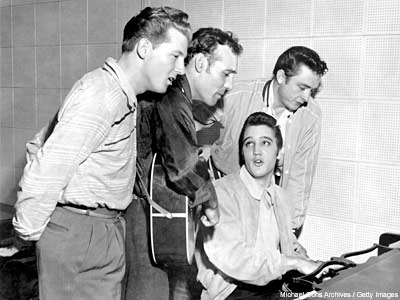 played it repeatedly for the last two hours of the show and later had Elvis himself in for an interview, in which he asked him to identify his high school so listeners could identify his color. Sun Records received over 6,000 advanced requests for the record, with a pop, 4/4, rock and roll version of slow waltz, “Blue Moon of Kentucky” to be pressed as the b-side.
So began the career of Elvis Aaron Presley, some would say with an act of minstrelsy, others would say with pure dumb luck and raw, unrefined genius.
Presley recorded more than twenty songs between 1953 and late 1956 for Sun Records. Of them, 18 “Elvis Presley” sides survive, two are lost, and the rest are billed to The Million Dollar Quartet, of recent Broadway fame. Of the songs credited solely to Presley (with Moore and Black), several the author believes to be among the finest of his career. It is no surprise, when listening to these recordings, that so many have had such issue with Presley’s singing. It is unique, ahead of his time in many senses, and strangely contemporary in others.
“That’s All Right,” Presley’s first hit, a slippery, top-down, walking-bass country blues bears moments of clear attraction to a young Roy Orbison (later to record with Sun Records), Presley’s silky vibrato wafting above of the slap-clang pound of the bass and thin, lick-heavy guitar, which, when taking the two together, appear to inspire the unrestrained grunge-wop, western rock and roll of a “Maybelline” era Chuck Berry to-come. When taken as a whole, the effect is a sound reminiscent of Johnny Cash in his days with the Tennessee Two (also later to record with Sun Records). “That’s all right, mama,” Presley sings, foreshadowing his own breaking stardom, overarching influences and legions of followers and imitators, “I’m leavin’ town, baby / I’m leavin’ town for sure / Well, I didn’t want you to be a-bothered with me a-hangin’ ‘round your door / Well, that’s all right / Well, that’s all right now, mama,” the acetate a fitting gift for his mother, a gesture of reassurance that he will make it, and a prescient stiff-arm to those who come after, inviting them to play in his wake, because he’ll be watching from the top, shaking his head, knowing they can’t do it like the King.
In 1955, a young Buddy Holly saw Presley perform in Lubbock, Texas. This left a sizable impression on Holly, as he then began to incorporate the country, rockabilly for which much of his music with The Crickets is known. Chances are very good that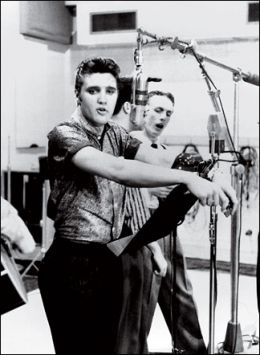 Holly’s attention was most closely drawn by, “I Don’t Care If The Sun Don’t Shine,” a song that sounds as if it could’ve been recorded by Holly himself and simply mislabeled as Presley. “I Don’t Care If The Sun Don’t Shine” exhibits the archetypal, up-and-down slap-bass of the Sun Records sound, coupled with bright, cutting guitar chords, occasional finger-picking and well-bent, Holly-esque solos of classic rock and roll simplicity. Presley rarely visits his lower register, singing of love for his baby in a high, dizzying vibrato akin to Holly’s performance of “Modern Don Juan”, bridging the gap between Presley’s newfound fame as a young, pop sensation and his earlier ballad-driven sensibilities, ostensibly eliminating doubts of his ability to adapt “all kinds” of music for the current market, simply because he “don’t sound like nobody else,” yet.
The song previously felt to be mediocre and difficult to market, “I Love You Because,” shows a particular interesting side of the “good ballad singer”. Elvis adopts a languid, melancholy croon that would later be heard issuing over audiences at the Copa Cabana and all over Vegas, Atlantic City, and other destination hot spots from the microphone of Dean Martin. Presley’s delicate, sliding vocal line is complemented by the striking, metallic and swinging jazz-cum-reverberated rock fingerpicking of Moore. Presley, in a sense, lets it all hang out, expanding to fill the sonic space, and putting his own unusual styling so strongly in the forefront that when he warbles, “No matter what the world may say about me / I know your love will always see me through / I love you for the way you never doubt me / But most of all I love you because you’re you,” it is distinctly as if he is in conversation with himself, echoing the same blind confidence that he first took with him to Sun Records, refuting the opinion of countless music teachers and bandleaders and even Phillips himself, continuing that, “No matter what the style or season / I know you’re heart will always be true.”
Over the course of the Sun Recordings, Presley successfully tackles a multitude of genres from sentimental ballad, to western swing, to country and country blues, to rockabilly, to even bluegrass waltz and blues standards like “Milk Cow Blues”, reworked into the boogie-woogie “Milkcow Blues Boogie”. With each song we hear a different, but equally poised and unyielding Elvis, singing unlike no one else in his day. It is apparent that Elvis is still finding his voice, but he is in no hurry. He is making everything his own, and as he does so cycles through vocal performances that will inspire countless singers for decades. Many have claimed Buddy Holly to be the single most influential figure in rock and roll. Others have said Roy Orbison or Chuck Berry. Perhaps, those with that claim did not go back far enough.
Written by Ben Brundage. Check out Ben’s Tumblr: Damned Fine Lion
In The Dust #2: Son House ‘The Grafton Sides’
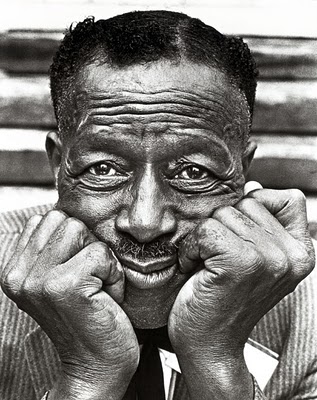
Once a week In The Dust rolls up its sleeves and digs to the back of the rack to find that record, the one you never knew you always wanted, the one that’s lost, but not forgotten.
It begins with a man named Henry Sloan. Shrouded in myth, little of Sloan’s life has been uncovered by historians, but many believe that he is the key to early blues, and possibly the genre’s father altogether. In 1903 W.C. Handy, who, with his band, went down in history nine years later for recording the first blues, “St. Louis Blues”, wrote of a mysterious vagrant he encountered while waiting for a train at Tutwiler Station, in Tallahatchie County Mississippi:
…A lean, loose-jointed Negro [who] had commenced plucking a guitar beside me while I slept. His clothes were rags; his feet peeped out of his shoes. His face had on it some of the sadness of the ages. As he played, he pressed a knife on the strings of the guitar. … The effect was unforgettable… The singer repeated the line (“Goin’ where the Southern cross the Dog”) three times, accompanying himself on the guitar with the weirdest music I had ever heard.
Many believe this man to be Sloan.
Then, there came a bluesman known as Robert Johnson. According to legend, Johnson, overcome with the desire to become a guitar player, heard of a place where one could acquire all the skills necessary to become the greatest living bluesman. Johnson was “instructed” to take his guitar to a crossroads near The Dockery Plantation, off the Sunflower River in Mississippi, and wait. At midnight Johnson met a large black man who offered to tune his guitar for him. The man played a few songs and handed it back to Johnson. In this exchange, Johnson acquired a comprehensive understanding of the guitar.
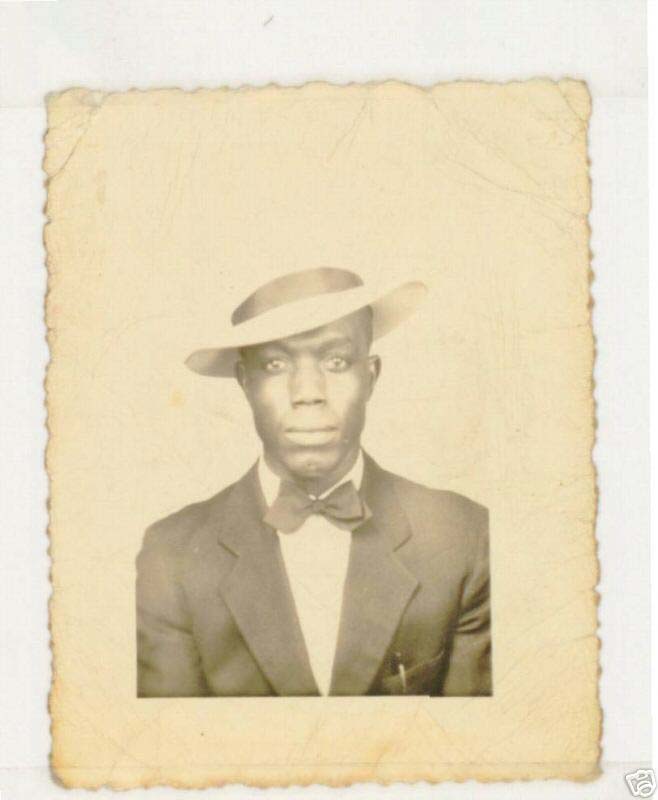
Johnson’s legend circulated amongst the blues community and small towns of rural Mississippi. Pete Welding, a writer for Down Beat Magazine, once asked Son House about Johnson’s seemingly overnight mastery of the guitar. House recounted the legend. It was then featured in a 1966 issue of Down Beat and effectively what we know as the Crossroads Myth began.
Many believe this man of this legend to be The Devil, and this exchange a Faustian agreement in which Johnson sold his soul to be a great guitar picker.
Many believe this man to be Sloan.
While there are many rumors of Sloan’s tutelage and impact on the blues, one detail of Sloan’s life we know for certain. He taught Charlie Patton, one of the most important men to ever pick up a guitar, how to play.
When Patton was nearing nine or ten years of age, his family moved to The Dockery Plantation, the same plantation where, later, Johnson would learn the instrument. At Dockery, Patton met Henry Sloan. He would prove to be a mentor to Patton and his single greatest influence. Patton followed him everywhere. Son House and Tommy Johnson, who played with Patton, remarked that Patton “dogged every step” of Sloan’s. It is through this close relationship, and several years as Sloan’s accompanist, that Patton became one of the greatest guitar pickers to ever live, and to some “the Father of the blues”.
Patton later taught the guitar to Howlin’ Wolf and John Lee Hooker and played with such greats as Willie Brown, Tommy Johnson and Son House.
In 1929, Paramount Records approaches Patton, offering to take him to Richmond, Indiana to make a recording. He makes fourteen, one of which, “Pony Blues” he composed at the age of 19 and is now a part of the National Recording Preservation Board of The Library of Congress. Paramount releases “Pony Blues” as his first recording. It sells well. Later that year, Paramount approaches Patton again, this time offering to take him to Grafton, Wisconsin. He records 28 sides, some of his most famous to date. Early the next year, Paramount taps Patton again to come to Grafton. Patton only has a few sides left, four to be exact, so he brings with him Louise Johnson, Willie Brown and Son House. Johnson records four sides, Brown two, and Son House nine.
Of the nine sides House recorded for Paramount, only eight were released. All were commercial failures. House would not record again commercially for 35 years, but despite the dismal sales figures of House’s Paramount sides, they would come to ensure his legacy as one of the best to have ever had the blues.
“Dry Spell Blues Pt. 1” and “Dry Spell Blues Pt. 2”, the first two sides House recorded for Paramount, illustrate the radiant finger-picking, thundering screech-and-bellow and dark, desperate imagery for which he is known. House coarsely screams, “The dry spell blues have fallen,” and then seamlessly wails with the force of a bus, “drive me from door to door.” He repeats the phrase, and follows it with a characteristically ominous prediction of demise: “The dry spell blues have put / everybody on the killing floor.” Beneath this farmer’s lament, a repetitive, low-end strum-and-hammering anchors the intense, piercing plucks that, as if super-heated, seem to spit from House’s steel strings onto the “Dry Spell” melody. House, never a large man but nonetheless as fearless and formidable as one would expect a man alleged to have killed in self-defense to be, sings and picks with the power of a giant. As if possessed, his timbre is penetrating, ghostly, terrifying. “Well, I stood in my backyard / wrung my hands and screamed,” he sings, and you see him. “Lord, I fold my arms and I walked away / Just like I tell you somebody’s got to pay” he sings, and you fear him.
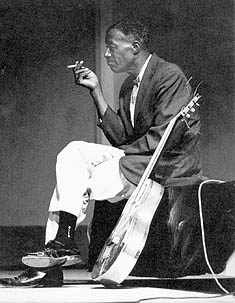 The next two sides House recorded for Paramount, “Preachin’ The Blues Pt. 1” and “Preachin’ The Blues Pt. 2”, are performed with the same fervor as “Dry Spell,” but delivered less darkly, and with different energy, one of enjoyment, not of anger and despair. House strums again an up-and-down rhythm peppered with similarly striking plucks as in “Dry Spell”, but his fingerpicking resonates and shimmers. Unlike “Dry Spell”, it is light as air and floats above his words, ascending as far as it can until it must dip and dive back down into the deep, driving heart-beat thump of House’s thumb on the six string and his foot on the floor. This constant thump excites the sly ecstasy with which House sings, “Yes, I’m gonna get me religion / I’m gonna join the Baptist Church.” A knowing smile on House’s face seems to shape his words as he continues, “I’m gonna be a Baptist preacher / and I sure won’t have to work.” House proceeds to explain how security is the only value he sees in religion, and he’d rather find the Spirit in women and the blues. Of his preference for a good time, he sings, “Oh, I’d-a had religion / Lord, this every day /
But the womens and whiskey / Well, they would not set me free,” and that doesn’t bother him. He doesn’t miss it, and sings of that fact with rapturous joy in Pt. 2, when he concludes that his religion is his own: “Whoa, I’m gonna preach these blues now / and choose my seat and sit down / When the spirit comes, / I want you to jump straight up and down.”
The next two sides House recorded for Paramount, “Preachin’ The Blues Pt. 1” and “Preachin’ The Blues Pt. 2”, are performed with the same fervor as “Dry Spell,” but delivered less darkly, and with different energy, one of enjoyment, not of anger and despair. House strums again an up-and-down rhythm peppered with similarly striking plucks as in “Dry Spell”, but his fingerpicking resonates and shimmers. Unlike “Dry Spell”, it is light as air and floats above his words, ascending as far as it can until it must dip and dive back down into the deep, driving heart-beat thump of House’s thumb on the six string and his foot on the floor. This constant thump excites the sly ecstasy with which House sings, “Yes, I’m gonna get me religion / I’m gonna join the Baptist Church.” A knowing smile on House’s face seems to shape his words as he continues, “I’m gonna be a Baptist preacher / and I sure won’t have to work.” House proceeds to explain how security is the only value he sees in religion, and he’d rather find the Spirit in women and the blues. Of his preference for a good time, he sings, “Oh, I’d-a had religion / Lord, this every day /
But the womens and whiskey / Well, they would not set me free,” and that doesn’t bother him. He doesn’t miss it, and sings of that fact with rapturous joy in Pt. 2, when he concludes that his religion is his own: “Whoa, I’m gonna preach these blues now / and choose my seat and sit down / When the spirit comes, / I want you to jump straight up and down.”
Son House’s signature song, “My Black Mama Pt.1” and “My Black Mama Pt.2”, he recorded next. Later reworked into “Death Letter” or “Death Letter Blues”, and famously covered by The White Stripes, it is House’s most well-known song, and for this author’s money, his best.
House sings of a classically tumultuous relationship. “Oh black mama / what’s the matter with you?” he asks. “Said if it ain’t satisfactory / don’t care what I do,” he complains, but despite her 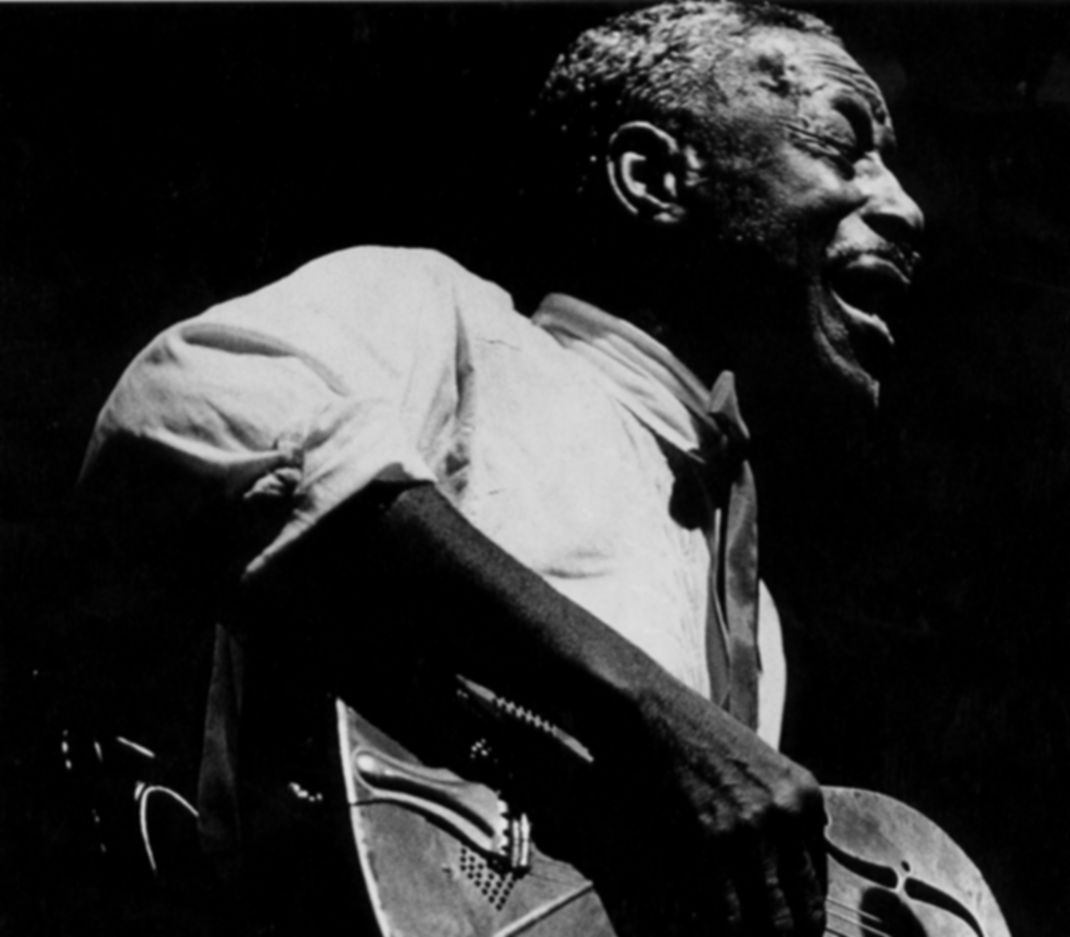 nagging and negativity he finds her so beautiful and knows in his bones he loves her more than he could any other woman. “Well my black mama’s face / shine like the sun
/ Oh lipstick and powder sure / won’t help her none.” He sings her praises until the housework suddenly seems to go undone and he hasn’t seen his mama in sometime. It is then he realizes she has gone. He is hurt and distraught, resolved to leave her, but in Pt. 2, he receives a letter: “I solemnly swear Lord / I raise my right hand
/ That I’m goin’ get me a woman / you get you another man /
I got a letter this morning / how do you reckon it read?
/ Oh, hurry, hurry, / gal, you love is dead”. House must go to the Coroner’s to identify her body. He sees her upon the cooling board and returns home in a deep depression. Another up-and-down strumming pattern, seemingly more frantic than in his other blues, separates quick, choppy bursts of picking and sliding. The single chords House repeatedly strums during the chorus and refrain and the repetitive sound they create evoke the monotonous insanity often brought on by overwhelming grief. To ease his pain, he calls out a line that echoes through the songs of many, many bluesman before and after, a line that derives its power from the very soul of the blues: “Some people tell me the worried blues ain’t bad / Buddy, the worst old feelin’, Lord, I ever had.” His woman is gone from this earth, and it hurts, but nothing hurts quite like being left.
nagging and negativity he finds her so beautiful and knows in his bones he loves her more than he could any other woman. “Well my black mama’s face / shine like the sun
/ Oh lipstick and powder sure / won’t help her none.” He sings her praises until the housework suddenly seems to go undone and he hasn’t seen his mama in sometime. It is then he realizes she has gone. He is hurt and distraught, resolved to leave her, but in Pt. 2, he receives a letter: “I solemnly swear Lord / I raise my right hand
/ That I’m goin’ get me a woman / you get you another man /
I got a letter this morning / how do you reckon it read?
/ Oh, hurry, hurry, / gal, you love is dead”. House must go to the Coroner’s to identify her body. He sees her upon the cooling board and returns home in a deep depression. Another up-and-down strumming pattern, seemingly more frantic than in his other blues, separates quick, choppy bursts of picking and sliding. The single chords House repeatedly strums during the chorus and refrain and the repetitive sound they create evoke the monotonous insanity often brought on by overwhelming grief. To ease his pain, he calls out a line that echoes through the songs of many, many bluesman before and after, a line that derives its power from the very soul of the blues: “Some people tell me the worried blues ain’t bad / Buddy, the worst old feelin’, Lord, I ever had.” His woman is gone from this earth, and it hurts, but nothing hurts quite like being left.
Often dubbed “the holy grail” of lost blues recordings, House next put to tape “Clarksdale Moan”, a tribute to Clarksdale, Mississippi, House’s birthplace. The recording was the only of House’s rumored to be lost. It was in this absence it held its importance. Previously unheard outside of House’s time, in 2005 an anonymous collector discovered the only copy currently known to exist. While lyrically insignificant, House’s blistering fingerpicking and soaring single-string slides make “Clarksdale Moan” an exhibition of some of the finest finger-work of his career.
Also lost, as it was the A-side to “Clarksdale Moan”, “Mississippi County Farm Blues” is thought to be House’s first-hand account of his convicted murder. Said to have shot a man in self-defense after said man had gone on a shooting spree, House sings of enduring an unwarranted fate, “They put me in jail, wouldn’t let me be / Put me in jail, would not let me be / They said I killed old Leroy Lee,” his guitar echoing his voice, rubbing his back, commiserating with him and soothing his soul. He laments his wrongful imprisonment and resents the police and court system for handing down a sentence not only to an undeserving man, but a sentence more severe than most cold-blooded murders: “Some got six months and some a year / Some got six months, lord, and some a year / Poor me, poor me got lifetime here.” In actuality, House received 15 years, and served two , but to a 25 or 26-year old, the age at which House was convicted, 15 years is nearly a lifetime. Being so young, House did not have the foresight to imagine a time beyond prison. Distressed by an impending decade and a half behind bars, he wishes more than anything to go back to his childhood, a time before crimes and before even punishment. Above the mournful arpeggio of House’s masterful finger-picking, he cries, “Wish I was a babe in my mama’s arms / Wish I was a baby in my mama’s arms / Wouldn’t-a been here working on the County Farm.” Of course, such a desire is impossible to fulfill. And so he must press-on and accept life in, and after, prison.
He does so with a wink and a nod to Robert Johnson and, in the process, himself.
For his last Paramount side, House chooses to record “Walkin’ Blues” a song that Johnson had composed as a reworking of House’s own “My Black Mama”. With “Walkin’ Blues” House concludes his first recording session ever with an homage to himself, a cocky gesture, a suggestion of perceived self-worth and perhaps things to come. Could House have known the impact he would have on the world of blues? Could House have known, after being virtually forgotten, of his own rediscovery by The Library of Congress ten years later, and 21 years after that by the world at-large? Could House have known that these songs would be responsible? He tells it best, in the last stanza of his brilliant, 1930, “Walkin’ Blues”:
You know I’m going away / I’ll stay a great long time / I ain’t coming back here / until you change your mind / Oh, I’m going away / I believe I’ll stay a great long time / I said I ain’t coming back, honey / until you change your mind.
Written by Ben Brundage. Check out Ben’s Tumblr: Damned Fine Lion
 Thought on Tracks
In The Dust #3: John Coltrane ‘A Love Supreme’
Once a week In The Dust rolls up its sleeves and digs to the back of the rack to find that record, the one you never knew you always wanted, the one that’s lost, but not forgotten. (Listen via Spotify)
This is the Holy Grail.
I wish I could leave it at that, but a record this dense, of this magnitude, of such indescribable brilliance—while with opaque brevity seems the only effective way to approach it, this record deserves more.
John Coltrane recorded A Love Supreme in a single day, on December 9th, 1964, at Van Gelder Studios in Englewood Cliffs, New Jersey. The personnel list is a veritable who’s who of hard bop: Jimmy Garrison on double bass, McCoy Tyner on piano and Elvin Jones on drums. The album is structured as a four-song suite and clocks in at a trim 33:02, but as many physicists contend that an entire universe can exist in a single atom of one’s fingernail, so does a universe in every note of A Love Supreme.
At the albums center is a single concept and a single motif. Coltrane writes in his liner notes to A Love Supreme, “This album is a humble offering to Him. An attempt to say “THANK YOU GOD” through our work, even as we do in our hearts and with our tongues.” It is indeed a spiritual album, a prayer, one over the course of which Coltrane embarks on a quest for understanding and purity. Through this suite, Coltrane wishes to establish a communion with God and express to Him a realization that neither his talent nor his horn are his own, but rather gifts from Him, and for that he is grateful.
Coltrane establishes this communion in a sequence reminiscent of said prayer. Of the structure, Coltrane writes:
The music herein is presented in four parts. The first is entitled “Acknowledgement,” the second, “Resolution,” the third, “Pursuance,” and the fourth and last part is a musical narration of the theme, “A LOVE SUPREME,” which is written in the context; it is entitled, “Psalm.”
Part I, “Acknowledgement” is Coltrane’s “Dear God.” It begins with a gong, a call to attention, over which Coltrane floats a repetitive fanfare that is a loose variation on the piece’s central theme. From beneath Coltrane’s rooster-crow, Elvin Jones washes his way into focus with dusty cymbal crescendos and rolls. It is then, in the deep groove of Garrison’s double bass, we first hear the central motif: “ba-dum ba-dum, ba-dum ba-dum.” Garrison leads this motif as it is repeated four times. Jones then strikes the beat. It is repeated four more times and Tyner joins with a smattering of complementary chords. It is repeated eight more times, as if to set the stage for the main attraction, and Coltrane returns, sliding onto the forefront of the aural canvas with break-neck modulated variations, at which point Garrison retreats and all proceed to follow the master. Coltrane’s horn seems to cry out with the repressed anguish of every past transgression, first in a spitfire wailing, like a pressurized liquid breaking its seal, and later in controlled four-note bleats, as if he has nothing more to confess, no more tears to cry, and is now apologizing to Him, pleading that he’s been a believer all along. These four-note bleats slowly recede into the most visceral, penetrative moment of the album: a vocal refrain from Coltrane himself of the albums theme: “A Love Supreme,” a final acknowledgement, a moment of peace in knowing that if one can muster confession, He can muster forgiveness.
Part II, “Resolution,” begins, as did Part I, with Garrison leading, this time alone. He rapidly plucks sharp pairs of repeating notes with palpable determination, generating a forward momentum, on which Jones, Tyner and Coltrane can simultaneously jump. They attack with a purposeful and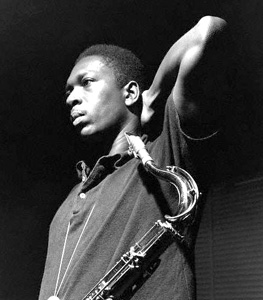 deliberate ferocity, one that they effortlessly maintain throughout “Resolution,” one that echoes the very title of the movement itself. Coltrane has concluded his address to God, not-so-literally acknowledging own misdeeds and misgivings and His grace and power, and graduated to discussing with God what he believes he can do to atone and gain His favor. Coltrane’s resolve comes in the form of two fervent, insistent solos, both foreshadowing and echoing each other respectively, and separated by, as if from His own lips, a strict, capable, and somehow patiently impassioned retort from the keys of McCoy Tyner. Coltrane pleads to be a better man, promising that by giving ownership of his talent and craft away to a higher power, he will become a conduit for Him, and thus more powerful himself. The movement bookends how “Acknowledgement,” began not with a bang, but with a whimper: Jones crashes hard, then rolls softly and washes into the ether as the band slowly and carefully descends and side 1 hisses to a close.
“Pursuance,” Part III of the suite, the beginning of the second side and the centerpiece of the album, is Coltrane’s response to what he proposed in “Resolution.” It begins, appropriately enough, with a drum solo from Elvin Jones. Jones was once asked how he and Coltrane are capable of making the music they do. Jones famously responded, “To play the way we play, you have to be willing to die for the motherfucker.” Jones’s solo is a perfect example of this, and a fitting retort to “Resolution.” He begins in empty space, tapping inquisitively on his ride cymbal and tentatively on his toms until runs begin to materialize, along with his confidence and direction, which take their shape before you as if by magic. He slowly emerges from an ambient whisper to practically scream, “We told you about it, now watch us do it!” From the first notes out of Coltrane’s horn, a walking bounce of sorts, it’s clear that “Pursuance,” is pure action! Coltrane sets this tone and immediately passes it to Tyner for further exposition. Tyner sprints his way up and down the keyboard, tickling wind-chime runs that he breaks with terse, round chords as Jones rides hard and Garrison walks the bass behind him. Coltrane breaks back in over Tyner with fire and brimstone. Inaction is sin! No more propositions! Each member of Coltrane’s band asserts that suggestions and hints have occupied their place in this suite and now it is time for execution. And heads do roll.
Part IV, “Psalm,” is the spire on the church, as the cherry is to the sundae. In his description of the suite, Coltrane refers to “Psalm” as a ‘musical narration’ of his devotional poem of same name as the album, included in the liner notes. The poem reads as follows:
A Love Supreme
I will do all I can to be worthy of Thee O Lord.
It all has to do with it.
Thank you God.
Peace.
There is none other.
God is. It is so beautiful.
Thank you God. God is all.
Help us to resolve our fears and weaknesses.
Thank you God.
In You all things are possible.
We know. God made us so.
Keep your eye on God.
God is. He always was. He always will be.
No matter what…it is God.
He is gracious and merciful.
It is most important that I know Thee.
Words, sounds, speech, men, memory, thoughts,
fears and emotions—time—all related …
all made from one … all made in one.
Blessed be His name.
Thought waves—heat waves—all vibrations—
all paths lead to God. Thank you God.
His way…it is so lovely…it is gracious.
It is merciful—Thank you God.
One thought can produce millions of vibrations
and they all go back to God … everything does.
Thank you God.
Have no fear…believe…Thank you God.
The universe has many wonders. God is all. His way…it is so wonderful.
Thoughts—deeds—vibrations, etc.
They all go back to God and He cleanses all.
He is gracious and merciful…Thank you God.
Glory to God…God is so alive.
God is.
God loves.
May I be acceptable in Thy sight.
We are all one in His grace.
The fact that we do exist is acknowledgement of
Thee O Lord.
Thank you God.
God will wash away all our tears…
He always has…
He always will.
Seek Him everyday. In all ways seek God everyday.
Let us sing all songs to God
To whom all praise is due…praise God.
No road is an easy one, but they all go back to God.
With all we share God.
It is all with God.
It is all with Thee.
Obey the Lord.
Blessed is He.
We are from one thing…the will of God…
Thank you God.
I have seen God—I have seen ungodly—none can
be greater—none can compare to God.
Thank you God.
He will remake us … He always has and He
always will.
It is true—blessed be His name—Thank you God.
God breathes through us so completely…so gently
we hardly feel it…yet, it is our everything.
Thank you God.
ELATION—ELEGANCE—EXALTATION
All from God.
Thank you God. Amen.
Coltrane, in his ‘musical narration’, effectively “plays” these words to close the suite. Over the thick, heavy pulse of Tyner’s chords, the asymmetrical, tympanic rolling of Jones’s drums, the sizzling splash of his cymbals, and the flurried thumping of Garrison’s bass beneath Jones, Coltrane pours his soul from his horn, echoing the messages of each previous movement, and speaks of new life emerging from them. “I will do all I can to be worthy of Thee O Lord. / It all has to do with it. / Thank you God,” he sings, repeating his “Acknowledgement.” “One thought can produce millions of vibrations / and they all go back to God … everything does. / Thank you God. / Have no fear … believe … thank you God,” he sings, colored with the promises of “Resolution.” “No road is an easy one, but they all / go back to God. / With all we share God. / It is all with God. / It is all with Thee. / Obey the Lord. / Blessed is He. / We are from one thing … the will of God … thank you God. / I have seen God – I have seen ungodly – / none can be greater – none can compare to God. / Thank you God,” he sings as we retrace the steps along the road of “Pursuance.” He concludes both his ‘musical narration’ and his poem, “ELATION-ELEGANCE-EXALTATION / All from God. / Thank you God. Amen,” and he summons from his horn a cry of mad and tearful ecstasy, like Baldwin’s John in Go Tell It On The Mountain, writhing on the floor of a Calvinist Church, screaming, disoriented and exhausted, aching from the intense mental trial of being saved. Coltrane’s last breath passes in a flurry of notes and dies softly, as if he is drained of it, and with it the last of him is gone. He will continue to blow his horn, but he will not own it, and it will not be his breath that fills it. It will be His.
Written by Ben Brundage. Check out Ben’s Tumblr Damned Fine Lion.