


In the Dust #7: Magic Sam Blues Band ‘West Side Soul’

Once a week In The Dust rolls up its sleeves and digs to the back of the rack to find that record, the one you never knew you always wanted, the one that’s lost, but not forgotten.
When asked if Magic Sam would, were he still alive today, rank on the same echelon of the blues annals as the great Buddy Guy, Delmark’s Bob Koester, producer of Junior Wells’ Hoodoo Man Blues (last week’s In The Dust), responded without hesitation, “Yes, indeed, oh, God, yes!” Early this year, Delmark reissued Magic Sam’s classic Chicago blues opus, West Side Soul. Long a record with a deep and rabid cult following, Magic Sam and West Side Soul are to the novice blues fan what finding $1000 in your pants pocket is to the rest of us. His is not a name that is often tossed around outside of deep blues circles. Granted he is certainly not unheard of, but he is certainly, and most criminally, under-heard of.Born in Grenada, Mississippi, just after the action of the first Great Migration and just before the second, Samuel “Magic Sam” Gene Maghett was raised in an era of Mississippi life during which Chicago hung heavy in the air. The idea of Chicago was now a bona fide one. While still an achievement, it was also a newly realistic and widely attainable destination, promising a prosperous life for blacks of the South.
The trip from Mississippi to Chicago is a subject of myth in many of the blues songs Sam grew to admire. He began, early in his youth, listening to the records of Little Walter and Muddy Waters, who were among the first wave of Chicago-style blues titans. Inspired by the hot, heavy sounds of these records, Sam fashioned a variation of what is known as the Diddley Bo, a string nailed to a board or wall and stretched by hand, and set about learning the guitar.
Sam moved to Chicago at the age of thirteen, where he began gigging as a guitarist on Chicago’s West Side. By nineteen Sam signed to Cobra Records, where the great Buddy Guy was his label mate, and began recording singles. None of them made the charts, but all were greatly influential, especially to fellow Chicago bluesmen.
But like the careers of many artists inopportunely stalled, Sam was drafted into the Army. His service was short-lived, as Sam deserted soon after reporting for duty. He was caught and imprisoned as a result, issued a dishonorable discharge and returned to Chicago, but somewhere in the rigmarole Sam had lost his mojo. Subsequent recordings for Chief Records were found wanting, Mel London, the label’s chief, citing that Sam had lost his energy, his soul.
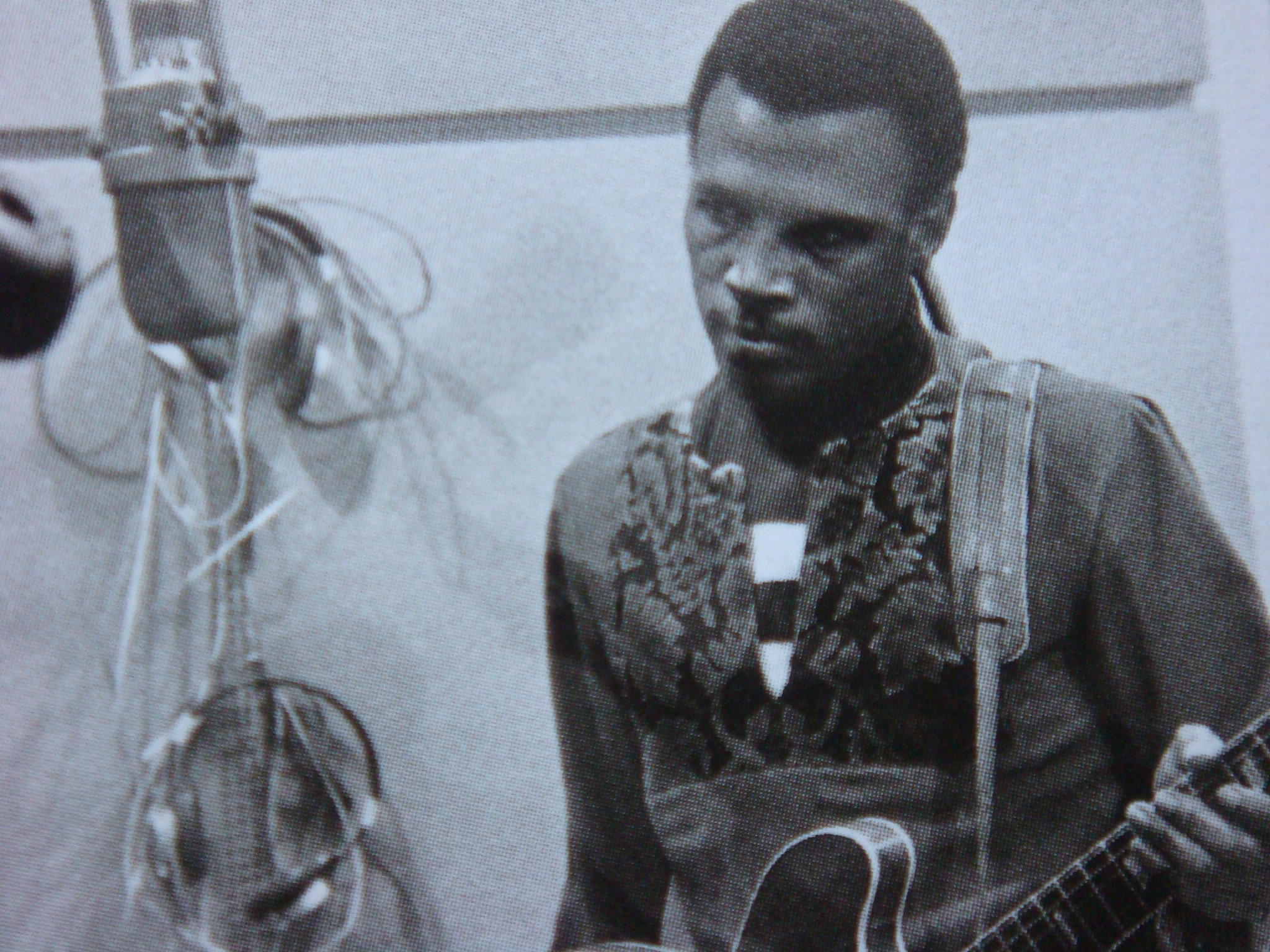
Luck struck and in 1963 Sam grazed the charts with a hit single, “Feelin’ Good (We’re Gonna Boogie)”, and Sam embarked on a tour of the US, Germany and the UK. Upon his return in 1967, Bob Koester signed Magic Sam to Delmark and, appropriately enough, that is where the magic happened.
Magic Sam and his band recorded West Side Soul in 1967 over the course of two days, two months apart from one another. The name is a reference to a particular new brand of blues, a crisper, more polished Chicago style that bordered closely on blues-inflected soul music. Much like the music of Junior Wells and Buddy Guy, West Side Soul is at times smooth as butter, but also raw, uninhibited and carnal. Thanks in part to Bob Koester and his hands-off production style, the album is akin to Hoodoo Man Blues in the sense that it captures the unadulterated energy of the Chicago blues club, and the music of Magic Sam itself, without the impurity of overdubs, extra effects and fader-tweak-heavy production techniques. Men. In a good room. Playing blues. To echo the philosophy of Bob Koester and quote Magic Sam: “That’s all I need.”
Koester granted Magic Sam the same liberties with his recordings as he did Junior Wells. Sam could pick his band and pick his track listing. Among the musicians he selected, many are staples of the West Side Chicago blues club: Mighty Joe Young on guitar, Odie Payne Jr. and Odie Payne III on drums, Mack Thompson on bass, Sam’s accomplice Shaky Jake Cadillac assisting in production and many other fine shuffle-slingers.
Half of the songs picked for the sessions are originals, but all of them Magic Sam makes his own.
The album begins with “That’s All I Need,” a Magic Sam original and a simple blues plea for love. Over the joyful, rubbery shuffle of Odie Payne III’s drums and Sam’s simple-but-ample rhythm guitar, the true jewel of Sam’s sound shines: his incredible voice. Bob Koester, perhaps, said it best:
He was a great singer. He was a great singer. I don’t judge artists by how well they play. I judge ’em by how well they sing. That’s why we record occasionally people who don’t even play an instrument.

Bookending “I Feel So Good (I Wanna Boogie)” are, for the author’s money, Sam’s two finest vocal performances on the album, “I Need You So Bad,” and “All Of Your Love,” respectively.
“I Need You So Bad” is a brilliant, almost-slow groove upon which Sam’s voice cascades down like the purest clover honey. The grace and beauty of how Sam slides into his “Oh, I, I need you so bad,” is the kind of indescribable, shiver-inducing moment of infamy that is produced outside of music only by the best meals, most existential, sunset-drenched epiphanies, greatest art, and the voice, face and scent of the most stunning, captivating woman you convince yourself you have ever seen. That said, Sam’s solos of comparable beauty are not to be overlooked. Again simple, understated, but not limp in any sense of the word, it is as much about what he is playing as what he is not, touching only the right and necessary notes, in their right and necessary order, evoking the ethos of an entire, culture, locale musical movement in 16 bars or less.“All Of Your Love,” recorded first nearly ten years prior as his premier single, is another, equally penetrative, almost-slow groove. The cadence, timber and vibrato in Sam’s repetition of the line “All of your love…” is transcendent in a similar way to “I Need You So Bad”. His voice trembles with such subtlety and lovely uncertainty of control that it seems to shake the listener’s heart along with it. The radiant tremolo and reverb of Sam’s lead line applies much needed complimentary heat to his sultry vocal caress, lulling the listener into complete adoring submission, in which the listener willingly remains until the albums end.
“I Don’t Want No Woman,” is Sam’s assertion of perpetual independence in the face of adoration. While he craves love and affection, he also “don’t want no woman telling [him] what to do”. He is “grown now, woman / just as grown as you”. Classic of cocksure bluesmen, singers, harpists, lead guitarists and singular virtuosos of importance in general, the frequent reminder of autonomy and alluded-to-if-not-totally-affirmed infidelity is the milk to the cookies of this textbook, bar-burning blues jam. As sure it shines on record as it would in the blues club, “I Don’t Want No Woman,” is two hands on the bootstraps of every red-blooded blues-loving male, regardless of his personal disposition to companionship and faithful behavior. “You used to boss your men,” Sam sings, “of that I won’t deny / Before I let you boss me I’ll lay down and die / I don’t want no woman / Tellin’ me how to live my life / Yes, I’m gonna leave you, darlin’ / ‘Cause I don’t want no wife,” admittedly, a variation of a sentiment that has crossed the mind of every man.
West Side Soul being a Chicago blues classic, and Magic Sam being a Chicago bluesman, he also performs a cursory rendition of the Robert Johnson standard, “Sweet Home Chicago,” of which the author will say nothing more than that, for what it is, this version is one of the best, purest, least tired and most replay-able versions he has ever heard, aside from Johnson’s original and that of other delta bluesmen. Sam’s solo is, per usual, immaculate.
Every song on this record, in its own right, is a gem, especially “Every Night and Every Day,” a trim 3:11 slow groove that Sam occupies with trademark poise, issuing one of the most understatedly beautiful vocal performances in electric blues. All flourishes in the right place, it is Sam’s subtle hand, and voice, at work again to craft a painfully perfect, tantalizingly succinct and satisfying blues bite that commands you eat everything else around it as well. And, again, Sam’s solo is immaculate.
Magic Sam, in the words of Bob Koestner, was a great singer, and stands as one of the best in the blues. West Side Soul proves that, and Koester knew it all along.
[Sam] wasn’t a great music writer, but he wrote some nice lyrics and he picked some damn good songs, and he as a damn good singer and a damn good guitar player, and probably got some records in the collections of a lot of rock ‘n’ roll musicians I would imagine.
Willie Dixon, famous contrabassist and songwriter for Chess Records, stolen-from by umpteen artists (most famously Led Zeppelin), and later, one of Sam’s producers, recalled Sam’s sound with distinction:
“Magic Sam had a different guitar sound. Most of the guys were playing the straight 12-bar blues thing, but the harmonies that he carried with the chords was a different thing altogether. This tune “All Your Love”, he expressed with such an inspirational feeling with his high voice. You could always tell him, even from his introduction to the music.
Soon after his breakthrough performance at the Ann Arbor Blues Festival in 1969, Sam died of a heart attack, a tragic turn of events on the eve of a string bookings in the US and Europe. It is because of Sam’s untimely death that his oeuvre is widely unknown. While West Side Soul and Black Magic are largely considered his finest works, all of Sam’s work is special simply because Sam himself is special, not because he is unknown, but because when you put on a Magic Sam record you feel something. You feel like a thousand dollars has slipped into your pocket. Like Sam says, you “feel so good.” You feel like magic.
Written by Ben Brundage Check out Ben’s Tumblr Damned Fine Lion
In the Dust #6: Junior Wells’ Chicago Blues Band ‘Hoodoo Man Blues’
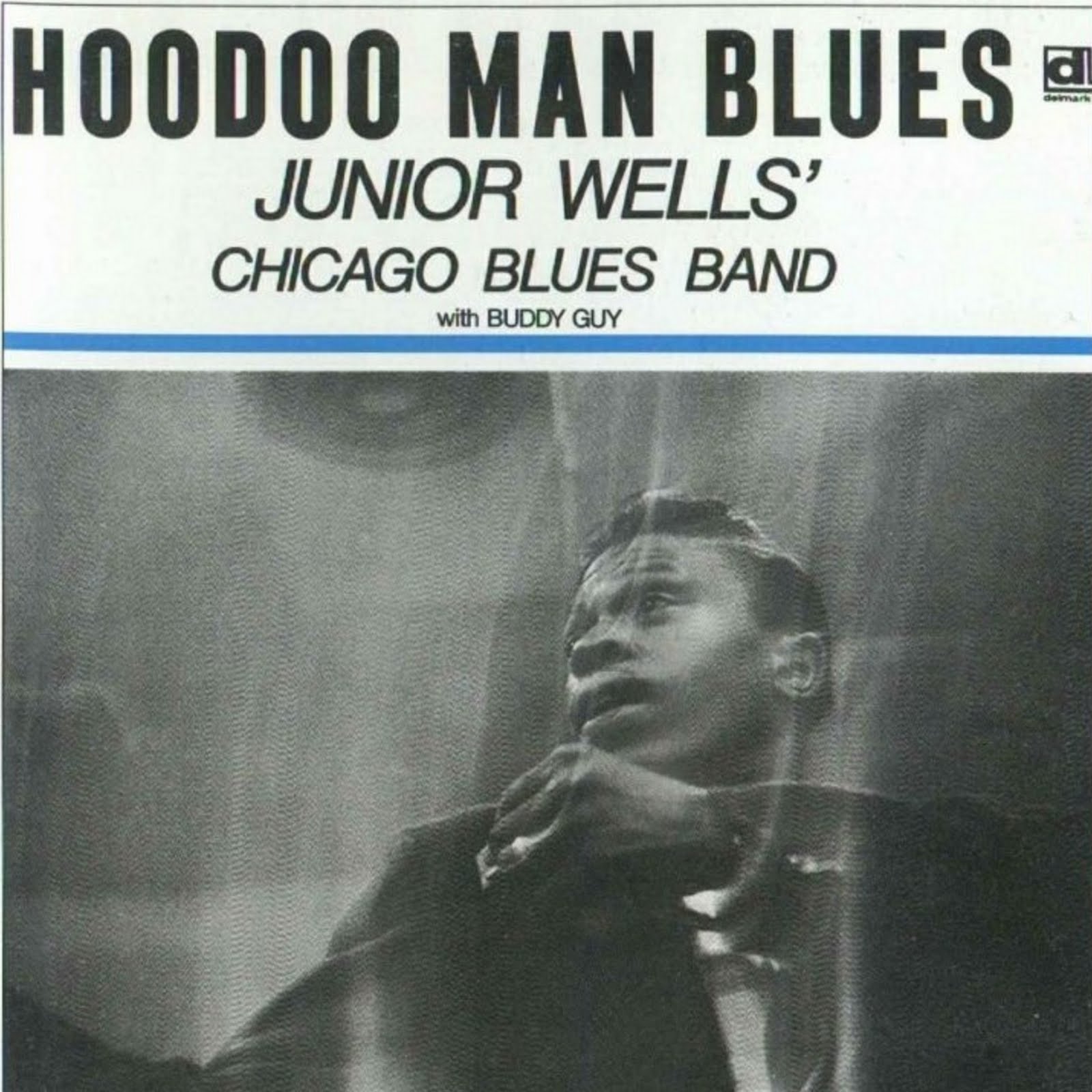
Once a week In The Dust rolls up its sleeves and digs to the back of the rack to find that record, the one you never knew you always wanted, the one that’s lost, but not forgotten.
hoo·doo
noun
1. Magic healing and control, especially in African-based folk medicine in the United States and the Caribbean. Also called conjure.
2. a. Bad luck.
b. One that brings bad luck.
verb
1. bewitch
Almost mystically so, Hoodoo Man Blues, Junior Wells’ first full-length record as a bandleader, began with a feeling.
Bob Koester, a Record Producer and founder and Chicago label Delmark record, had heard Don Kent, of Yazoo Records, and others whisper about a kid who played the harp. They said he’d been playing since the age of seven. They said he learned it from Sonny Boy Williamson II. They said he was good, so good, in fact, that he replaced Little Walter to blow for Muddy at 18. Koester knew he had to find this kid. He remembers his first encounter with Junior well:
I first heard Junior Wells on the States 78’s of “Hoodoo Man“, etc. during my days in St. Louis. I later heard the Muddy Waters band on a trip to Chicago, at the Club Zanzibar c.1957 and was perturbed that Little Walter had left and a new guy had taken his place but when I requested Key To The Highway and Muddy said, “I think Junior Wells does that better than I do.” Junior certainly cut Walter in the vocal department.
By the time Koester found him, Wells had stirred more than just a whisper, but had yet to record a full record. He had already made a name for himself within the Chicago bluesman scene, blowing for The Aces, Muddy Waters and solo for labels such as States, Profile and Chief, where his single, “Little By Little” rose to #23 on the Billboard R&B charts, but he was still relatively unknown outside of those who played the blues on Chicago’s South Westside.
Wells had a few scattered singles under his belt but nothing in which Koester could find the confidence to give him his own record. Wells was only 21. Koester was not sure if Wells could carry 2 sides, 30+ minutes, 10+ tracks. He also doubted that Wells’ music would find the audience necessary to fund the expense of sidemen and ample recording time, given their unusually crisp, urban style, one that featured band uniforms and synchronized movement, which was, of course, a world away from blues, bordering more closely on Motown.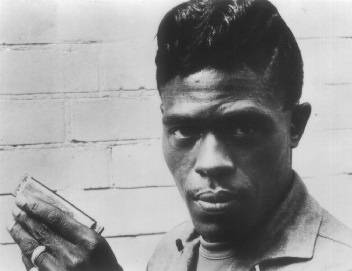
But Koester had a feeling about Wells, one he kept with him since the first moment he saw him blow with Waters in ‘57. Wells’ voice, musicianship, and sense of movement made him a naturally infectious performer, and Koester liked it too much to resist.
He gave Wells the record, and even allowed Wells’ to choose his own band and his track list, without restrictions. The sessions followed resulted in what is one of the greatest blues records ever made, and one of the most genuine, accurate documents of the Chicago blues sound in existence today.
The track list Wells selected is about half original and half blues standards, of which it featured “Good Morning Little Schoolgirl,” a song written by his mentor, Sonny Boy Williamson II, “Hound Dog,” by Leiber and Stoller, “Early In The Morning,” a traditional, and “Yonder Wall,” by fellow Chicago axe-man and “King of the Slide Guitar,” Elmore James.
Perhaps the most noteworthy decision of the entire session, Wells’ invited a 29-year old Buddy Guy to play guitar. This, as it was for the 21-year old Wells, Guy’s first crack at a full studio album. Wells’ rounded out the rest of the group with top-notch session men and Southside bar bluesmen.
The pair of Wells and Guy proved to be an unstoppably ebullient and explosive combination. From the first hit of the first track, “Snatch It Back And Hold It”, the pure force their relationship is palpable. The guitar, drums and bass play in unison a fanfare of a single note, but in this single note is more confidence, attitude and pure ferocity than many whole records of the time. This cocky snarl is accentuated by Koester’s, and all of the Delmark people’s, urge to bring the purely carnivorous Chicago blues sound out the bar and into the perfect acoustics of a recording studio, while leaving its spirit unadulterated. The sound is so raw, so live, so pure, allowing Wells’ natural charisma and masterful harp, Guy’s guitar and the innate infectiousness of their particular blend of Chicago blues-funk-soul to carry itself. “Somebody help me! / I can’t help myself,” Wells screams, as if under his own spell. As with classic blues lore, Wells must seek a way to shake off his hoodoo. The band is just too nasty, the music has a mind of it’s own, and Wells is caught in the undertow. The only way he can release himself is to wail and blow it out until the tidal wave spits him out.
“Hound Dog,” the Leiber and Stoller classic that launched the careers of, first, Big Mama Thornton and, later, Elvis Presley, is re-imagined as a crisp, frenetic sweat-storm and platform for Wells’ electrified harp lines and Guy’s masterful picking. Clocking in at an astonishingly lean 2:11, it is more a display of Wells’ Chicago Blues Band’s mastery of their craft than homage to the blues itself. In the energy of “Hound Dog” and the dogged efforts of his drummer Bill Warren, there is a certain trance-like quality, which is echoed by Guy’s repetitive complimentary guitar, peaking the album’s energy, solidifying that the listener is under his hoodoo, before it brings it back down in preparation for the record’s slowest, smoothest number, “In The Wee Hours.”
Bring with it the sizzling, sultry swing of the Southside Chicago barroom, “In The Wee Hours,” is the finer of Wells two attempts at slow-groove on the record. Following the frantic intensity of “Hound Dog,” “In The Wee Hours,” functions as a sleepy, hypnotic lobotomy, slicing the crown from the listeners head and slowly sinking its long, dark fingers deep inside to slice and tweak and toy, destroying in the process any previous conceptions of how profound a sub-four minute song can be, how good Chicago blues can be and how indescribably hot Junior Wells and his Chicago blues band can serve it up. Wells’ harp wafts lightly over the steamy, clean lines of Guy’s sensual and cryptically suggestive guitar. The delicate, light touch of Warren’s drums and Jack Myers’ subtle, driving bass add indispensible accoutrement to the midnight-moonlight atmosphere in which Guy and Wells are free move. Almost completely devoid of lyrics, the song has Junior, as in “Snatch It Back And Hold It,” pleading for help. He sings “I just need somebody / Somebody got to help me / Oh, Lord, to sing these blues / Lookie here, Lookie here, baby,” before embarking on a mournful, ethereal harp solo. Guy lends as much help as he can muster, summoning a lean, choppy solo that stands as one of his finest licks on the record, but the tone Wells’ harp is so lost, forlorn, spectral it is clear that Wells is still hopelessly under the spell, beyond assistance, hoodoo’d by the blues and desperately trying to play his way out.
The album’s title track comes soon after, leading off side A with another fanfare, a classic blues turn around in which the band bangs out together, compounding the swinging 4/4 blues rhythm to create a rambling, tumbling feeling that propels the listener into the center of the groove, where it is instantly apparently that Buddy Guy’s guitar sounds remarkably different. Guy’s amplifier stopped working part way through the Hoodoo Man Blues sessions, and so they chose to wire his guitar through the Leslie speaker of a Hammond B-3 organ, the effect of which is distinctive and has since inspired guitarist for generations. It adds a welcomed mystically to the track, in line with the spirit of hoodoo, and a poignant juxtaposition to Wells’ lyrics. Wells’ past pleads for assistance have fallen on deaf ears, and in “Hoodoo Man Blues,” he is determined to explain his case to, hopefully, sympathetic and potentially loving ears:
“Lord, I wonder, what’s exactly the matter / Child you know the time / It seemed like hours / Everything had changed / But I hold up my hand / Lord, I’m trying to make you understand / Lord, now, everybody tell me / Somebody done hoodoo’d the hoodoo man”
Wells is reaching out, as the hoodoo has consumed his life and he can no longer keep it to himself. The blues has grown to rule him and distort his sense of time, state of being and relationships. Somebody truly done hoodoo’d the hoodoo man.
Wells is truly afflicted, as is Guy, Wells’ band and Koester. Hoodoo Man Blues stands as, until recently, Delmark’s best-selling release of all-time, inflicting with the hoodoo man blues Bonnie Raitt, The Rolling Stones, Van Morrison, the author and many more.
In the remainder of the record, Wells never does relieve himself of the hoodoo, though he still tries. Perhaps this is the perfect sentiment for the debut record of an artist who would spend a lifetime under its spell: a hoodoo man chasing the blues.
Written by Ben Brundage
In The Dust #5: Django Reinhardt ‘The Classic Early Recordings’ (1935-1939)
Once a week In The Dust rolls up its sleeves and digs to the back of the rack to find that record, the one you never knew you always wanted, the one that’s lost, but not forgotten.
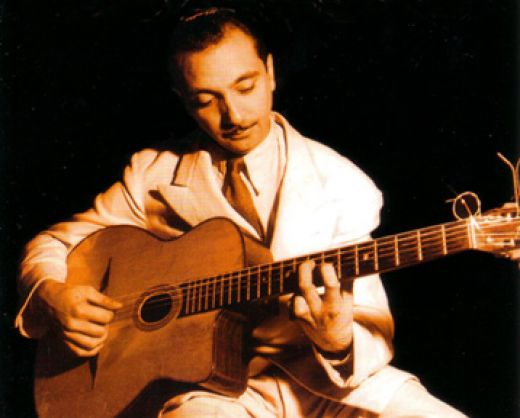
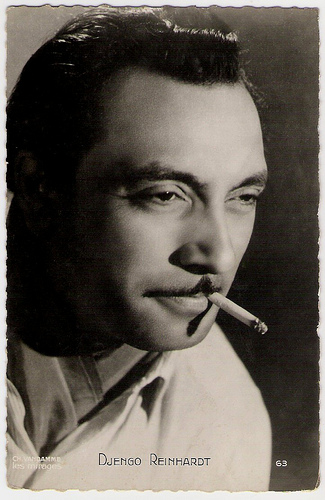
In the Belgian countryside in 1910, a baby boy was born to the Reinhardts, a family of Manouche gypsies. They named him Jean, but soon would refer to him by his nickname, “Django”, Romani for “I awake”. Little is known about his life, as such a community keeps no record, though we know just enough to account how a near-death accident begat one of the most original and most influential jazz guitar players in history.
The Reinhardts were furniture makers. They scavenged for cane or any suitable material they could find to weave it into tables, chairs, anything of necessity for potential customers. The Reinhardts lived mostly in group encampments close to Paris, but far enough away that the community’s vagrancy was not a bother.
As entertainment was hard to come by, the Reinhardt clan and their extended community included a number of talented amateur musicians and music was a keystone of life. Django exhibited an interest from an early age, learning very young how to play the violin and, later, at age 12, the banjo. Thanks to the tutelage of two older gypsy musicians, Django left furniture making behind and began playing banjo professionally one year later, at the age of 13.
By 18, Django was married, living with his wife in their own caravan, and deep into his career as a professional musician. They were desperately poor, as Django was still young and inexperienced, so his wife, Florine, sold flowers she twisted out of celluloid and paper for extra money. After returning home late from a gig, Django knocked over a candle. He went to bed, not knowing his wife’s flowers had caught flame.
Django’s neighbors pulled he and his wife to safety, but not before Django had sustained first and second-degree burns over a substantial portion of his body. His right leg was initially completely paralyzed, and the ring and pinky fingers of his left hand, the one he used to form chords, were severely burned. He was taken to a hospital, where doctors informed him they would have to take his leg, and he would never play guitar again.
Reinhardt refused the surgery. Within a year he was walking with the aid of a cane and, after receiving it as a gift from his brother, Reinhardt put aside his banjo and set about reinventing jazz guitar.
His ring and pinky fingers never overcame their partial paralysis. Reinhardt learned to play solos with just his index and middle fingers, the others he used exclusively for chording. This new technique resulted in a curious and entirely new style now referred to as “hot” jazz guitar, akin to style of New Orleans-based Louis Armstrong and his band, featuring blinding tempos and frenzied improvisations of astonishing speed and dexterity, peppered by crisp, cutting chord work.
Soon after Reinhardt’s rehabilitation and discovery of “hot” jazz, he met a young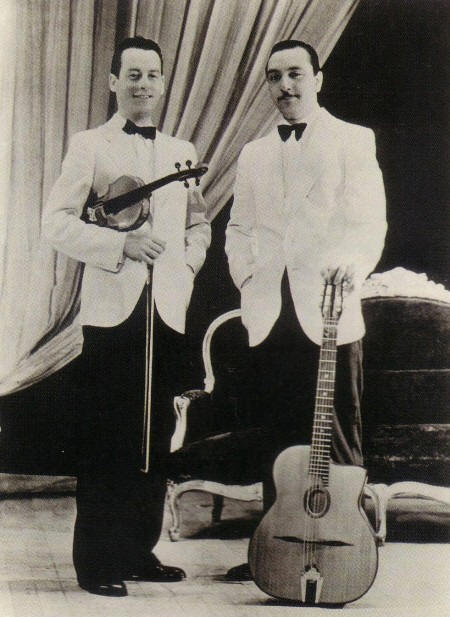 violinist named Stephane Grappelli. The two were both enamored of Louis Armstrong and shared similar musical sensibilities. Because of the radical nature of Reinhardt’s new style, paid work was nonexistent, so from the years of 1929 to 1933, he and Grappelli played only for, and with, each other and several other local musicians. These years, along with Reinhardt’s previous rehabilitation, are largely considered to be one the most important “quiet” periods in jazz, and the musical companionship of Reinhardt and Grappelli, for many, produced the finest music of either of their careers.
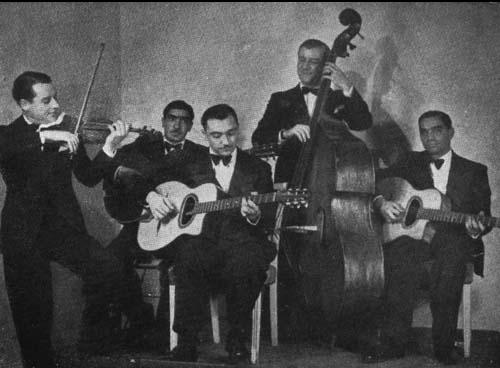
In 1934, Reinhardt’s brother, Joseph, invited Django and Grappelli to join his Quintette du Hot Club du France. Effectively no longer a quintet, the group now featured three guitars, a violinist, and a bassist, all string instruments, which at the time was rare. Occasionally the group would back a singer, but Reinhardt, his groundbreaking guitar playing and masterful interplay with Grappelli would soon become the focal point.
It is at the formation of the Quintette du Hot Club du France The Classic Early Recordings, a five-disc box set, begins, featuring the group’s first ever recordings, twenty-two sides billed as their own and four as the backing band for instrumentalists Frank ‘Big Boy’ Goudie and Alix Combelle. Of the twenty-two QHCF sides, nineteen are jazz standards or popular songs, but “Djangology”, a dizzying, jaunty, knock-kneed three minutes split into first a Reinhardt then a Grappelli solo, one of the groups first original compositions, would soon become a jazz standard itself and solidify Reinhardt, Grappelli and the entire QHCF as artists of the highest caliber.
Volume B skips ahead considerably in the chronology, as it is a collection of the 1938 & 1939 London Decca Recordings, some made with the QHCF, others with Reinhardt and Grappelli or even Django by himself. This session featured a matured, strengthened QHCF, and an equally more sophisticated Reinhardt and Grappelli. Of the songs recorded for Decca in London, about half are original compositions, most notably, “Daphne” another Reinhardt and Grappelli original that would make it’s way into the cannon of jazz standards. “Daphne” is a cheerful, almost-sing-a-long lead by Grappelli’s soaring violin, which bookends first with a refrain and then a solo and refrain a long, scaling Django solo of remarkably pure trills and triplets. The consistency of rhythm, balanced velocity and tonal quality of the band in this recording show truly proficient musicians operating at their finest, and the poise with which Grappelli and Reinhardt show in their ability to sail just over them, not overcome them, and play into and off of each other with such lackadaisical ease and seeming carelessness, alternating matador and bull, is the mark of a fully realized musical relationship.
The collection visits the concurrent Paris Decca Recordings in Volume C, also from 1938 & 1939. The vast majority of QHCF recordings and Reinhardt and Grappelli work happened in Paris, London Decca being the obvious exception, but the same competent, talented band as the London Decca sessions is now back home, in familiar surroundings, and free to feel and play as only nationals can in the country of their birth. Paris Decca features most of the core members of the QHCF, but not billed as such. These recordings are again about half standard or popular song and half original. The interesting feature of this volume is that many of the songs are collected with multiple takes and assembled from dubs, which show the striking amount of improvisation from take to take of every song recorded by Django, Grappelli and the QHCF, no matter the structure of stature of a particular tune. The differences, at times, are astounding. The two takes of “Twelfth Year” (Version 1 & Version 2) another Reinhardt original, contain some of the most incomprehensibly brilliant jazz guitar anyone has ever heard, but both swing in completely different ways, both so strongly rooted in a unique feeling worlds apart from one another, solely due to Reinhardt’s varying expression of the intro rhythm, hinting refrain and color of his improvisations. Grappelli does the same with his solos, which close out the piece. Both artists defer first to the mood, and then to each other, to craft totally flawless and entirely spontaneous performances on each and every go-around, which, to put it simply, is jazz.
We travel back in time some to 1935 & 1936 for Volume D, more Paris recordings, and some of the most exciting of the collection, those made with tenor sax legend Coleman Hawkins. While Django mostly plays sideman in these sessions, his guitar is always very audible, and there are moments where he is allowed to shine. He does not disappoint, showing up many of the bands soloists and, at times, Coleman himself. On “Avalon”, the second song of the first session, Django performs a very brief but scalding solo which he slides into with insane, frantic grace, then immediately slows to a slender syncopated picking pattern, and finally speeds back into a reckless, but never out-of-pocket, flurry of strums. On “Stardust”, the only song of the second session, we see prominently Stephane Grappelli’s remarkable skill at the piano, a delight that is featured several times in the collection. Django also gets another solo, one of similar length, but of a slower lover’s tempo so that he can really unfold. Django chimes in with a small fanfare as Coleman commences the last four bars of his solo. Django then takes over with calm, collected runs that drip contemplatively like wax from a candle, scaling up and scaling down, arpeggiating and resolving, in characteristic style, with a flourish and not a flicker.
 The collection concludes with Volume E, an “odds and ends” of sorts, featuring two sessions, the 1935 Garnet Clark and 1937 HMV recordings, none of which, in themselves, are particularly rare but the condition in which these recordings are presented is. Composed mostly of standards and popular songs, these sessions contain many songs of the hottest songs of the day, such as “Charleston,” “Ain’t Misbehavin’,” and “Body and Soul,” recorded by the classic QHCF personnel, but also three recorded by Garnet Clark and his Hot Club’s Four, which includes Django playing some of his few-and-far-between contract work. They play “Stardust,” as did Django with Coleman, but of the three songs they recorded, “Rosetta,” is the standout. At times sounding mysteriously like a precursor to Monk and bebop, Garnet Clark’s piano is a tumbling, lazy-eyed and delirious trip across the various octaves of the keyboard, separating the excellent solos of his various band members, but unfortunately relegating Django solely to rhythm work.
Of the 124 sides of this collection, many are some of the finest jazz ever recorded, but that is not to say that Django’s brilliance commenced, and ceased, here. He went on to record some of his best work and play in Paris and around the world through the Second World War and on into the early fifties. He settled in Samois-sur-Scene, a small French town in his later years, where he rarely travelled, but still played out consistently. He began playing the electric guitar. His final recordings show Reinhardt’s total comprehension, and appreciation for, the burgeoning bebop movement.
There is a myth that Reinhardt simply disappeared, vanished, never to be heard from again. That is not the case. Reinhardt collapsed of a brain hemorrhage at a train station in Avon and was pronounced dead on arrival at a hospital in nearby Fontainebleau. He was 43 years old. But as craftsmen die, their handiwork lives on. Like the furniture of the finest furniture maker, proud, aged, dignified, impervious, destined to outlive it’s master, so is the legacy of Django Reinhardt, carefully woven from so many unusual strands into a strong, totally unique and altogether incomparable body of work upon which can rest the weight of his influence, and the ears of scores of adoring fans for centuries to come.
This entire five volume set is available via Spotify.
Written by Ben Brundage. Check out Ben’s Tumblr Damned Fine Lion
 Thought on Tracks